
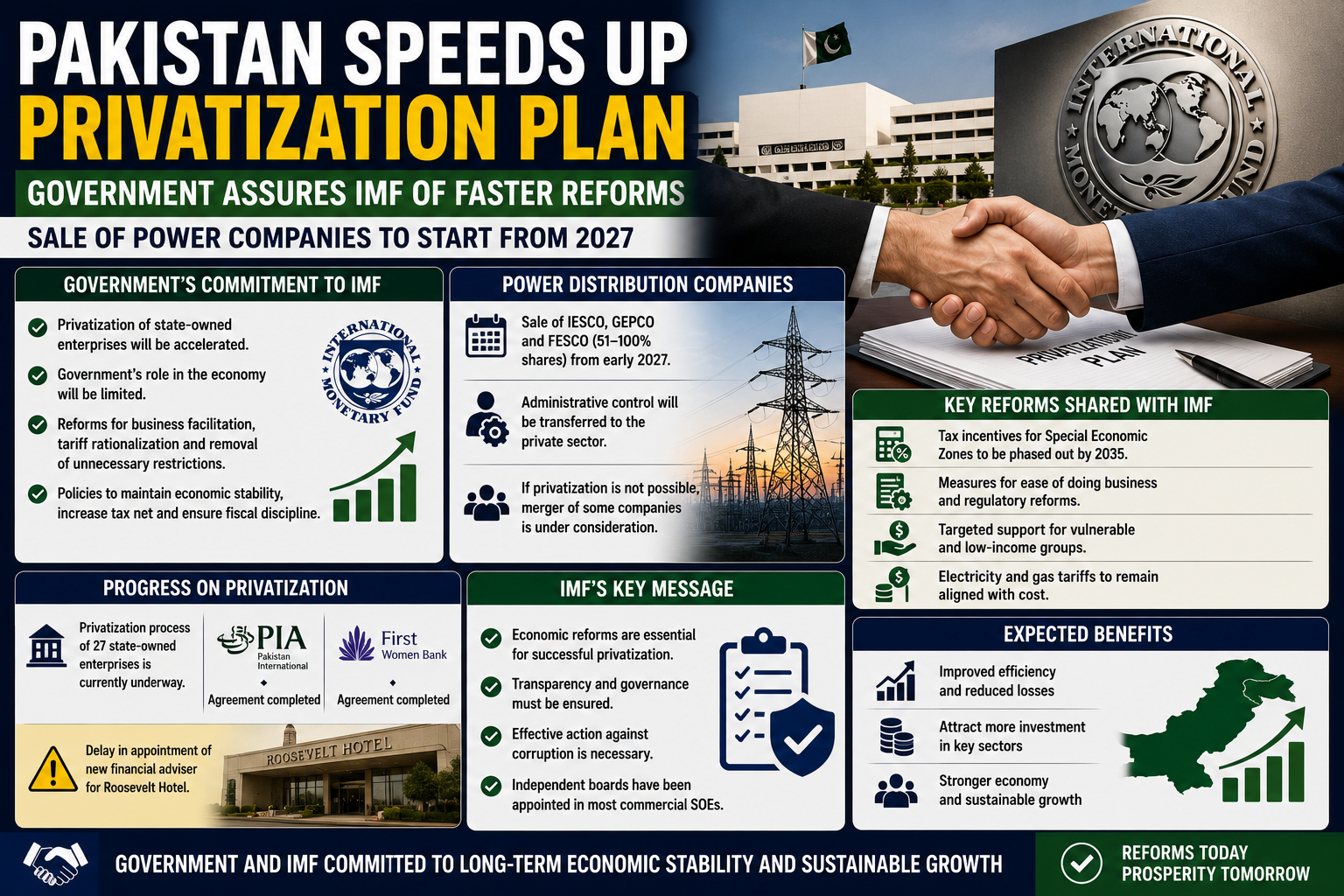
Pakistan privatization plan has moved forward after the federal government reportedly assured the International Monetary Fund (IMF) that the privatization process for state-owned enterprises would be accelerated in coming years. Officials also shared plans related to electricity distribution companies, tax reforms, and reducing the government’s role in commercial sectors as part of broader economic restructuring efforts.
According to reports, the government informed the IMF that the sale of major power distribution companies could begin from 2027 while additional economic reforms are also under consideration.
🏛️ Government Promises Faster Privatization Process
Officials reportedly assured the IMF that Pakistan would speed up privatization efforts involving multiple state-owned enterprises.
Sources stated that the government shared updated reform plans during discussions with the IMF mission, focusing on reducing the state’s role in commercial and industrial sectors.
Economic analysts believe privatization remains a central component of Pakistan’s broader economic reform strategy linked to IMF-supported programs.
⚡ Power Distribution Companies May Be Sold in 2027
According to reports, the government plans to sell between 51 and 100 percent shares of electricity distribution companies including IESCO, GEPCO, and FESCO from early 2027.
Officials stated that administrative control of these companies may also be transferred to the private sector under the proposed restructuring framework.
The government reportedly presented an alternative plan to the IMF in case full privatization of distribution companies faces delays or operational challenges.
🔄 Company Merger Option Also Under Review
Sources stated that if privatization efforts for power distribution companies do not progress successfully, the government may consider merging some companies.
Officials believe restructuring and consolidation could improve operational efficiency and reduce financial losses within the energy sector.
Analysts say Pakistan’s power sector reforms remain highly important for reducing circular debt and improving long-term financial sustainability.
📊 Progress Report Shared on 27 State-Owned Enterprises
The government reportedly informed the IMF that privatization work involving 27 state-owned enterprises is currently underway.
According to reports, privatization agreements related to Pakistan International Airlines and First Women Bank have already been completed.
Reports also mentioned delays regarding the appointment of a new financial adviser for the Roosevelt Hotel project.
💼 Tax Incentives and Economic Reforms Discussed
Officials reportedly shared plans to phase out tax incentives for Special Economic Zones by 2035.
The government also assured the IMF that steps would continue to simplify business regulations, implement tariff reforms, and remove unnecessary restrictions affecting investment and trade activity.
Economic experts believe such reforms are intended to improve Pakistan’s business environment and encourage private sector growth.
📉 IMF Emphasizes Transparency and Governance
According to reports, the IMF stressed the importance of transparency, governance reforms, and anti-corruption measures for successful privatization.
Officials also reiterated commitments to expanding the tax net, maintaining fiscal discipline, and keeping electricity and gas tariffs aligned with actual costs.
Analysts believe continued cooperation with the IMF will remain important for Pakistan’s financial stability and international investor confidence.
🤝 Government Promises Protection for Vulnerable Groups
The government reportedly assured the IMF that targeted support programs would continue for lower-income and vulnerable populations.
Officials stated that economic reforms would be accompanied by financial assistance measures aimed at reducing pressure on weaker segments of society.
The government also informed the IMF that independent boards have already been appointed in most commercial state-owned enterprises as part of governance reforms.
📈 Economic Reform Agenda Continues
Pakistan’s broader reform agenda continues focusing on privatization, fiscal stability, energy sector restructuring, and improving the investment climate.
Experts believe the success of these reforms will play a major role in shaping Pakistan’s future economic performance and long-term financial sustainability.
International financial institutions continue closely monitoring the implementation of reforms linked to IMF-supported economic programs.