
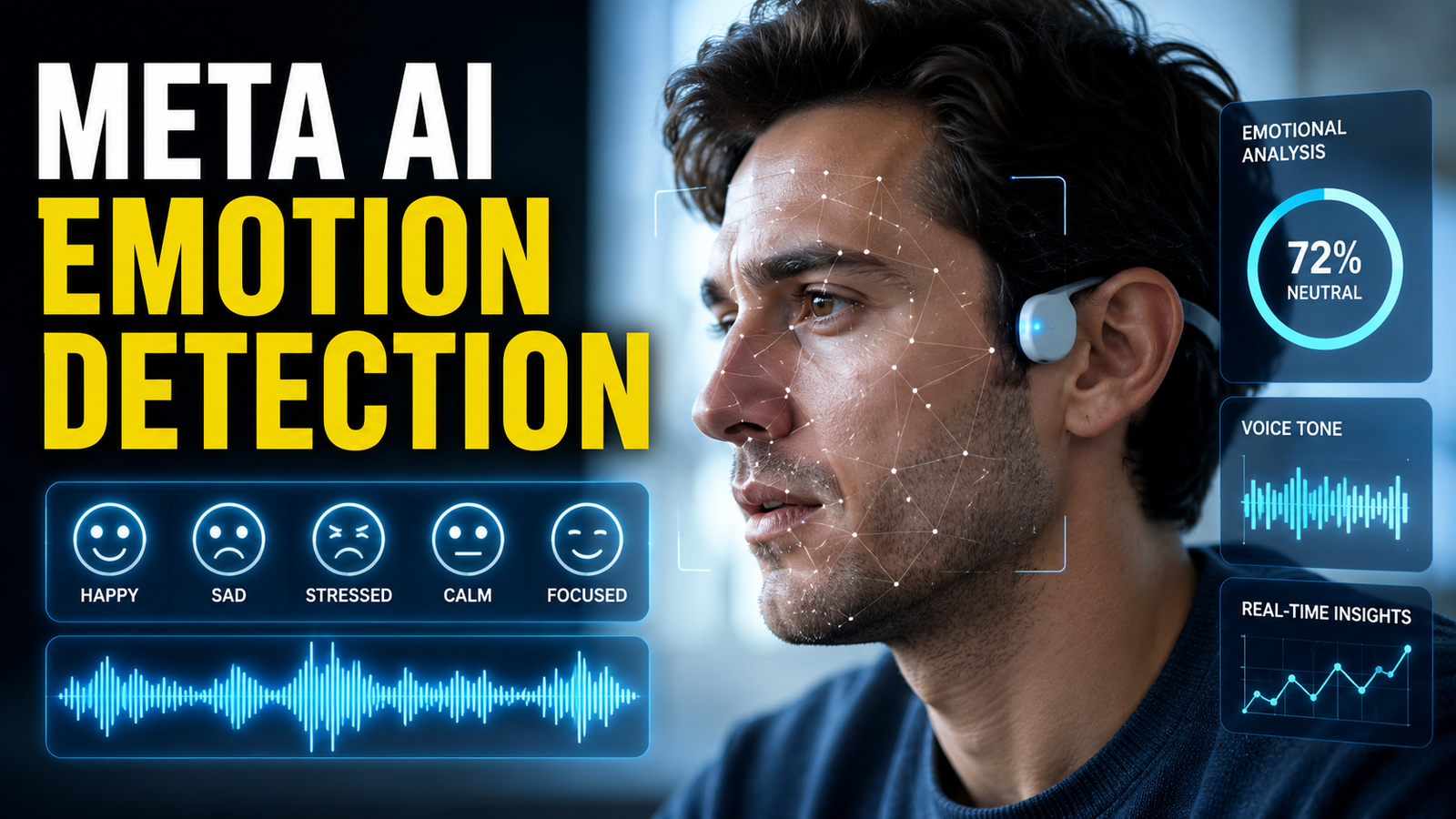
Meta AI Device could soon become capable of analyzing a user’s emotional state through speech patterns, laughter, sighs, and other verbal and non-verbal cues, according to a newly published patent application. The filing outlines an artificial intelligence-powered system designed to interpret emotional signals using machine learning while considering user interactions and contextual information.
The patent application, published on July 2 by the United States Patent and Trademark Office (USPTO), describes technology that may enable future AI devices to assess emotions in real time. While the filing provides insight into Meta’s research, it does not confirm that such a product will be commercially released.
🤖 AI Device Designed to Analyze Human Emotions
According to the published patent, the proposed AI-powered device is intended to monitor various forms of human communication, including spoken language, laughter, sighs, tone of voice, pauses, facial expressions, and other behavioral signals. By combining these indicators with contextual information, the system could estimate a user’s emotional condition at a given moment.
The patent explains that the device may also consider location-based information and environmental context to improve the accuracy of its emotional assessments. This broader analysis is designed to help the AI better understand how different situations may influence a person’s emotional responses.
The technology would rely on machine learning algorithms trained to recognize patterns associated with different emotional states. These models could continuously improve over time as they process additional data and interactions.
😊 Personal Emotional Insights for Users
According to the patent documents, users may be provided with personalized emotional measurements generated by the AI system. These insights are intended to help individuals better understand their emotional and mental well-being by presenting a summary of detected emotional patterns.
The filing suggests that such feedback could support greater self-awareness by allowing users to review changes in their emotional responses over time. However, the document does not specify how these emotional summaries would be displayed or whether they would be integrated into existing Meta products.
As with many patent filings, the document outlines possible applications of the technology rather than confirmed product features.
🧠 Machine Learning Interprets Verbal and Non-Verbal Signals
The patent states that the AI system would use machine learning models to interpret both verbal and non-verbal communication. Verbal indicators may include speech content, voice pitch, speaking speed, pauses, and vocal intensity.
Non-verbal indicators could involve laughter, sighing, facial movements, gestures, or other behavioral cues that may reflect a person’s emotional condition.
By combining these different sources of information, the AI would attempt to identify emotional indicators rather than relying on a single signal. According to the patent, this multi-layered approach could improve the reliability of emotion recognition compared with analyzing speech alone.
📹 Video Call Example Explained in the Patent
The patent includes an example scenario to demonstrate how the technology might function in everyday situations.
According to the document, if a user participates in a video call from home and speaks with signs of frustration or reduced enthusiasm, the AI system could detect changes in vocal delivery and communication patterns. Based on those observations, the device may estimate that the user is experiencing a particular emotional state.
The example illustrates the intended operation of the technology but should not be interpreted as confirmation of future commercial features.
🔒 Privacy Questions May Accompany Emotion Recognition Technology
Although the published patent primarily focuses on the technical aspects of emotion detection, technologies that analyze personal behavior often raise questions regarding privacy and data handling.
The patent itself does not provide detailed information about future privacy safeguards, data storage methods, or user consent mechanisms. Any commercial implementation would likely need to comply with applicable privacy regulations and platform policies in the regions where such technology may eventually be introduced.
Technology companies frequently submit patent applications exploring future innovations, many of which never become consumer products.
🌍 Patent Reflects Ongoing AI Research
Meta continues to invest in artificial intelligence research across multiple areas, including machine learning, computer vision, wearable technology, and human-computer interaction.
The newly published patent highlights one possible direction for future AI development by exploring systems capable of interpreting emotional signals from everyday interactions. However, the existence of a patent application does not guarantee that the technology will reach the market.
Industry observers often view patent filings as indicators of research priorities rather than confirmed product announcements. Whether this emotion-recognition technology becomes part of future consumer devices remains uncertain.