
Humanoid Robots: First MMA Fight Held in China
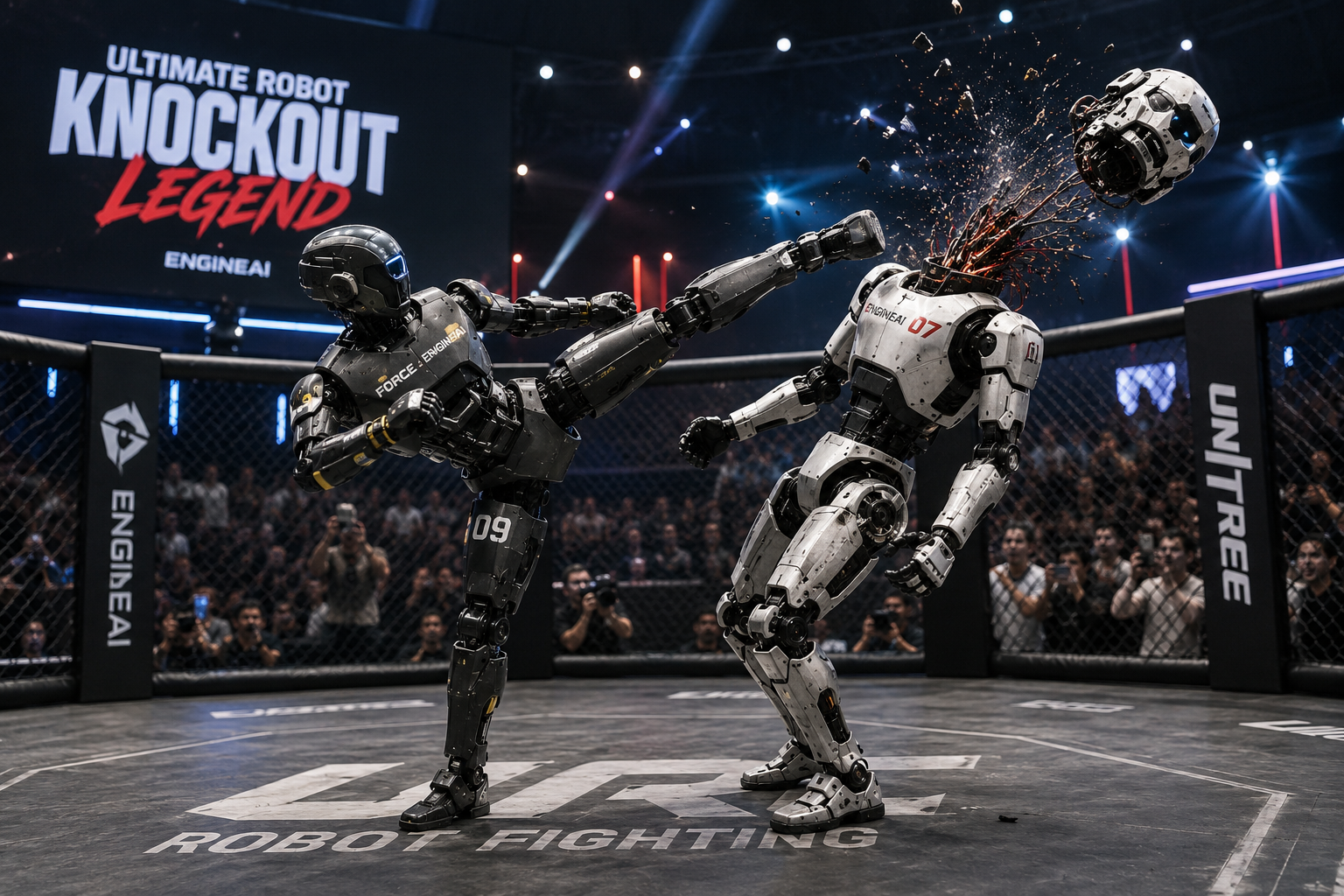
Humanoid Robots took center stage in China as the country hosted its first-ever mixed martial arts (MMA) competition featuring human-like robots. The event showcased advanced robotics technology, engineering innovation, and artificial intelligence in a competitive sports setting. During one of the most talked-about moments of the tournament, a robot landed a powerful head kick that caused its opponent’s head to detach from its body, drawing strong reactions from spectators.
The event highlighted the growing role of robotics in entertainment and technology while bringing together teams from leading universities and engineering organizations around the world.
🤖 China’s First Humanoid Robot MMA Tournament
China organized the unique event under the Ultimate Robot Knockout Legend competition, hosted by Chinese robotics company Engine AI.
The tournament took place at the Shenzhen Nanshan Cultural and Sports Center, where specially designed humanoid robots competed in one-on-one MMA-style matches. The event combined robotics, engineering, and artificial intelligence with competitive sports, offering a new demonstration of technological capabilities.
The competition attracted widespread attention from robotics enthusiasts, researchers, and technology experts interested in the future of intelligent machines.
🏆 Teams From Around the World Competed
More than 200 teams representing 10 countries participated in the competition.
Following an online qualification stage, 32 teams advanced to the final rounds. Every participating team received Engine AI’s T800 humanoid robot, which they customized by modifying its armor, engineering systems, and technical components within the competition rules.
The tournament focused not only on winning matches but also on demonstrating each team’s engineering expertise and ability to improve robotic performance.
🎓 Leading Universities Joined the Event
Several internationally recognized universities participated in the competition through their engineering and robotics teams.
The participating institutions included the University of California, Berkeley, Stanford University, Tsinghua University, Zhejiang University, and the University of Hong Kong, among others.
According to the organizers, the total prize pool for the event was 10 million yuan, making it one of the largest competitions of its kind in the robotics field.
The participation of leading academic institutions highlighted the increasing collaboration between universities and the robotics industry.
⚙️ Robots Evaluated on Technical Performance
The humanoid robots were assessed using multiple technical criteria throughout the tournament.
Judges evaluated each robot based on factors including:
- Motion control
- Balance and stability
- Decision-making capability
- Power system performance
- Structural durability
These technical standards were designed to measure both engineering quality and operational performance during competitive matches.
The evaluation process reflected the broader research goals of improving robotic movement, responsiveness, and reliability.
🥋 Powerful Kick Became the Highlight
One of the competition’s most memorable moments occurred when a robot executed a powerful tornado-style head kick during a match.
The impact caused its opponent’s head to separate from the body, surprising spectators attending the event. Although the incident became the highlight of the tournament, it reflected the physical nature of the robot combat competition rather than any malfunction.
The dramatic moment quickly attracted attention because it demonstrated both the force generated by the robots and the durability challenges engineers continue to address in humanoid robotics.
🚀 Robotics Technology Continues to Advance
The tournament demonstrated how robotics technology continues to evolve beyond industrial and research applications.
Events like this provide engineers with opportunities to test balance, mobility, artificial intelligence, and structural design under real competitive conditions.
As robotics development continues worldwide, competitions involving humanoid robots are becoming valuable platforms for testing new technologies while encouraging innovation among universities, research institutions, and technology companies.
The successful organization of China’s first humanoid robot MMA tournament marks another step in the growing development of intelligent robotic systems capable of performing increasingly complex physical tasks.