
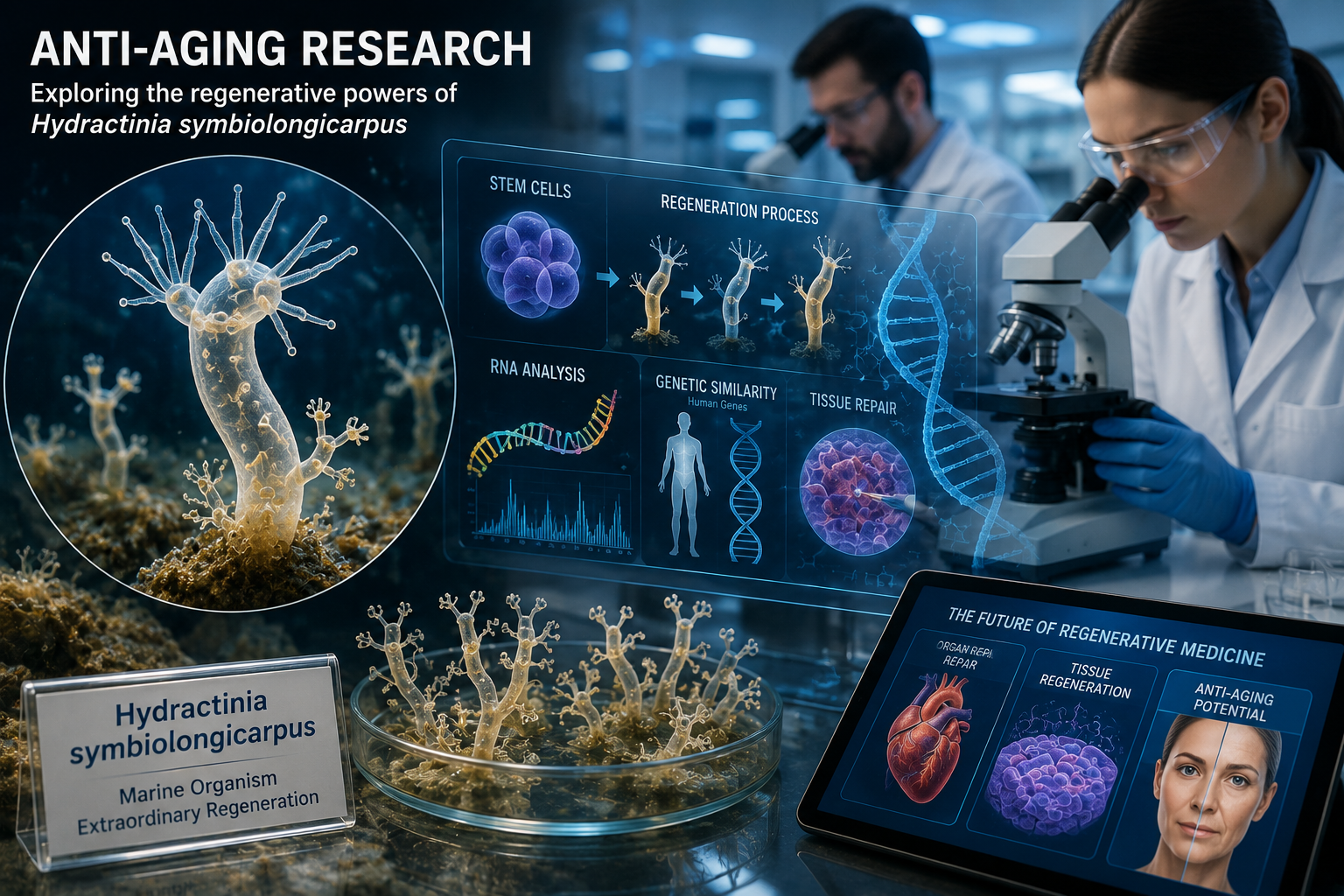
Anti-Aging Research has taken a promising step forward after scientists discovered that a tiny marine organism with extraordinary regenerative abilities could help unlock new insights into aging and tissue repair. Researchers believe studying this sea creature may contribute to future treatments for age-related diseases, damaged organs, and the biological processes linked to growing older.
The findings are based on new scientific research examining a species known as Hydractinia symbiolongicarpus, a small marine organism with an exceptional ability to regenerate different parts of its body. While the research does not suggest that humans can stop aging, scientists say the organism provides valuable clues that could improve the understanding of regeneration and healthy aging.
🧬 Tiny Marine Organism Draws Scientific Attention
The focus of the research is Hydractinia symbiolongicarpus, a tube-shaped marine organism closely related to jellyfish. It typically lives on the shells of certain marine crustaceans and has attracted scientific interest because of its remarkable ability to rebuild damaged body parts.
Researchers say the organism can regenerate tissues using specialized cells located around its mouth. This unique biological feature allows it to repair and replace parts of its body more effectively than many other animals.
Scientists believe these regenerative abilities could help explain biological mechanisms that may eventually improve treatments for human diseases and tissue damage.
🔬 Researchers Study the Genetics of Aging
The research team analyzed the organism’s genetic material and identified sections of RNA associated with biological aging and regeneration.
According to the study published in the journal Cell Reports, many biological systems responsible for regeneration are closely interconnected. Understanding how these systems work together could help scientists develop better approaches for treating age-related disorders and protecting overall health.
The researchers emphasized that the findings improve scientific understanding of regeneration rather than providing an immediate treatment for aging.
🩺 Humans Already Possess Limited Regenerative Ability
Scientists noted that humans naturally possess some regenerative capacity.
For example, broken bones can heal over time, and the liver is capable of regenerating part of its tissue after injury or surgery. However, these abilities remain limited compared to several other species found in nature.
The study explains that while human tissue repair is relatively modest, some animals have evolved much more advanced regenerative systems.
🌊 Other Species Also Display Remarkable Regeneration
The research highlights several organisms known for their exceptional regenerative abilities.
Salamanders can regrow entire limbs, while zebrafish can regenerate damaged fins and certain internal tissues. Hydractinia demonstrates a similarly impressive capacity by rebuilding multiple body structures through specialized stem cells.
Comparing these organisms may help researchers understand why regeneration differs so significantly across species.
Scientists hope such comparisons could eventually reveal biological pathways that might support future regenerative medicine.
🧪 Stem Cells Play a Key Role
Researchers discovered that Hydractinia relies on powerful stem cells—often referred to as “master cells”—to regenerate its body.
These stem cells have the ability to develop into different tissue types, allowing the organism to repair damaged structures efficiently.
The study also identified genetic similarities between some Hydractinia genes and genes found in humans. Researchers believe these similarities could provide important clues for future medical studies focusing on tissue repair and healthy aging.
👨🔬 Experts See Long-Term Medical Potential
Dr. Andy Baxevanis of the US National Human Genome Research Institute (NHGRI) said studying organisms with extraordinary regenerative abilities may reveal important biological mechanisms involved in regeneration and aging.
According to the researchers, these discoveries could eventually contribute to medical advances aimed at repairing damaged organs, improving tissue regeneration, and treating diseases associated with aging.
However, scientists caution that the research remains at an early stage and should not be interpreted as evidence that a cure for aging has been found.
🌍 Future Research May Improve Human Health
Researchers believe continued investigation into regenerative organisms could expand scientific knowledge of aging, stem cells, and tissue development.
While much more research is required before practical medical applications become available, the findings offer a better understanding of how nature repairs damaged tissues and maintains biological function.
Scientists say future studies may eventually support new therapies for age-related conditions, organ repair, and regenerative medicine, but additional research and clinical testing will be necessary before such treatments become available.