
Trump Iran Threat: Military Action or Deal
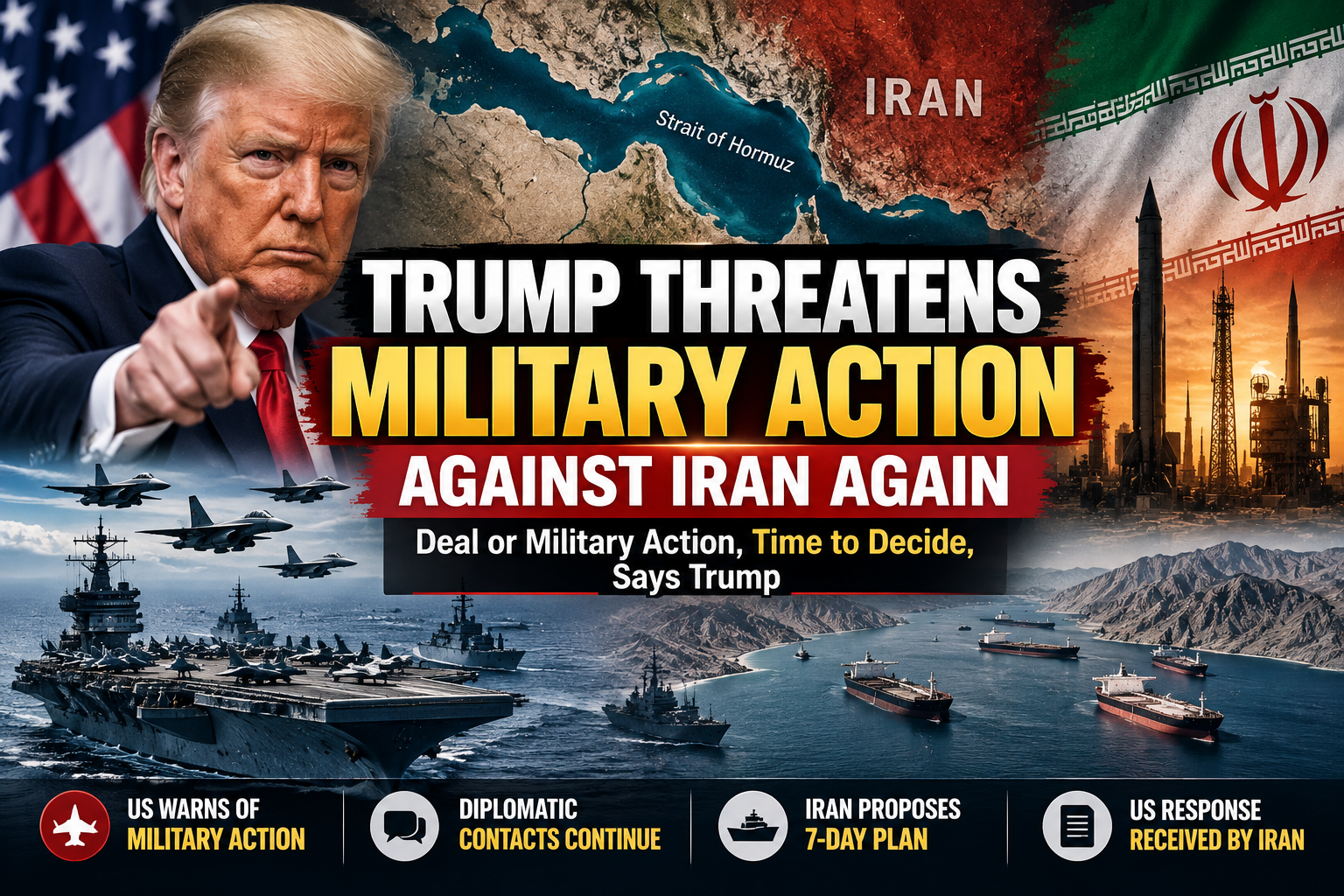
The Trump Iran Threat has renewed attention on the continuing confrontation between Washington and Tehran, as US President Donald Trump has indicated that his administration faces a choice between reaching an agreement with Iran and pursuing military action, according to the supplied report.
Trump made the remarks while speaking to reporters amid ongoing tensions and diplomatic contacts between the two countries. His comments come as Iran seeks an agreement involving a ceasefire, the reopening of the Strait of Hormuz and changes to US restrictions affecting Iranian trade and assets.
Diplomatic efforts have continued through intermediaries, although major disagreements remain. On September 26, Trump publicly rejected Iran’s latest seven-day proposal to reopen the strategic waterway and resume negotiations. <Cite refs={[“turn918239search3″,”turn918239search5”]} />
⚠️ Trump Raises the Possibility of Military Action
Trump was asked how the United States could reach an agreement with Iranian leaders whom he had described as unreasonable. In response, he indicated that Washington would have to choose between a deal and military action, according to the supplied report.
His remarks underline the uncertainty surrounding the next phase of US policy towards Iran. Although the president has left the possibility of negotiations open, his comments also signal that military action remains among the options being discussed.
The statement does not, by itself, establish that a new attack has been ordered or that a specific timetable for military action has been announced.
The diplomatic situation remains complicated by disagreements over Iran’s nuclear programme, sanctions, maritime security and the conditions required to end hostilities. Both countries have communicated through intermediaries, but no final settlement has been confirmed in the information available.
🛡️ US Defense Chief Makes Military Claims
US Defense Secretary Pete Hegseth, speaking to military leaders at Marine Corps Base Quantico in Virginia, claimed that American forces had severely damaged Iran’s military capabilities.
According to the supplied report, Hegseth said US operations had damaged Iran’s navy, air force, air defence systems, leadership and military-industrial capabilities. He also claimed that Iran’s nuclear capabilities had suffered substantial damage.
These are statements attributed to the US defense chief. The full extent of the reported damage has not been independently established by the information provided here.
Military assessments from parties involved in a conflict require careful attribution, particularly when independent verification is limited. The claims should therefore not be treated as independently confirmed measurements of Iran’s remaining military capabilities.
The statements nevertheless form part of the wider context in which Washington is considering its next steps and Tehran is pursuing diplomatic engagement.
🕊️ Iran’s Seven-Day Proposal
Iran has proposed a seven-day plan intended to reopen the Strait of Hormuz and restart negotiations. Iranian Foreign Minister Abbas Araghchi presented the proposal through diplomatic intermediaries, including Qatar, according to reporting by Reuters and the Associated Press. <Cite refs={[“turn918239news18″,”turn918239news19”]} />
Under the proposal, the reopening of the strait would follow certain steps by the United States. These include measures concerning the US naval blockade, oil sanctions and frozen Iranian assets. The plan also links de-escalation to a ceasefire and the resumption of broader negotiations.
Iran has said that, if the necessary conditions are met, normal maritime passage could resume within seven days. The proposal is intended to establish a sequence for reducing hostilities and returning to negotiations.
The Strait of Hormuz is a strategically important shipping route for international energy supplies. Any prolonged disruption can affect maritime traffic, oil shipments and market expectations, making the future of the waterway an international concern.
🇺🇸 Washington Rejects Tehran’s Initial Terms
Trump rejected Iran’s seven-day proposal on September 26, saying it was unacceptable. The proposal had sought to link the reopening of the Strait of Hormuz to US concessions and a renewed diplomatic process. <Cite refs={[“turn918239search3″,”turn918239search5”]} />
The rejection highlights the gap between the two sides’ stated positions. Tehran has tied progress to changes in sanctions and the naval blockade, while Washington has expressed reservations about Iran’s terms and has continued to press for an agreement addressing wider issues.
According to the supplied report, Iran subsequently received a US response, and Iranian Foreign Minister Abbas Araghchi briefed President Masoud Pezeshkian and the cabinet. The complete details of that response were not included in the supplied information.
The reported communication indicates that diplomatic channels remain relevant, but it does not establish that the two governments have reached an agreement or accepted each other’s conditions.
🌍 Qatar and Other Mediators Keep Contacts Open
Diplomatic intermediaries have continued efforts to reduce tensions between Washington and Tehran. Qatar has played a role in passing messages between the two sides, while other regional contacts have also been reported.
Recent reporting describes continuing efforts to bridge differences over maritime access, sanctions and the terms of a possible interim agreement. However, the sequencing of proposed measures and the conditions attached to them remain points of disagreement. <Cite refs={[“turn918239news12″,”turn918239news23”]} />
The continuation of diplomatic contacts does not necessarily mean that a breakthrough is imminent. Negotiations can continue even when public statements from the parties remain sharply opposed.
For now, the key questions concern whether the two sides can agree on the conditions for a ceasefire, whether shipping through the Strait of Hormuz can return to normal and whether broader discussions on Iran’s nuclear programme can resume.
📌 What Happens Next?
The immediate outlook depends on the next steps taken by Washington and Tehran. Trump has publicly rejected Iran’s initial seven-day proposal, while the supplied report says Iranian officials have been informed of a US response.
The possibility of further military action remains part of the public discussion, but the available information does not confirm a new attack order or a definite timetable for one.
The diplomatic track also remains unresolved. Any progress would require the two sides to address their differences over sanctions, maritime restrictions, security arrangements and the scope of future negotiations.
Developments around the Strait of Hormuz will remain important because of the waterway’s role in international shipping and energy markets. Further official statements and independently verified reporting will be needed to establish whether the current standoff moves towards a negotiated arrangement or further escalation.