
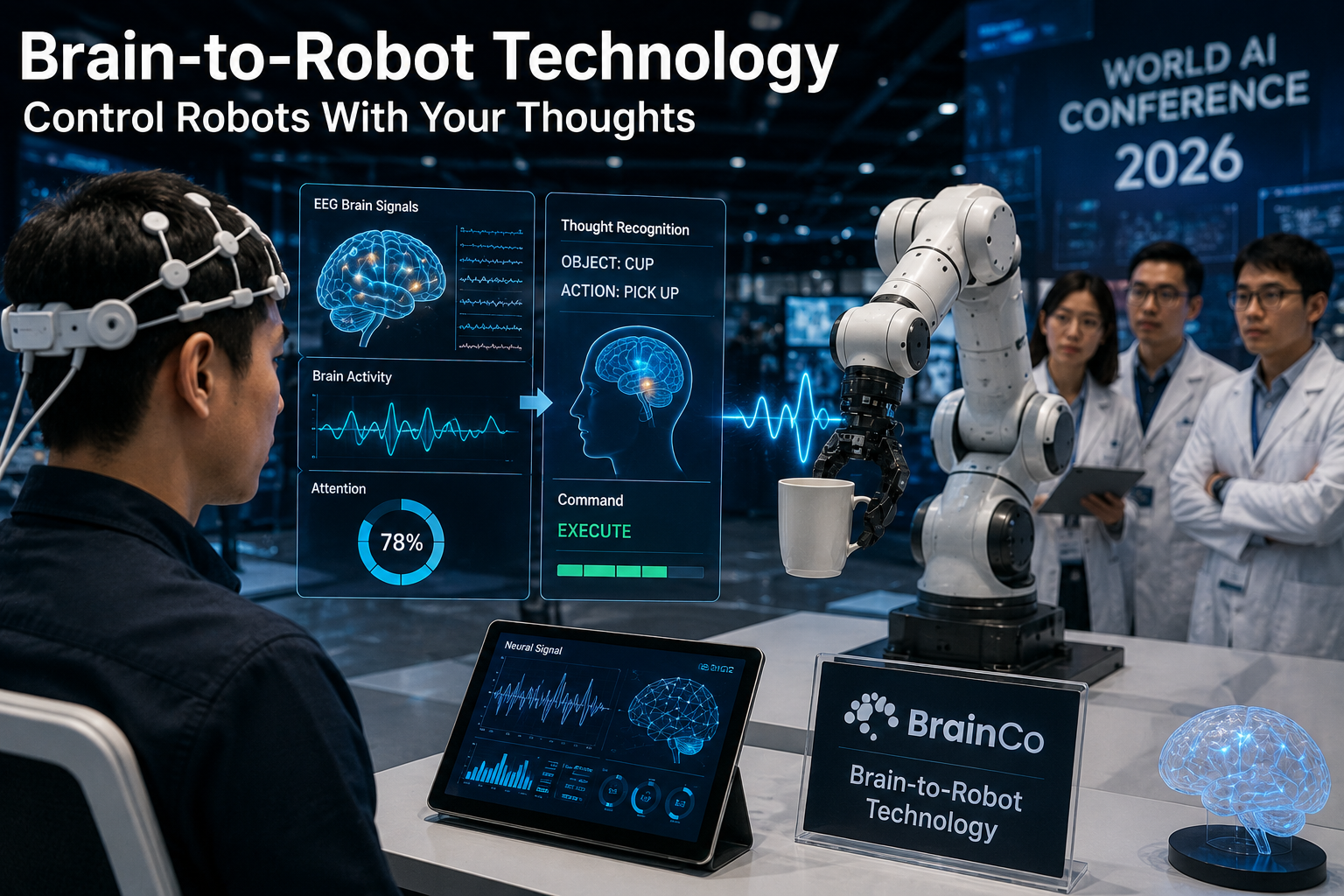
Brain-to-Robot Technology has taken another major step forward after a Chinese technology company demonstrated a system that allows people to control robots using only their thoughts. Unlike implant-based brain-computer interfaces, the new system does not require brain surgery or implanted chips. Instead, it relies on a lightweight headset that reads brain signals and uses artificial intelligence to translate them into robotic movements.
The technology was presented during the World AI Conference 2026 in Shanghai, where Chinese company BrainCo showcased its latest brain-computer interface system. Company representatives said the technology could eventually benefit people with physical disabilities while also improving industrial automation and robotics.
🧠 Brain-to-Robot Technology Uses EEG Signals
According to BrainCo, the new system works by using a wearable headset that records the brain’s electrical activity through electroencephalography (EEG).
The headset captures brain signals without requiring any surgical procedure or implanted device. AI-powered software then analyzes these signals and attempts to identify the user’s intended action before sending commands to a connected robot.
The company says this approach makes brain-controlled robotics more accessible because it eliminates the need for invasive medical procedures.
🤖 Robotic Arm Responds to Human Thoughts
During a live demonstration at the conference, a robotic arm successfully responded to a user’s brain signals.
BrainCo explained that when a person imagined picking up a cup, the AI system interpreted the intention from EEG signals and instructed the robotic arm to perform the action.
The demonstration highlighted how human intention could potentially be translated into robotic movement without physical gestures or voice commands.
⚙️ Technology Could Control Different Types of Robots
Company officials stated that the system is not limited to robotic arms.
According to BrainCo, the same technology could also be applied to humanoid robots, robotic dogs, and other intelligent machines capable of receiving digital control commands.
Developers believe the platform could support a wider range of robotic applications as the technology continues to improve.
🎓 Short Training Time Claimed
BrainCo said users do not need extensive experience with brain-computer interfaces before using the system.
The company claims that a researcher with no previous experience can learn to control a robot through brain signals after approximately 10 minutes of training.
However, the company did not provide independent scientific data during the demonstration to verify this performance claim.
🔬 Different From Neuralink’s Approach
BrainCo’s system differs significantly from Elon Musk’s Neuralink technology.
Neuralink requires a surgically implanted brain chip to read neural activity, while BrainCo’s solution relies entirely on an external EEG headset.
Because no implant or operation is involved, the company says its technology offers a non-invasive alternative for brain-computer interaction.
♿ Potential Applications for Healthcare and Industry
Researchers believe the technology could eventually help people with physical disabilities operate robotic arms, prosthetic limbs, or wheelchairs using only mental commands.
Beyond healthcare, brain-controlled robotics may also improve manufacturing, scientific research, automation, and human-machine collaboration.
Experts say practical adoption will depend on improving accuracy, reliability, and real-world performance.
🌍 Further Testing Still Needed
BrainCo was founded in 2015 and has become one of China’s emerging companies in artificial intelligence, brain-computer interfaces, and robotics.
While the company described its platform as the world’s first integrated Brain-to-Robot system, this claim has not yet been independently verified.
Researchers emphasize that additional scientific studies and independent testing will be necessary before the technology’s long-term capabilities and large-scale commercial potential can be fully evaluated.