
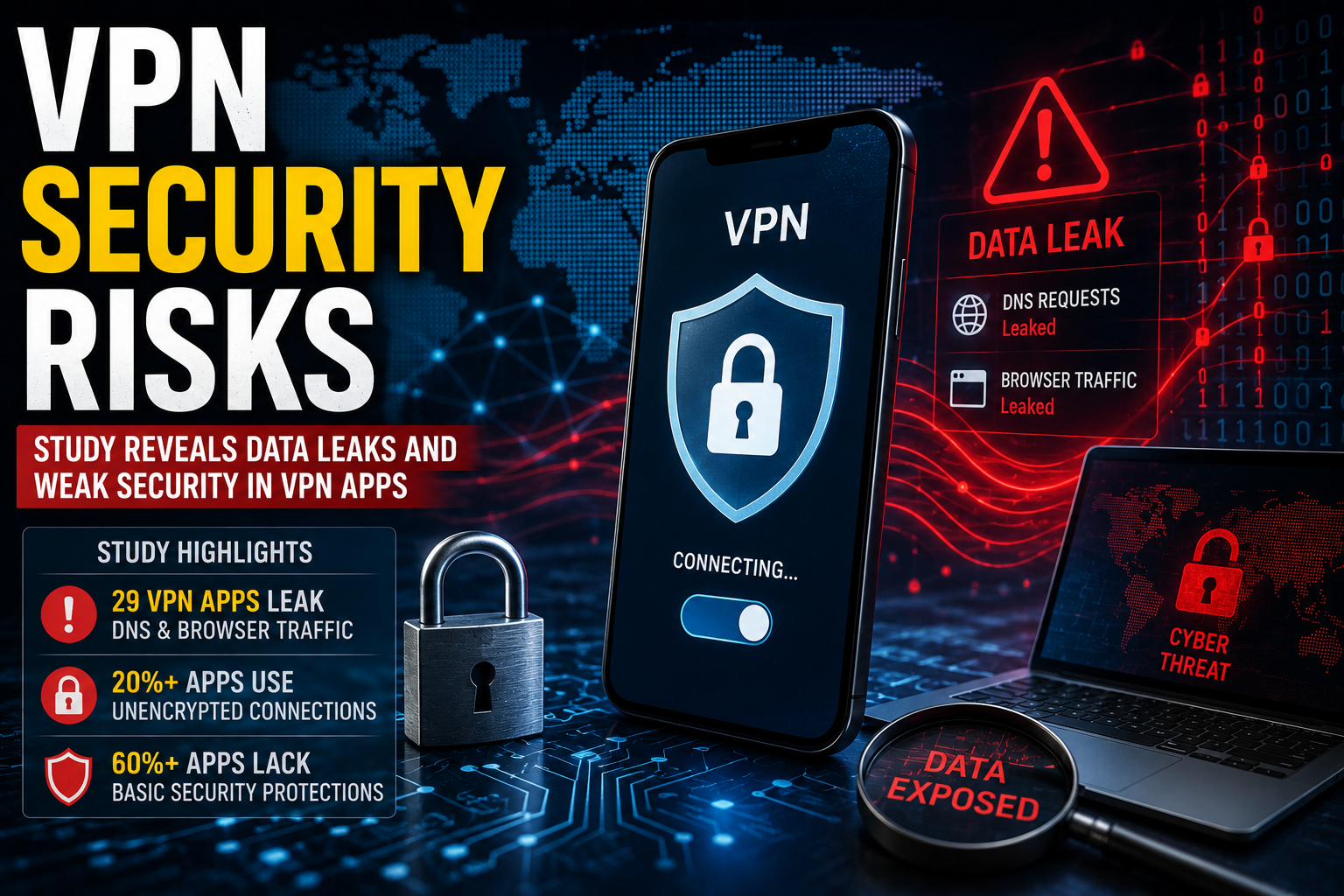
VPN Apps Security Risks have been highlighted in a new cybersecurity study, which claims that several popular virtual private network (VPN) applications are failing to protect users’ online privacy and security as expected.
According to research conducted by the University of Michigan Engineering, many widely used VPN apps either leak sensitive internet traffic or fail to meet basic cybersecurity standards. The findings raise fresh concerns for millions of users who rely on VPN services to protect their personal information while browsing the internet.
Researchers say the study aims to improve transparency within the VPN industry and help users make more informed decisions when selecting privacy tools.
🔒 Study Examines Popular VPN Applications
The research analyzed 281 popular Android VPN applications to evaluate their security performance.
To conduct the assessment, researchers developed MVPNalyzer, described as the world’s first automated framework capable of testing large numbers of mobile VPN applications for security weaknesses.
The framework was presented at the Network and Distributed System Security (NDSS) Symposium 2026, where researchers outlined several vulnerabilities found across multiple VPN services.
The study highlights the growing need for stronger security standards in consumer privacy applications.
🌐 Data Leaks Found in Multiple VPN Apps
According to the research, 29 VPN applications were found leaking users’ DNS requests and browser traffic.
Such leaks can expose browsing activity even when a VPN connection is active, reducing the effectiveness of privacy protection.
Researchers noted that preventing DNS and traffic leaks is one of the primary purposes of VPN technology.
The findings suggest that some applications may not provide the level of privacy users expect.
⚠️ Weak Encryption Raises Security Concerns
The report also found that more than 20% of the analyzed VPN applications transmitted internet traffic without proper encryption.
In addition, over 60% of the apps lacked important security protections that help defend users against cyberattacks.
Cybersecurity experts warn that weak encryption or missing security safeguards can increase the risk of data interception and unauthorized access.
The report recommends stronger implementation of industry security practices.
👩💻 Researchers Call for Greater Transparency
Senior study author Roya Ensafi, Associate Professor of Computer Science and Engineering at the University of Michigan, said millions of people depend on VPN services to protect their online privacy.
She noted that many applications fail to satisfy even basic security requirements despite marketing themselves as privacy tools.
According to the research team, the goal is to provide consumers, researchers, and regulators with better insight into how VPN applications actually operate.
Greater transparency may encourage higher security standards across the industry.
📱 Choosing a Reliable VPN Matters
Security experts advise users to carefully evaluate VPN providers before installing their applications.
Factors such as independent security audits, clear privacy policies, strong encryption standards, regular software updates, and a transparent ownership structure can help users identify trustworthy services.
Experts also recommend downloading VPN applications only from official app stores and reputable developers.
Regular updates remain important for maintaining security against evolving cyber threats.
📈 Privacy Protection Remains a Growing Challenge
As internet users become increasingly concerned about digital privacy, demand for VPN services continues to grow worldwide.
However, the latest research suggests that not all VPN applications deliver the level of protection they advertise.
Researchers hope their findings will encourage software developers to improve security practices while helping users make better-informed decisions regarding online privacy tools.
The study also highlights the importance of ongoing cybersecurity research as digital threats continue evolving.