
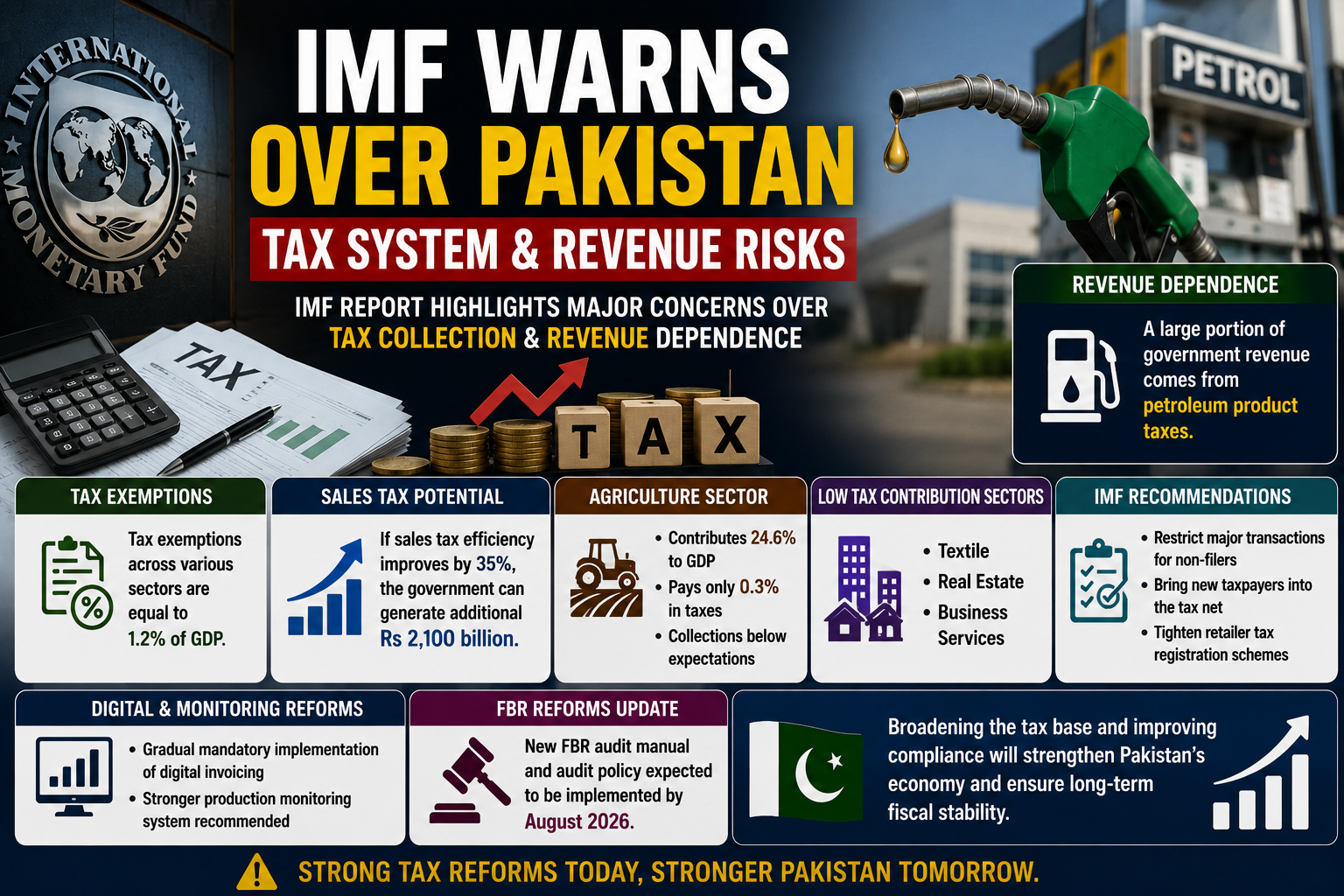
IMF tax warning has raised concerns about Pakistan’s revenue structure after the International Monetary Fund reportedly highlighted the government’s heavy dependence on petroleum-related taxes and weaknesses in the country’s tax collection system. The report also pointed to limited tax coverage, sector-specific exemptions, and inefficiencies in the sales tax structure as major economic risks.
According to the report, reforms aimed at expanding the tax base and improving tax enforcement are urgently needed to strengthen Pakistan’s long-term fiscal stability.
💰 IMF Raises Concerns Over Tax Revenue Structure
The International Monetary Fund reportedly expressed concern regarding declining tax collection performance by the Federal Board of Revenue (FBR).
According to the report, Pakistan’s narrow tax base and continued revenue shortfalls remain major economic challenges affecting fiscal sustainability.
The IMF reportedly emphasized the need for faster reforms to improve revenue generation and expand the number of active taxpayers.
⛽ Government Revenue Heavily Linked to Petroleum Taxes
The report revealed that a large portion of government revenue currently depends on taxes imposed on petroleum products.
Economic analysts believe excessive dependence on fuel-related taxation can increase inflationary pressure and raise transportation and production costs across the economy.
The IMF also noted that various sectors continue receiving tax exemptions equal to approximately 1.2 percent of the country’s GDP.
📊 Sales Tax Reforms Could Increase Revenue
According to the report, multiple provincial GST systems have created complications within Pakistan’s taxation framework.
The IMF estimated that if sales tax efficiency improves by 35 percent, the government could potentially generate an additional Rs2,100 billion in revenue.
Experts say simplifying the sales tax structure and improving compliance mechanisms may help increase revenue collection significantly.
🌾 Agricultural Sector Paying Very Low Taxes
The IMF highlighted the agricultural sector as an example of weak tax contribution despite its major role in the economy.
According to the report, agriculture contributes around 24.6 percent to Pakistan’s GDP but pays only 0.3 percent in taxes.
Although agricultural income tax rates were increased in 2025, the report stated that actual collections remained far below expectations.
🏢 Textile, Real Estate and Services Also Under Review
The IMF reportedly identified sectors including textiles, real estate, and business services among industries contributing relatively low tax revenues.
Officials were advised to introduce stronger enforcement measures and improve compliance monitoring across these sectors.
Analysts believe broader tax participation remains essential for reducing dependence on indirect taxation.
🧾 IMF Pushes for Stronger Tax Enforcement
The report recommended stricter restrictions on major financial transactions involving non-filers in the upcoming federal budget.
The IMF also urged authorities to expand the tax net by bringing new taxpayers into the system and tightening retailer registration schemes.
Experts say enforcement-focused reforms may improve transparency and increase tax documentation across the economy.
💻 Digital Invoicing and Monitoring System Planned
According to the report, the IMF instructed Pakistan to gradually make digital invoicing mandatory nationwide.
The report also called for stronger production monitoring systems to improve tax tracking and reduce leakages.
Officials stated that a new FBR audit manual and updated audit policy are expected to be implemented by August 2026.
📈 Economic Reforms Remain Central Focus
Economic experts believe tax reforms will remain one of the most important areas in Pakistan’s ongoing discussions with the IMF.
Analysts say improving tax collection efficiency, reducing exemptions, and broadening the tax base could strengthen fiscal stability and reduce reliance on indirect taxes in the long term.
The government is expected to continue consultations regarding taxation reforms ahead of the upcoming federal budget.