
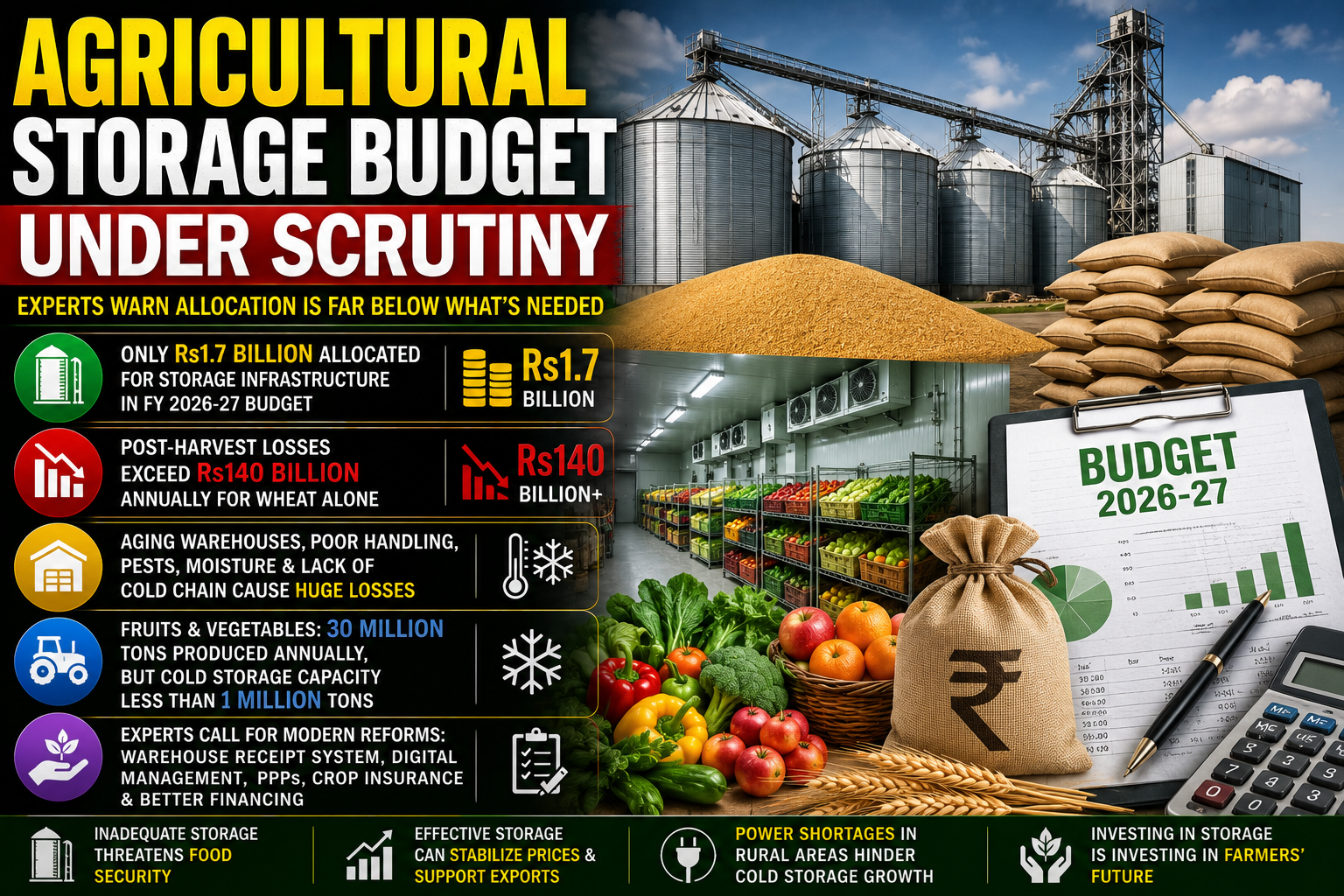
Agricultural Storage Budget allocations for the upcoming fiscal year have drawn concern from agriculture experts and industry stakeholders, who argue that the amount set aside for storage infrastructure remains far below what is needed to address Pakistan’s growing post-harvest losses.
The federal budget for 2026-27 has allocated Rs1.7 billion for agricultural storage facilities and related infrastructure. However, experts say the funding is insufficient given the scale of losses faced by farmers due to inadequate storage systems, outdated warehouses, and limited cold-chain capacity.
Industry representatives warn that unless significant improvements are made in storage and supply chain infrastructure, Pakistan will continue losing a substantial portion of its agricultural output every year.
🌾 Experts Raise Concerns Over Budget Allocation
Agricultural experts have questioned whether the latest budget allocation can effectively address long-standing storage challenges facing the country’s farming sector.
According to industry estimates, Pakistan loses more than Rs140 billion worth of wheat annually because of storage-related inefficiencies and post-harvest losses. Experts argue that the newly allocated funds are unlikely to solve structural problems that have persisted for decades.
Agriculture stakeholders believe that investment in modern storage systems should be considered a national priority, particularly as food security concerns continue to grow.
They emphasize that reducing post-harvest losses can significantly increase the availability of food without requiring additional cultivated land.
🏚️ Storage Infrastructure Remains a Weak Link
Agricultural analysts describe storage infrastructure as one of the weakest components of Pakistan’s agricultural value chain.
The sector continues to face challenges including insufficient warehouses, aging storage facilities, inadequate cold-chain systems, poor handling practices, and losses caused by moisture and pests.
While wheat benefits from a relatively organized procurement and storage mechanism, other crops often lack adequate protection after harvest.
Products such as maize, pulses, fruits, and vegetables remain especially vulnerable to spoilage due to the absence of modern storage facilities.
Experts note that improving infrastructure could help farmers preserve quality and reduce losses throughout the supply chain.
🍎 Fruit and Vegetable Sector Faces Bigger Challenges
The situation is particularly serious in the horticulture sector.
Pakistan produces approximately 30 million tons of fruits and vegetables each year, yet available cold storage capacity remains below one million tons.
The gap between production and storage capacity results in significant losses, especially during peak harvesting seasons when supply exceeds immediate market demand.
Farmers frequently struggle to preserve perishable produce, forcing many to sell quickly at lower prices to avoid spoilage.
Industry observers argue that expanding cold storage networks would help stabilize markets while improving returns for growers.
🌾 Wheat Storage Capacity Falls Short
Wheat remains Pakistan’s most important staple crop, yet experts say modern storage capacity remains inadequate.
Annual wheat production is estimated at nearly 29.6 million tons, while modern storage facilities can accommodate only a small fraction of that volume.
This mismatch leaves large quantities of wheat exposed to quality deterioration and wastage.
Agricultural economists believe investment in modern silos and warehouse systems could significantly reduce losses and strengthen food security.
Improved storage would also allow authorities to manage reserves more efficiently during periods of market volatility.
💰 Farmers Often Forced to Sell Early
Experts argue that storage challenges are closely linked to broader weaknesses in agricultural marketing and financing systems.
Many farmers lack access to affordable financing after harvest and are therefore compelled to sell crops immediately, even when market prices are unfavorable.
Limited participation by banks and financial institutions in post-harvest financing further compounds the problem.
Without access to storage facilities and financial support, growers have little choice but to accept lower prices, reducing profitability and discouraging future investment.
Industry representatives say improved financing mechanisms could help farmers hold inventory until market conditions become more favorable.
🚜 Calls for Modern Reforms and Technology
Agriculture specialists are urging policymakers to adopt broader reforms alongside infrastructure investment.
Recommendations include the introduction of a national warehouse receipt system, digital inventory management platforms, commodity tracking technologies, public-private partnerships, and stronger crop insurance mechanisms.
Experts believe modern technology can improve transparency, reduce inefficiencies, and strengthen the agricultural supply chain.
They also stress that effective storage systems play an important role in price stability, food security, and export competitiveness.
However, challenges such as prolonged power shortages and unreliable electricity supplies in rural areas continue to hinder the development of modern cold-storage facilities.
As Pakistan seeks to modernize its agricultural sector, industry stakeholders argue that long-term investment in storage infrastructure will be essential for reducing waste, increasing farmer incomes, and supporting sustainable economic growth.