
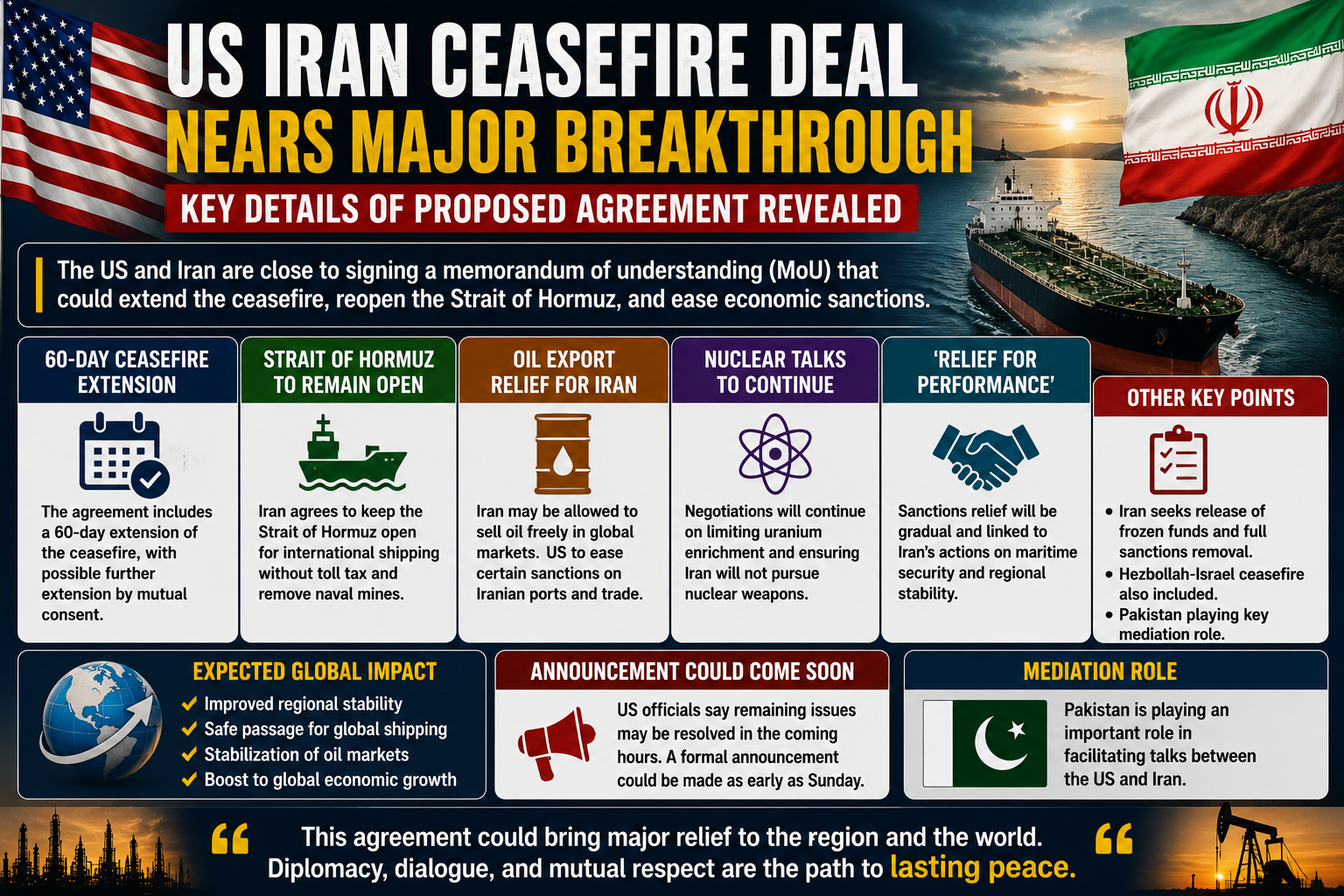
US Iran ceasefire deal discussions have reportedly entered a decisive stage after new details emerged regarding a proposed agreement between Washington and Tehran. According to international media reports, both countries are close to signing a memorandum of understanding (MoU) that could extend the current ceasefire arrangement, reopen maritime trade routes in the Strait of Hormuz, and ease certain economic sanctions imposed on Iran.
The reported agreement is being viewed as one of the most significant diplomatic developments in the Middle East in recent years because of its potential impact on regional security, oil markets, and global trade stability.
🇺🇸🇮🇷 Proposed Agreement Includes 60-Day Ceasefire Extension
According to reports published by Axios, the proposed agreement includes a 60-day extension of the existing ceasefire between the United States and Iran.
Sources stated that the arrangement would initially remain valid for two months, while both sides may later agree to extend it further through mutual understanding.
Diplomatic analysts believe the extension could provide additional time for negotiations regarding broader security and nuclear-related issues affecting the region.
🚢 Strait of Hormuz Trade Route Could Fully Reopen
One of the most important elements of the proposed agreement reportedly involves the reopening of maritime trade routes through the Strait of Hormuz.
According to reports, Iran may agree to keep the strategic waterway open for international commercial shipping without imposing toll taxes or restrictions.
Sources also suggested that Tehran is willing to remove naval mines reportedly placed in the region during earlier tensions in order to restore safe passage for international vessels.
Security experts say reopening unrestricted shipping routes through the Strait of Hormuz would significantly reduce risks for global energy markets and international trade networks.
⛽ Iran Could Receive Oil Export Relief
Reports indicated that the United States may agree to ease certain restrictions targeting Iranian ports and economic activity under the proposed arrangement.
According to sources, Iran may receive permission to sell oil more freely in international markets if the agreement moves forward successfully.
Economic analysts believe such relief measures could provide major support to Iran’s economy while also helping stabilize global oil prices that have experienced volatility during recent regional tensions.
Experts noted that improved Iranian oil exports may increase supply in global markets, potentially easing pressure on energy-importing countries.
☢️ Nuclear Negotiations Expected to Continue
The proposed agreement reportedly also includes continued negotiations regarding Iran’s nuclear program.
According to American officials cited in reports, Iran may provide assurances that it will not pursue nuclear weapons development under the framework of future talks.
Discussions are also expected to focus on limiting uranium enrichment activities and reducing existing stockpiles of highly enriched uranium.
Diplomatic observers believe nuclear negotiations will remain one of the most sensitive and complex parts of any long-term agreement between Tehran and Washington.
📉 “Relief for Performance” Formula Proposed
Reports stated that the proposed agreement follows a “performance for relief” principle.
Under this approach, the United States would gradually ease sanctions in response to verified Iranian actions involving the restoration of maritime security and regional stability.
American officials reportedly emphasized that broader sanctions relief would depend on practical implementation rather than promises alone.
Analysts say this phased model is designed to create confidence between both parties while minimizing the risk of immediate diplomatic collapse.
💰 Iran Seeking Frozen Funds and Sanctions Removal
According to reports, Iran is also pushing for the release of frozen financial assets and broader removal of international sanctions.
However, US officials reportedly maintain that full economic relief would only be considered after concrete actions are implemented under the agreement.
Economic experts believe the issue of frozen Iranian assets may become one of the most important bargaining points during the next phase of negotiations.
🔥 Hezbollah-Israel Conflict Also Included
Sources indicated that discussions regarding the conflict between Hezbollah and Israel have also been incorporated into the broader diplomatic framework.
Analysts believe regional stability efforts may require parallel understandings involving Lebanon, Israel, and armed groups operating across the region.
The inclusion of these issues highlights the broader geopolitical importance of the proposed US-Iran agreement.
🇵🇰 Pakistan Reportedly Playing Mediation Role
Reports further suggested that Pakistan has played an important diplomatic role during the ongoing negotiations.
According to sources, Pakistani representatives and senior officials participated in mediation efforts aimed at helping both sides move closer toward a final understanding.
Diplomatic observers say Pakistan’s involvement reflects Islamabad’s growing efforts to support regional peace initiatives and maintain balanced relations with both Washington and Tehran.
📢 Official Announcement Could Come Soon
According to reports, remaining issues between the two sides may be finalized within hours.
American officials reportedly expressed optimism that a formal announcement regarding the proposed agreement could be made as early as Sunday.
Global markets and international governments continue closely monitoring developments because the agreement could significantly influence oil prices, regional security conditions, and diplomatic relations across the Middle East.
🌍 Global Impact of the Proposed Agreement
Experts believe the proposed agreement could create far-reaching economic and geopolitical consequences beyond the Middle East.
Restoring stability in the Strait of Hormuz may improve confidence in global shipping and energy markets while reducing fears of supply disruptions.
Analysts also believe successful negotiations between the United States and Iran could open the door for broader diplomatic engagement regarding regional conflicts, sanctions, and long-term security arrangements.
Despite optimism surrounding the proposed deal, observers caution that implementation challenges and political disagreements may still emerge during later stages of negotiations.