
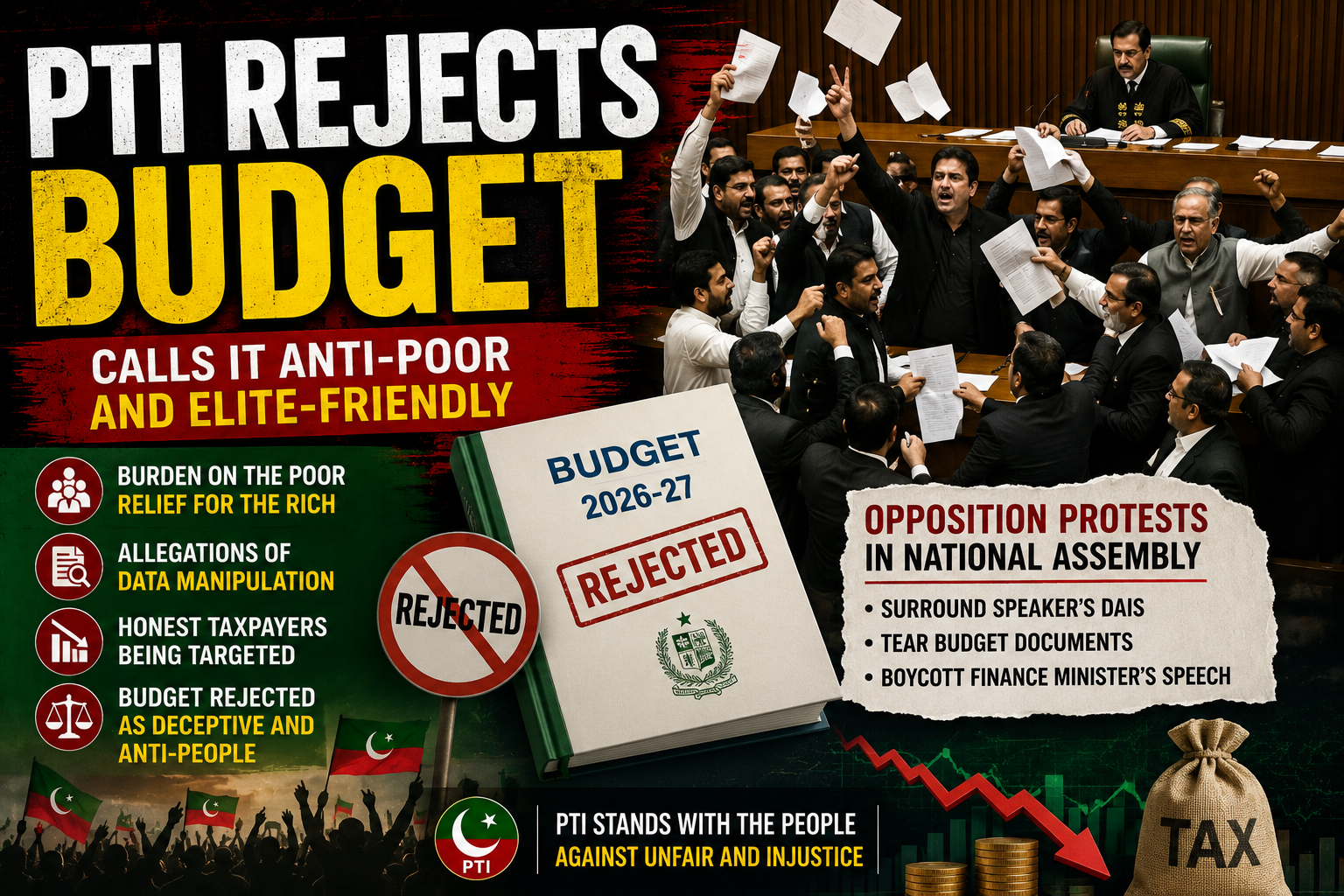
PTI Rejects Budget for the upcoming fiscal year, describing it as an anti-poor and elite-friendly financial plan that places additional pressure on ordinary citizens while providing relief to privileged segments of society.
The criticism came from Pakistan Tehreek-e-Insaf (PTI) leadership following the presentation of the federal budget for 2026-27. The party accused the government of relying on tax measures that burden taxpayers and businesses rather than introducing meaningful economic reforms.
The latest reaction highlights the political divide over the government’s economic strategy, with opposition parties questioning both the priorities and effectiveness of the proposed budget measures.
🏛️ PTI Rejects Government’s Budget Plan
PTI’s Central Information Secretary, Sheikh Waqas Akram, formally rejected the budget and described it as a budget designed by the ruling party for its own political interests.
According to him, the financial plan fails to address the challenges faced by ordinary Pakistanis and instead favors influential groups. He argued that the budget places additional financial pressure on lower and middle-income citizens at a time when many households are already dealing with economic difficulties.
The opposition leader maintained that the government had missed an opportunity to introduce reforms aimed at improving economic conditions and reducing public hardship.
💰 Allegations of Relief for Elites
PTI leaders claimed the budget provides greater benefits to wealthier segments of society while offering limited relief to lower-income groups.
According to Sheikh Waqas Akram, the government’s policies continue to favor privileged sectors despite widespread economic challenges. He argued that the measures announced in the budget do not adequately support citizens struggling with rising living costs and financial pressures.
The opposition also questioned whether the proposed relief measures would have a meaningful impact on the daily lives of ordinary people.
Government officials, however, have defended the budget as a balanced financial plan designed to support economic stability and growth.
📊 PTI Raises Concerns Over Budget Figures
Another major point raised by PTI involved concerns about the figures and projections included in the budget documents.
The party alleged that some economic data presented by the government does not accurately reflect ground realities. Opposition leaders claimed that statistical adjustments had been used to present a more favorable picture of economic performance.
They argued that policymakers should focus on addressing structural economic challenges rather than relying on numerical targets and projections.
The government has not accepted these allegations and continues to maintain that the budget is based on official economic assessments and fiscal planning.
🧾 Criticism of Tax Measures and Audits
PTI also criticized several taxation-related measures announced in the budget.
Party leaders expressed concerns about policies they believe could place additional pressure on documented businesses and compliant taxpayers. Particular criticism was directed toward audit-related procedures and compliance mechanisms.
According to PTI representatives, the focus should be on expanding the tax base and addressing tax evasion rather than increasing the burden on individuals and businesses already operating within the formal economy.
The opposition argued that long-term economic improvement requires broader reforms aimed at encouraging investment, business growth, and job creation.
⚡ Protest During National Assembly Session
The budget debate also led to strong reactions inside the National Assembly.
During the budget session, PTI lawmakers staged protests against the government’s financial proposals. Opposition members surrounded the Speaker’s dais and voiced objections while the budget proceedings were underway.
Reports from the assembly session indicated that some lawmakers also tore copies of budget documents during the protest.
The demonstration reflected the party’s broader opposition to the government’s economic policies and its dissatisfaction with the budget proposals.
Political observers noted that budget sessions often become a focal point for disagreements between the government and opposition parties, particularly when major economic decisions are being discussed.
📈 Budget Debate Likely to Continue
The government’s budget proposals are expected to remain a major topic of political discussion in the coming weeks.
While government officials argue that the budget is designed to support economic recovery and fiscal stability, opposition parties continue to question its priorities and impact on ordinary citizens.
Economic experts will also be examining the proposed measures to assess their likely effect on inflation, investment, taxation, and overall economic growth.
As parliamentary discussions continue, both supporters and critics of the budget are expected to present further arguments regarding the direction of Pakistan’s economic policy.
For now, PTI has made its position clear by rejecting the budget and calling for policies that it says would provide greater relief to the wider population.