
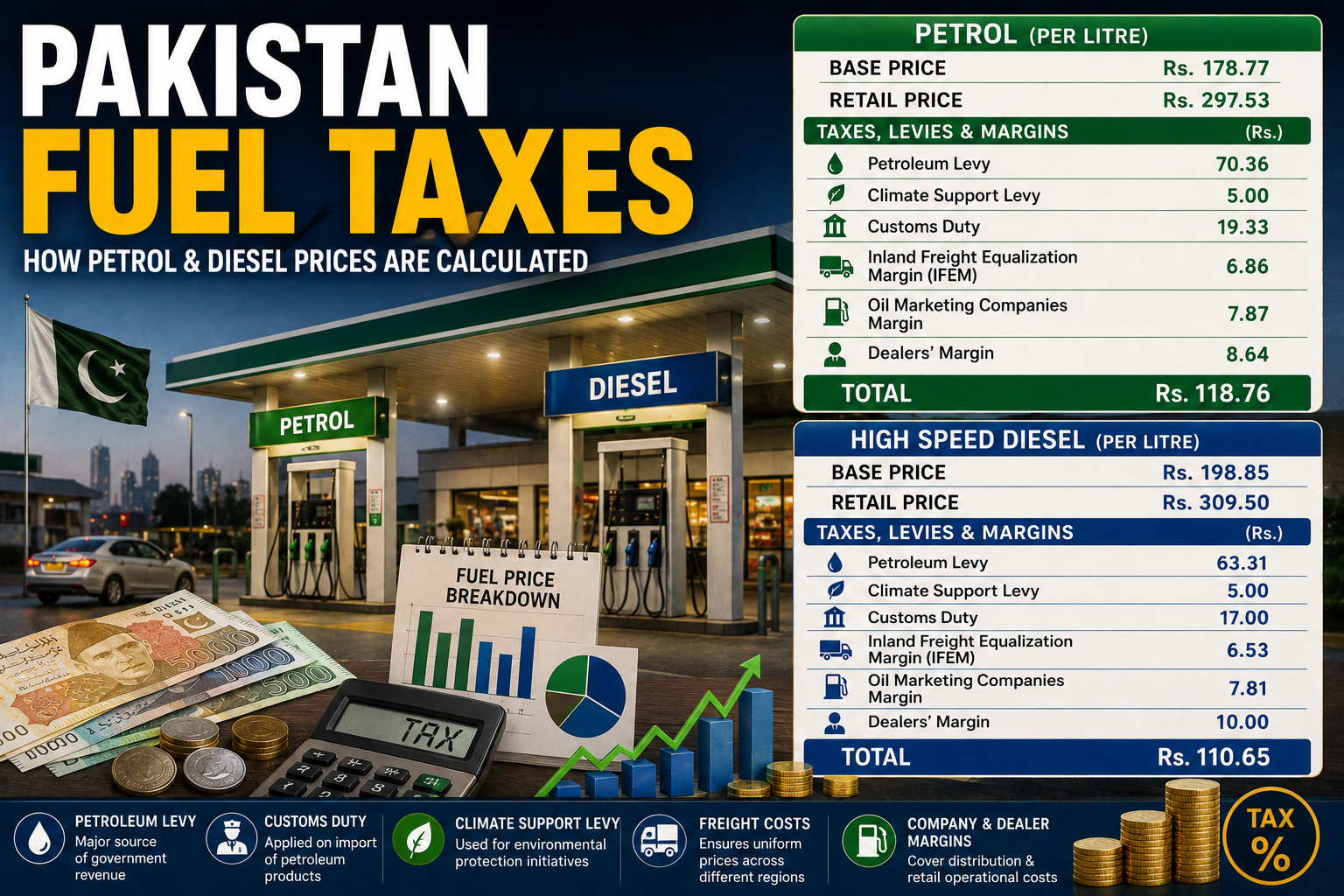
Pakistan Fuel Taxes and Levies have come under renewed public attention after official documents revealed the detailed breakdown of taxes, petroleum levy, customs duty, freight charges, and marketing margins included in the prices of petrol and high-speed diesel.
According to the available documents, consumers currently pay Rs. 118.76 per litre in taxes, levies, and margins on petrol, while Rs. 110.65 per litre is added to the price of every litre of high-speed diesel through various government charges and industry margins.
The breakdown provides a clearer picture of how retail fuel prices are calculated before reaching consumers across Pakistan.
⛽ Petrol Price Includes Multiple Charges
Official documents show that the base price of petrol is Rs. 178.77 per litre, while the official retail price has been fixed at Rs. 297.53 per litre.
The difference consists of several taxes, levies, transportation costs, and industry margins.
According to the documents, petrol includes:
- Petroleum Levy: Rs. 70.36
- Climate Support Levy: Rs. 5.00
- Customs Duty: Rs. 19.33
- Inland Freight Equalization Margin (IFEM): Rs. 6.86
- Oil Marketing Companies Margin: Rs. 7.87
- Dealers’ Margin: Rs. 8.64
Together, these components total Rs. 118.76 per litre.
🚛 High-Speed Diesel Also Carries Multiple Levies
The documents also provide a similar breakdown for high-speed diesel (HSD).
The base cost of HSD stands at Rs. 198.85 per litre, while the official retail price has been fixed at Rs. 309.50 per litre.
The difference between the base cost and retail price consists of petroleum levy, taxes, freight adjustments, and marketing margins.
According to official figures, total government charges and industry margins on diesel amount to Rs. 110.65 per litre.
💰 Petroleum Levy Remains Major Component
Among all price components, the petroleum levy continues to represent the largest share added to retail fuel prices.
The levy is collected by the federal government and contributes to national revenue generation.
Other charges such as customs duty, climate support levy, and transportation adjustments also play a role in determining the final consumer price.
Energy experts note that fuel pricing depends on several financial and regulatory components rather than international oil prices alone.
📊 How Retail Fuel Prices Are Calculated
Retail fuel prices are determined after combining international import costs with domestic taxes, regulatory charges, transportation expenses, and commercial margins.
The Inland Freight Equalization Margin helps maintain relatively uniform fuel prices across different regions of the country.
Oil marketing companies and fuel dealers also receive officially approved margins for distribution and retail operations.
These components collectively determine the final prices paid by consumers at petrol stations.
🌍 Fuel Pricing Closely Watched
Fuel prices remain one of the most closely monitored economic indicators because they directly influence transportation costs, inflation, and household expenses.
Changes in international crude oil prices, exchange rates, government policy, and taxation can all affect domestic petroleum prices.
Consumers and businesses continue monitoring official fuel price revisions announced periodically by the government.
Economic analysts believe transparency regarding fuel pricing helps improve public understanding of how petroleum prices are determined.
📈 Future Adjustments Depend on Market Conditions
Officials continue reviewing petroleum prices in line with international market movements and domestic fiscal policies.
Future adjustments will depend on global crude oil prices, exchange rate fluctuations, taxation policy, and other economic factors.
Analysts expect fuel pricing to remain an important issue for consumers, businesses, and policymakers as Pakistan continues managing energy costs and fiscal requirements.