
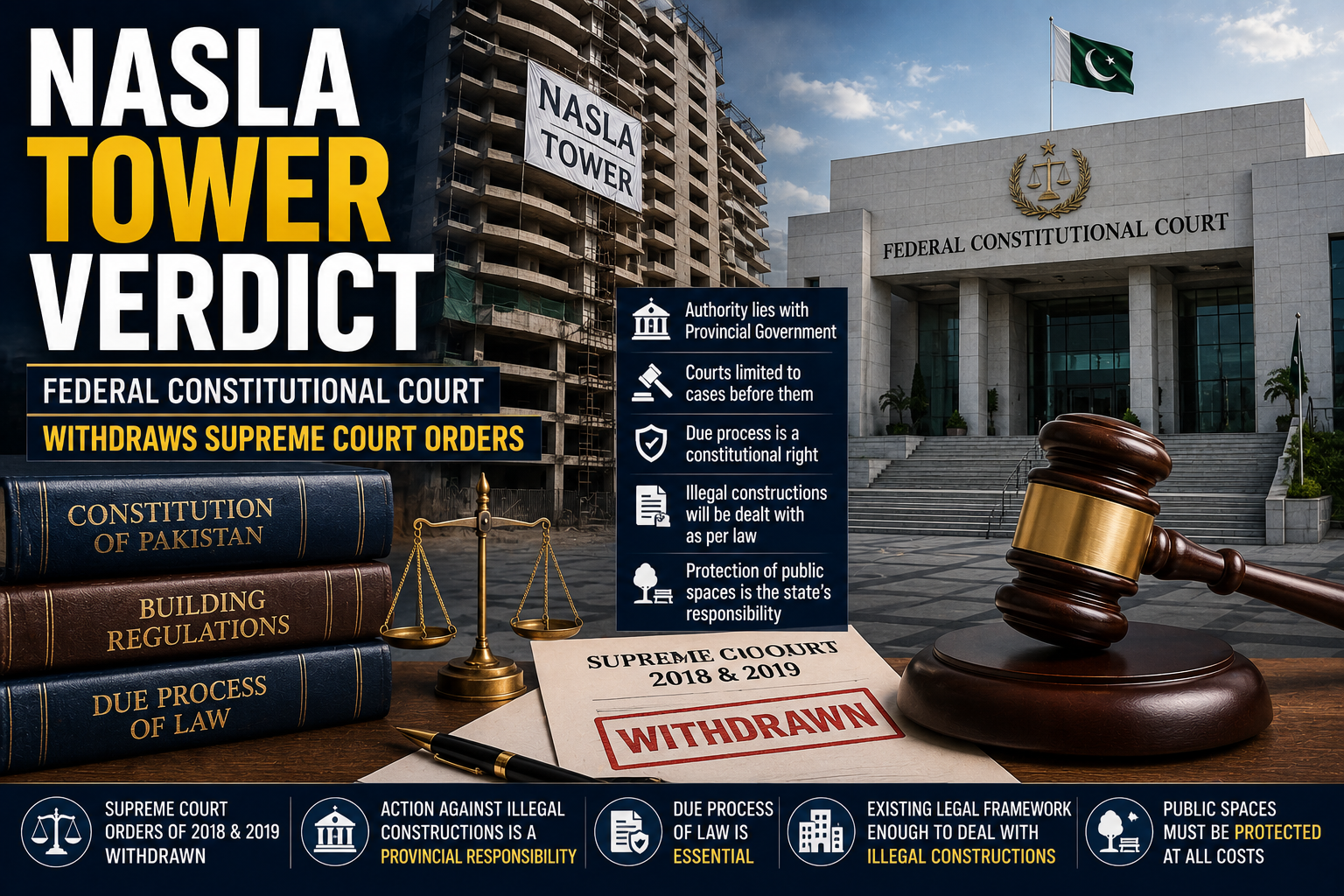
Nasla Tower Demolition Verdict has taken a significant legal turn after the Federal Constitutional Court withdrew the Supreme Court’s 2018 and 2019 orders that led to the demolition of Karachi’s Nasla Tower.
In its detailed judgment, the court ruled that action against illegal constructions primarily falls within the jurisdiction of provincial governments and relevant regulatory authorities rather than the judiciary. The ruling emphasized that courts should remain confined to disputes brought before them and avoid issuing directions beyond the scope of the case.
The judgment also stressed the constitutional importance of due process before any action is taken against property owners.
⚖️ Court Withdraws Earlier Supreme Court Orders
The Federal Constitutional Court formally withdrew the Supreme Court’s orders dated 21 December 2018 and 22 January 2019, along with actions taken under those directives.
According to the judgment, the earlier proceedings extended beyond the issues directly under consideration in the original case.
The court observed that judicial intervention should remain limited to matters properly placed before it.
The ruling clarifies that constitutional courts must exercise judicial authority within established legal boundaries.
🏢 Provincial Authorities Hold Primary Responsibility
The court held that responsibility for taking action against illegal constructions primarily rests with provincial governments and their regulatory agencies.
According to the judgment, existing legal institutions already possess the authority to investigate building violations, monitor construction activities, and initiate legal proceedings where necessary.
The decision reinforces the administrative responsibilities of provincial authorities in enforcing building regulations.
Officials responsible for urban development remain constitutionally obligated to act against unlawful constructions.
📑 Due Process Declared Essential
A key element of the judgment is its emphasis on due process of law.
The court stated that demolition orders cannot be issued solely on the basis of administrative reports without ensuring all legal requirements have been fulfilled.
According to the ruling, every affected party must receive fair legal treatment before any administrative or judicial action is taken.
The judgment describes due process as a constitutional requirement applicable to every legal proceeding.
🏛️ Decision Does Not Legalize Illegal Buildings
The Federal Constitutional Court clarified that its ruling should not be interpreted as granting legal protection to illegal constructions.
Instead, the judgment states that all actions against unauthorized buildings must strictly follow applicable laws and constitutional procedures.
The court emphasized that relevant provincial institutions remain fully empowered to proceed against illegal developments where legal requirements are satisfied.
The decision focuses on ensuring lawful enforcement rather than preventing regulatory action.
🌆 Existing Legal Framework Already Available
According to the judgment, Karachi already has an established legal and administrative framework for addressing unauthorized construction.
The court noted that agencies responsible for urban planning and building regulation possess the necessary legal authority to perform their duties.
It added that strengthening institutional performance remains more appropriate than expanding judicial intervention beyond pending disputes.
The ruling encourages proper implementation of existing laws by competent authorities.
📌 Additional Note Highlights Public Spaces
Justice Syed Arshad Hussain Shah attached an additional note emphasizing the state’s responsibility to protect citizens’ fundamental rights and public spaces.
He stated that parks, playgrounds, green belts, footpaths, beaches, and other public facilities should remain protected from illegal encroachments and unauthorized alterations.
According to the additional note, safeguarding public assets is among the government’s primary constitutional responsibilities.
The observation highlights the broader importance of protecting public infrastructure while ensuring compliance with the law.