
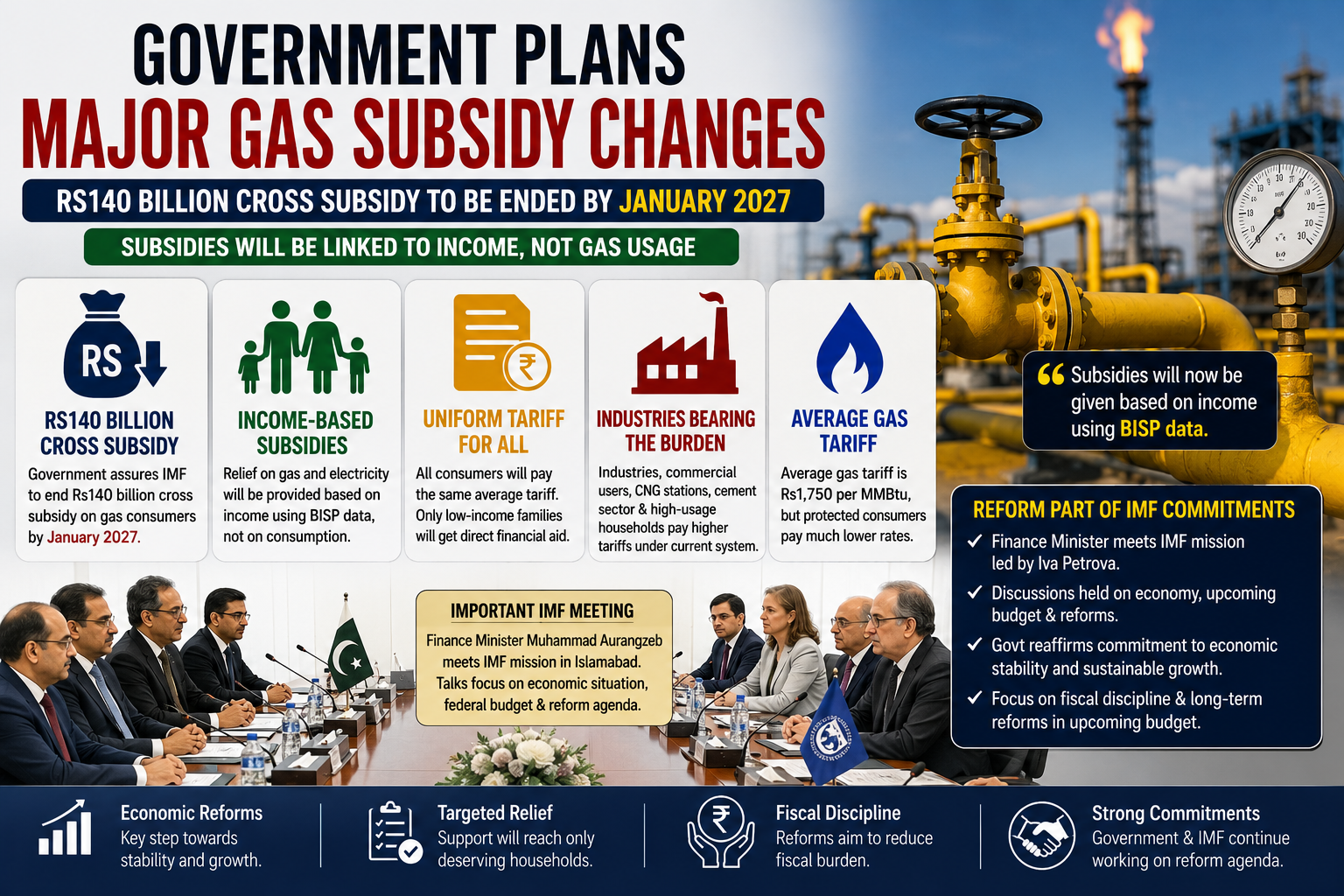
Gas subsidy changes are expected to reshape Pakistan’s energy pricing system after the government reportedly assured the International Monetary Fund (IMF) that nearly Rs140 billion worth of cross subsidies for gas consumers would be phased out by January 2027. Officials said the move is part of broader economic reforms aimed at improving fiscal discipline and restructuring the country’s energy sector.
Under the proposed system, subsidies on gas and electricity would no longer be based on the amount of energy consumed. Instead, support would be linked to household income levels using data from the Benazir Income Support Programme (BISP).
⛽ Government Plans Major Changes in Gas Pricing
According to officials from the Petroleum Division, the current system provides lower gas rates to protected and some non-protected consumers.
The financial burden of these subsidies is currently carried by industries, commercial consumers, CNG stations, the cement sector, and households with higher gas usage.
Authorities now plan to replace the existing structure with a uniform average gas tariff for all consumers while offering direct financial support only to lower-income families.
💰 Rs140 Billion Cross Subsidy to Be Removed
Officials said the government has committed to ending nearly Rs140 billion in cross subsidies by January 2027.
The decision reportedly forms part of ongoing negotiations and reform commitments linked to Pakistan’s economic cooperation with the IMF.
Economic experts believe the move could significantly change energy billing structures and reduce pressure on the national energy budget.
📊 Subsidies to Be Linked With Income Levels
Under the proposed policy, subsidies would be distributed based on verified income levels instead of gas or electricity consumption patterns.
Authorities said BISP data would be used to identify deserving households eligible for financial assistance.
Officials believe the new approach may improve targeting of subsidies and reduce misuse of government-supported energy relief programs.
🏭 Industries Currently Bearing Financial Burden
Petroleum Division officials stated that industries and commercial sectors are currently paying higher tariffs to compensate for subsidized domestic gas rates.
The sectors affected include manufacturing industries, commercial businesses, cement companies, and CNG operators.
Business groups have frequently argued that high energy costs reduce industrial competitiveness and increase production expenses.
📈 Average Gas Tariff Stands at Rs1,750
According to officials, the current average gas tariff stands at approximately Rs1,750 per MMBtu.
However, protected consumers continue paying significantly lower rates under the existing subsidy system. Authorities believe restructuring tariffs could help reduce distortions within the energy sector.
Energy analysts say pricing reforms are often considered necessary for long-term sustainability of public utility systems.
🤝 IMF Mission Holds Talks With Finance Minister
Finance Minister Muhammad Aurangzeb recently held an important meeting with the IMF mission in Islamabad.
According to the Finance Ministry, discussions focused on Pakistan’s economic situation, the upcoming federal budget, and broader economic reforms. The IMF delegation was led by mission chief Iva Petrova.
Senior officials including the State Bank governor, finance secretary, and FBR chairman also attended the meeting.
📉 Government Focused on Economic Stability
The government reiterated its commitment to economic stability and sustainable growth during discussions with the IMF delegation.
Officials stated that upcoming fiscal policies are expected to prioritize financial discipline, structural reforms, and economic stabilization measures.
Analysts believe energy sector reforms will remain a central part of Pakistan’s broader economic adjustment strategy in the coming years.