
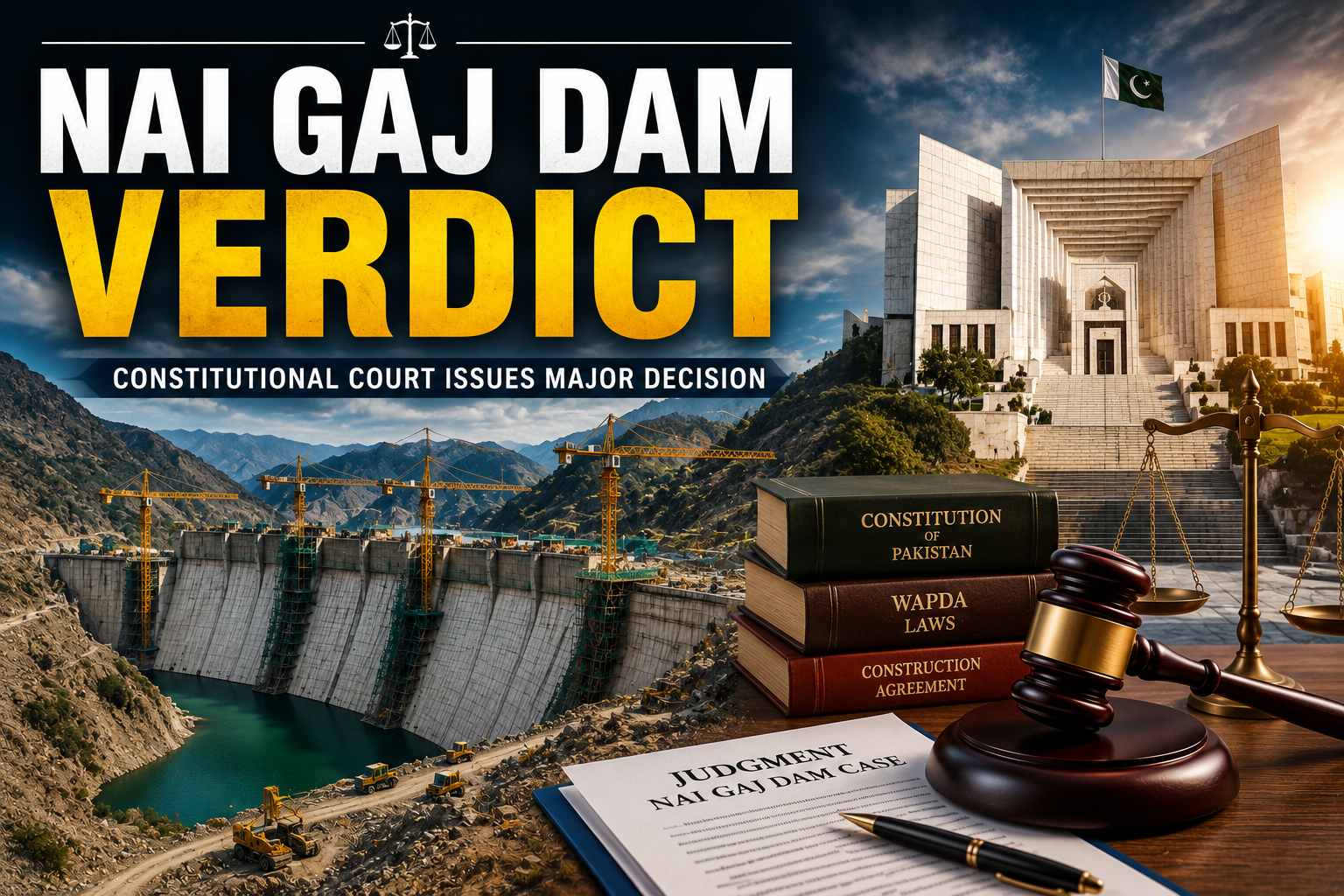
Nai Gaj Dam Case entered a new phase after Pakistan’s Federal Constitutional Court issued a detailed 17-page judgment, directing that no court should interfere with the Nai Gaj Dam construction project until its completion. The court said the order aims to prevent legal proceedings from delaying an important public infrastructure project while ensuring that contractual disputes are resolved through the mechanism already agreed upon by the parties.
The verdict, authored by Chief Justice Ameen-ud-Din Khan, set aside previous orders issued by the High Court regarding the project. The court held that the High Court had exceeded its jurisdiction by issuing directions without fully considering the applicable legal framework governing the project.
🏗️ Constitutional Court Bars Judicial Interference
According to the judgment, the Federal Constitutional Court ordered that no court should intervene in matters related to the Nai Gaj Dam project until construction is completed. The ruling stated that uninterrupted progress on the project is in the public interest and that continued litigation could delay the completion of a major infrastructure initiative.
The court explained that the purpose of its direction is to avoid unnecessary legal obstacles that may affect timely completion of the dam. According to the judgment, disputes arising during construction should be addressed through the contractual procedures agreed upon by the concerned parties.
Officials expect the ruling to provide greater certainty for the continuation of work on the project while maintaining the legal rights available under the contract.
⚖️ High Court Orders Declared Invalid
The Constitutional Court also declared the High Court’s earlier judgments and directions regarding the Nai Gaj Dam project to be without legal effect.
According to the written decision, the High Court issued directions without properly considering the relevant laws governing the project. The judgment stated that the court did not adequately examine the dispute resolution mechanism contained in the construction agreement, the applicable WAPDA regulations, or relevant NAB laws before issuing its orders.
The Constitutional Court concluded that these legal considerations were essential and should have been taken into account before any judicial intervention.
📜 Contractual Dispute Mechanism Must Be Followed
The judgment emphasized that disputes arising under the Nai Gaj Dam construction contract must be resolved strictly according to the dispute resolution procedure agreed upon in the original contract.
According to the court, contractual obligations remain binding on all parties involved in the project. Rather than seeking immediate judicial intervention, parties should first use the mechanisms specified in the agreement for resolving disagreements.
The court stated that adherence to contractual procedures promotes legal certainty and allows infrastructure projects to continue without unnecessary interruptions.
⚖️ Court Explains Constitutional Limits
The Federal Constitutional Court also discussed the constitutional scope of judicial powers under Article 199 of Pakistan’s Constitution.
According to the judgment, the jurisdiction granted to High Courts under Article 199 cannot be expanded beyond constitutional limits. The court observed that rewriting or extending constitutional jurisdiction may result in what it described as an “open failure of justice.”
The ruling stressed that courts must exercise their constitutional authority within the limits established by law while respecting contractual arrangements where appropriate.
📅 WAPDA Directed to Decide Complaint Within 15 Days
The judgment includes specific directions regarding future disputes involving the contractor.
According to the court, if a contractor submits a complaint, WAPDA must decide the matter within 15 days of receiving it. The court said this timeline is intended to ensure that disputes are addressed promptly without delaying construction activities.
The ruling further states that if the contractor violates the terms of the agreement, WAPDA will be free to proceed in accordance with the law, including initiating a fresh tender process for the remaining project work if necessary.
🌍 Project Expected to Continue Under Existing Agreement
The Constitutional Court expressed hope that all parties would continue implementing the project according to the original agreement.
The judgment encourages both WAPDA and the contractor to resolve any outstanding issues through the contractual framework rather than prolonged litigation. Legal experts note that the decision reinforces the principle that agreed dispute resolution mechanisms should generally be respected in large public infrastructure contracts.
While the ruling removes immediate judicial hurdles affecting the project, future contractual disputes may still be addressed through the procedures outlined in the agreement and applicable law.
The Nai Gaj Dam project is considered an important public infrastructure initiative, and the latest judgment is expected to provide legal clarity regarding its continuation. The decision also serves as guidance on the constitutional limits of judicial intervention in contractual disputes involving major development projects.