
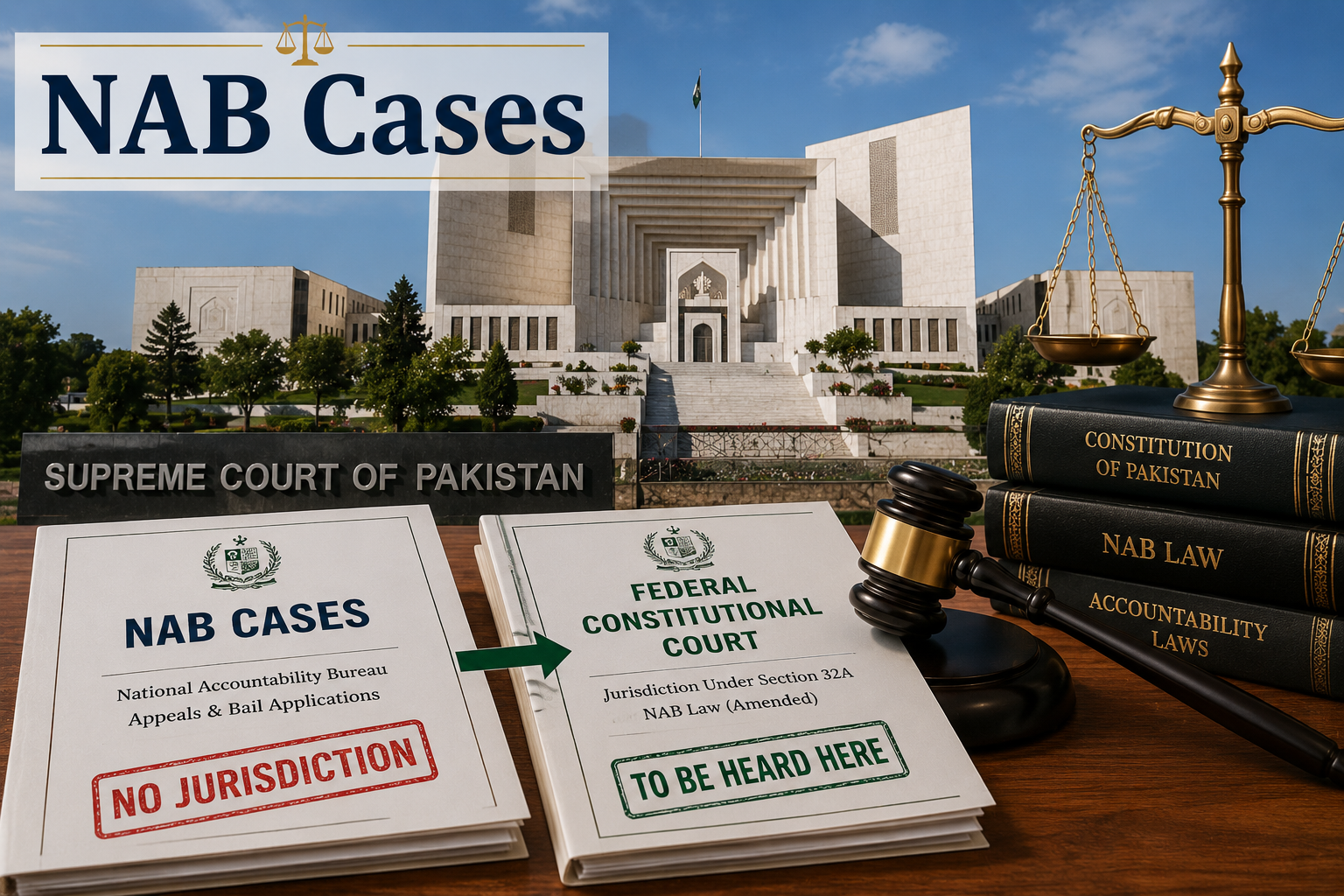
NAB Cases will no longer be heard by Pakistan’s Supreme Court after the court ruled that it does not have jurisdiction to hear appeals and bail matters under the amended National Accountability Bureau (NAB) law. The ruling states that such matters fall within the jurisdiction of the Federal Constitutional Court following amendments introduced earlier this year.
The short order was announced by Justice Muhammad Ali Mazhar, who said Sections 32 and 32A of the NAB law do not grant the Supreme Court authority to hear NAB appeals or bail petitions.
⚖️ Supreme Court Declares No Jurisdiction Over NAB Cases
A three-member bench of the Supreme Court ruled that the court lacks jurisdiction to hear NAB Cases involving appeals and bail applications.
According to the ruling, amendments made to the NAB law transferred these matters to the Federal Constitutional Court. Justice Muhammad Ali Mazhar stated that Sections 32 and 32A clearly define the competent forum for hearing such cases.
The court held that all pending criminal appeals and bail petitions under the NAB law should now be treated as transferred to the Federal Constitutional Court.
📜 Decision Based on Amended NAB Law
The judgment refers to amendments made to the National Accountability Bureau law on March 5, 2026.
Under the revised legal framework, the authority to hear central appeals and bail applications in accountability cases was assigned to the Federal Constitutional Court.
The bench observed that jurisdiction must be determined strictly according to the law, regardless of whether objections regarding jurisdiction were previously raised during proceedings.
🏛️ Pending Cases to Be Transferred
The court ruled that all pending criminal appeals and related applications under the NAB law will be deemed transferred to the Federal Constitutional Court under the relevant constitutional provisions.
According to the judgment, allowing one part of a case to remain before the Supreme Court while another part proceeds before the Constitutional Court would create an inconsistency contrary to the law.
The court emphasized that jurisdiction cannot be determined based on the preference of litigants.
👨⚖️ Bench Heard Arguments From Both Sides
The case was heard by a three-member bench headed by Justice Muhammad Ali Mazhar, with Justice Musarrat Hilali and Justice Shahid Bilal Hassan also serving on the bench.
During the proceedings, the petitioner’s counsel argued that bail matters should continue before the Supreme Court and referred to an earlier bail order issued after the NAB law amendments.
However, Attorney General Mansoor Usman Awan argued that both central appeals and bail matters should be heard by the Federal Constitutional Court.
The National Accountability Bureau’s legal counsel also supported the federal government’s position during the hearing.
📄 Thirty-Page Judgment Issued
Following earlier hearings, the Supreme Court reserved its verdict on July 16 before issuing a detailed 30-page judgment.
The judgment states that all pending criminal appeals and related petitions under the NAB law should be transferred to the Federal Constitutional Court.
The court further observed that even if parties fail to challenge jurisdiction during proceedings, the law itself determines which judicial forum has the authority to hear a case.
🗂️ Impact on High-Profile Cases
The ruling also affects several high-profile accountability matters.
The report notes that former Prime Minister Imran Khan had approached the Supreme Court regarding a bail matter after a High Court decision, while the Supreme Court Registrar returned the petition after raising jurisdictional objections.
Similarly, an appeal relating to bail filed by his wife in the 190 million pounds case also faced objections, directing the applicant to approach the Federal Constitutional Court.
Following the latest ruling, such matters will now proceed before the Federal Constitutional Court in accordance with the amended law.
⚖️ Court Rejects Forum Shopping
The Supreme Court stressed that litigants cannot choose their preferred judicial forum.
According to the judgment, allowing different parts of the same case to be heard before separate courts would conflict with the legal framework established by Parliament.
The bench concluded that judicial jurisdiction must be exercised strictly according to statutory provisions, ensuring consistency in accountability proceedings and preventing forum shopping.