
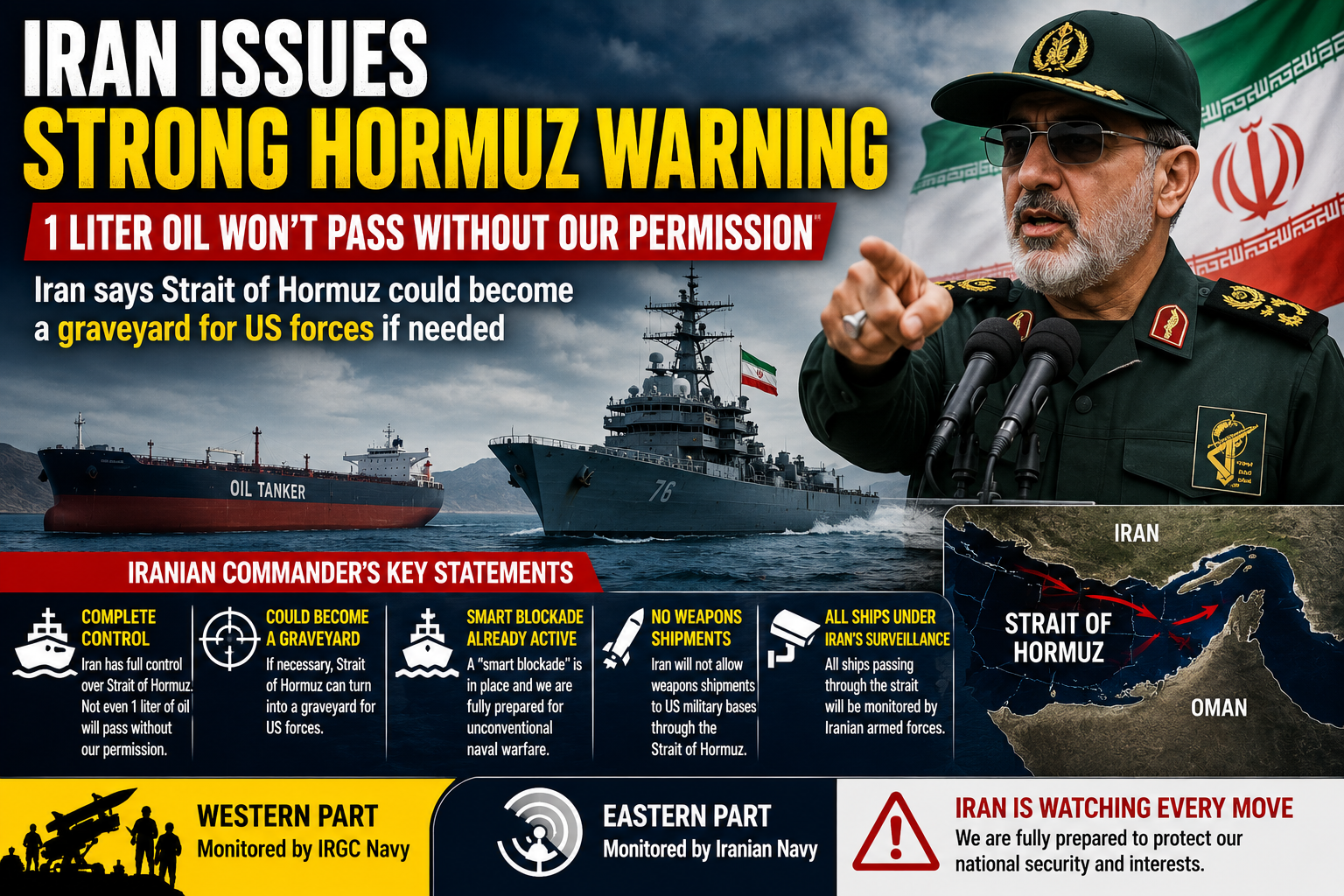
Hormuz threat warning from Iranian military officials has intensified tensions between Iran and the United States after senior commanders claimed Tehran could fully control shipping activity through the Strait of Hormuz if required. Iranian officials warned that the strategic maritime route could become extremely dangerous for American forces during any future escalation in the region.
The latest statements come amid rising geopolitical tensions, continued military deployments, and growing concerns regarding global oil supply routes connected to the Gulf region.
⚓ Iran Claims Full Control Over Strait of Hormuz
According to Iranian media reports, senior officials linked to Iran’s Revolutionary Guard stated that Tehran maintains full oversight of the Strait of Hormuz and surrounding waters.
Iranian military representatives claimed that if authorities decide, no oil shipment would be able to pass through the strategic waterway without Iranian approval.
Officials described the Strait of Hormuz as one of the most critical maritime routes for global energy transportation and regional trade.
🇮🇷 Iranian Commander Issues Strong Warning
The remarks were reportedly made by Captain Saeed Sayyah Sarani, deputy for cultural and psychological operations within the naval wing of Iran’s Revolutionary Guard.
According to reports, the Iranian commander stated that Tehran is carefully monitoring developments in the region and remains prepared for any escalation involving foreign military forces.
The statements were widely interpreted as part of Iran’s broader strategic messaging amid continuing tensions with the United States and its allies.
🚢 Iran Says “Smart Blockade” Already Active
Iranian officials also claimed that although a full-scale naval conflict has not started, Tehran has already implemented what they described as a “smart blockade” strategy in regional waters.
Military representatives said Iran is fully prepared for unconventional naval warfare if regional conditions worsen further.
Analysts believe such statements are intended to demonstrate Iran’s military readiness and influence over maritime routes connected to the Gulf region.
🛡️ Weapons Shipments Through Hormuz Targeted
Separately, an Iranian military spokesperson announced that Tehran would not allow the transfer of weapons through the Strait of Hormuz for American military bases located in the region.
Officials added that all ships traveling through the waterway would remain under surveillance by Iranian armed forces to ensure compliance with Iran’s security strategy and regional monitoring systems.
The remarks reflected growing concerns regarding military logistics and security operations connected to Gulf shipping routes.
🌍 Strategic Waterway Remains Global Concern
The Strait of Hormuz remains one of the world’s most important maritime passages because a significant percentage of global oil exports travel through the route every day.
Any disruption in the area often raises concerns in international energy markets and shipping industries. Security experts say tensions in the Strait of Hormuz can directly affect global oil prices and international trade activity.
Countries across the world continue monitoring developments in the Gulf because of the route’s importance for energy supplies and economic stability.
🇺🇸 Regional Tensions Continue Rising
Relations between Iran and the United States have remained tense due to disputes involving sanctions, military deployments, maritime security, and regional influence.
Recent statements from Iranian military officials are expected to further increase international attention toward Gulf security conditions and strategic shipping operations.
Political analysts believe continued escalation without diplomatic progress could increase uncertainty across the region.
🤝 Diplomatic Efforts Still Being Watched
Despite growing tensions, international observers continue calling for diplomatic engagement to prevent further instability in the Middle East.
Experts believe negotiations and regional communication channels remain important for reducing risks connected to military confrontation and global shipping disruptions.
The Strait of Hormuz continues to remain a central issue in ongoing geopolitical tensions between Tehran and Washington.