
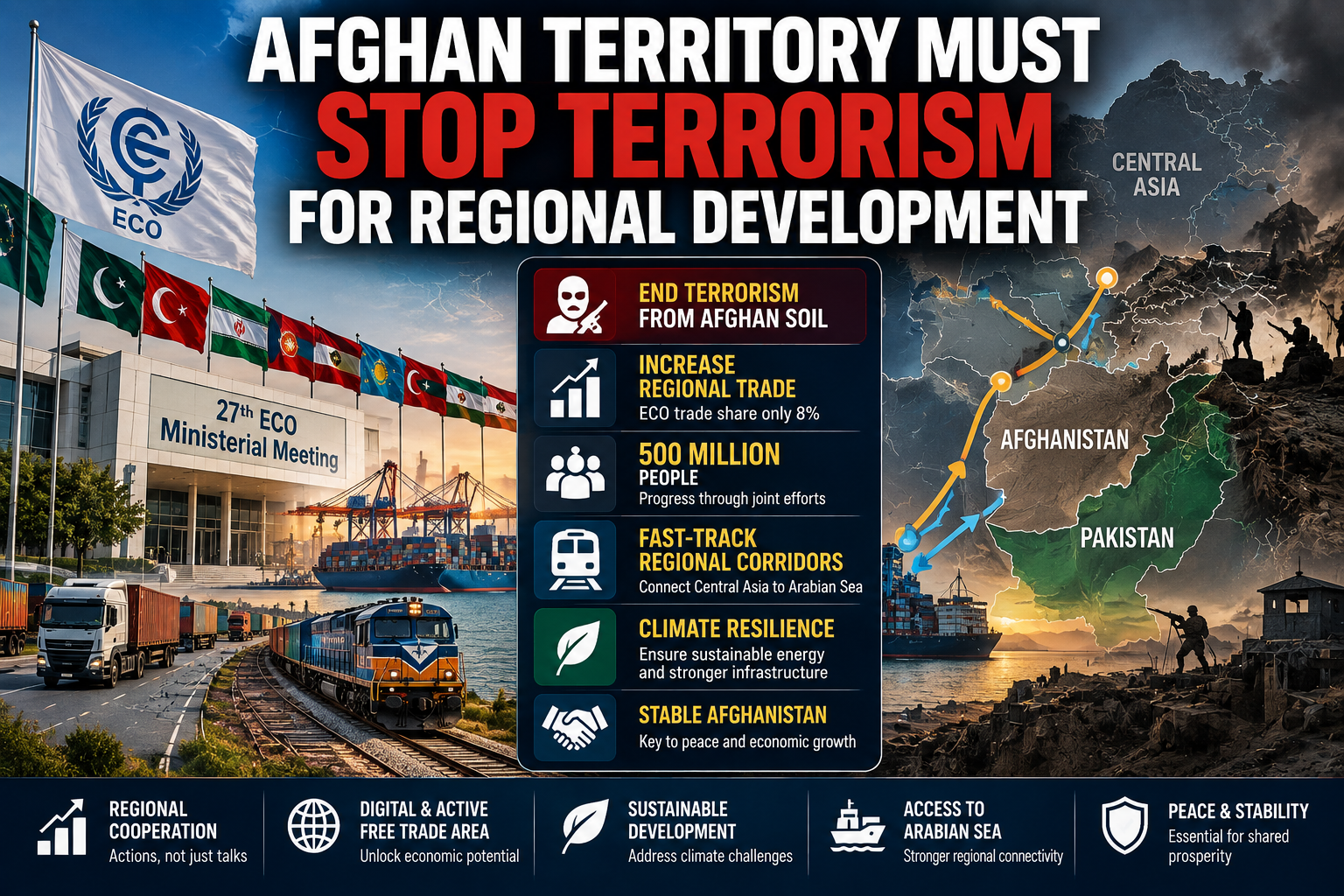
Afghan Soil Terrorism is undermining regional peace and development, Deputy Prime Minister and Foreign Minister Ishaq Dar said while addressing the 27th informal meeting of the Economic Cooperation Organization (ECO) Council of Ministers in New York. He said Pakistan believes regional peace and economic progress cannot be achieved without addressing the security threat it says is linked to Afghan territory.
Dar’s remarks came as Pakistan outlined its priorities for the ECO during its 2026-27 chairmanship. He called for practical steps to strengthen regional cooperation, increase trade, improve transport links and address security and climate-related challenges.
🛡️ Security Linked to Regional Development
Dar said the use of Afghan territory for terrorism remains a continuing challenge to regional stability. He said Pakistan’s objective is to see a peaceful, prosperous and stable Afghanistan that is integrated with the wider region and maintains peaceful relations with its neighbours.
Pakistan has repeatedly raised concerns about militant groups operating from Afghan territory. In his remarks, Dar said the Taliban government should address what Pakistan describes as its legitimate security concerns through concrete and verifiable action.
The Pakistani government has also said that preventing Afghan territory from being used for attacks against neighbouring countries is important for wider regional development.
🌍 ECO Region Seeks Stronger Cooperation
Dar said dialogue alone was not enough to strengthen regional cooperation and called for practical measures among ECO member states.
The ECO region has a population of nearly 500 million people, but intra-regional trade accounts for only about 8 percent of total regional trade, according to figures cited by Dar. He said the relatively low level of trade showed the potential for greater economic integration among member countries.
Pakistan is chairing the ECO Council of Ministers for 2026-27. Dar said the country’s priorities include trade and economic integration, connectivity and transit, trade facilitation, digital development and climate resilience.
🚢 Pakistan Offers Regional Gateway
Dar said Pakistan was ready to serve as a gateway for Central Asian countries by improving connections with ports on the Arabian Sea.
He called for faster progress on corridor projects linking Central Asia with the Arabian Sea and said better transport networks, transit systems and customs procedures were important for increasing regional trade.
Pakistan’s geographic position gives it a potential transit role between Central Asian markets and the Arabian Sea. Dar said stronger connectivity could help turn the region’s economic potential into greater trade and shared prosperity.
The foreign minister also highlighted the need to make the ECO Free Trade Area more effective and digitally enabled as part of efforts to improve regional economic integration.
🌱 Climate Change Adds Another Challenge
Climate change was another issue highlighted by Dar during the ECO meeting.
He said changing climate conditions pose serious risks to agriculture and water security across the region. He called for greater cooperation on sustainable energy and infrastructure capable of withstanding climate-related challenges.
The issue is particularly important for a region where agriculture, water availability and transport infrastructure are closely connected to economic activity.
Dar linked climate resilience with the broader ECO agenda, saying regional cooperation should address both economic opportunities and shared environmental challenges.
🚆 Uzbekistan-Afghanistan-Pakistan Railway
Dar also highlighted the Uzbekistan-Afghanistan-Pakistan railway project as one of Pakistan’s priorities.
He said Pakistan wants progress toward signing the framework agreement for the project, which is intended to strengthen transport links between Central Asia, Afghanistan and Pakistan. Earlier discussions between Pakistan and Afghanistan also identified the railway as an important regional connectivity project.
The proposed railway is part of Pakistan’s wider effort to improve regional transit connections and provide Central Asian countries with improved access to markets and ports.
Dar’s comments placed connectivity alongside security and economic cooperation as key elements of Pakistan’s regional policy.
🤝 Pakistan Seeks Constructive Engagement
Dar said Pakistan wants a stable Afghanistan and has pursued constructive engagement with the Taliban government.
According to his remarks, Pakistan has promoted bilateral and transit trade with Afghanistan while also seeking progress on regional connectivity projects. Pakistan has previously described sustained engagement as a way to address shared challenges involving security, trade and transit.
At the same time, Dar said Pakistan’s main expectation from the Taliban government is a lasting solution to what Islamabad considers its legitimate security concerns.
Pakistan has called for concrete action against militant groups that it says operate from Afghan territory. The Taliban administration has rejected accusations that Afghanistan is being allowed to be used against other countries.
🕊️ Pakistan Reaffirms Peaceful Approach
Dar also said Pakistan remains committed to the peaceful resolution of disputes in accordance with international law. He expressed concern about the changing security situation in the Middle East and the wider region.
The Pakistani position combines calls for regional security with efforts to expand economic cooperation through the ECO framework. Dar said greater connectivity, trade integration and practical cooperation are needed to support development across the region.
The Afghan Soil Terrorism issue therefore remains closely connected to Pakistan’s wider regional agenda, according to Dar. Islamabad says that addressing its security concerns is necessary alongside efforts to expand trade, transit and economic links.
The ECO meeting provided a platform for Pakistan to present these priorities while holding the chairmanship of the organisation. The agenda included security, regional trade, transport corridors, climate resilience and digital economic integration.
For Pakistan, the proposed Uzbekistan-Afghanistan-Pakistan railway and improved access to Arabian Sea ports are part of a broader connectivity strategy. At the same time, Islamabad continues to seek action from the Taliban government over militant activity that Pakistan says originates from Afghan territory.