
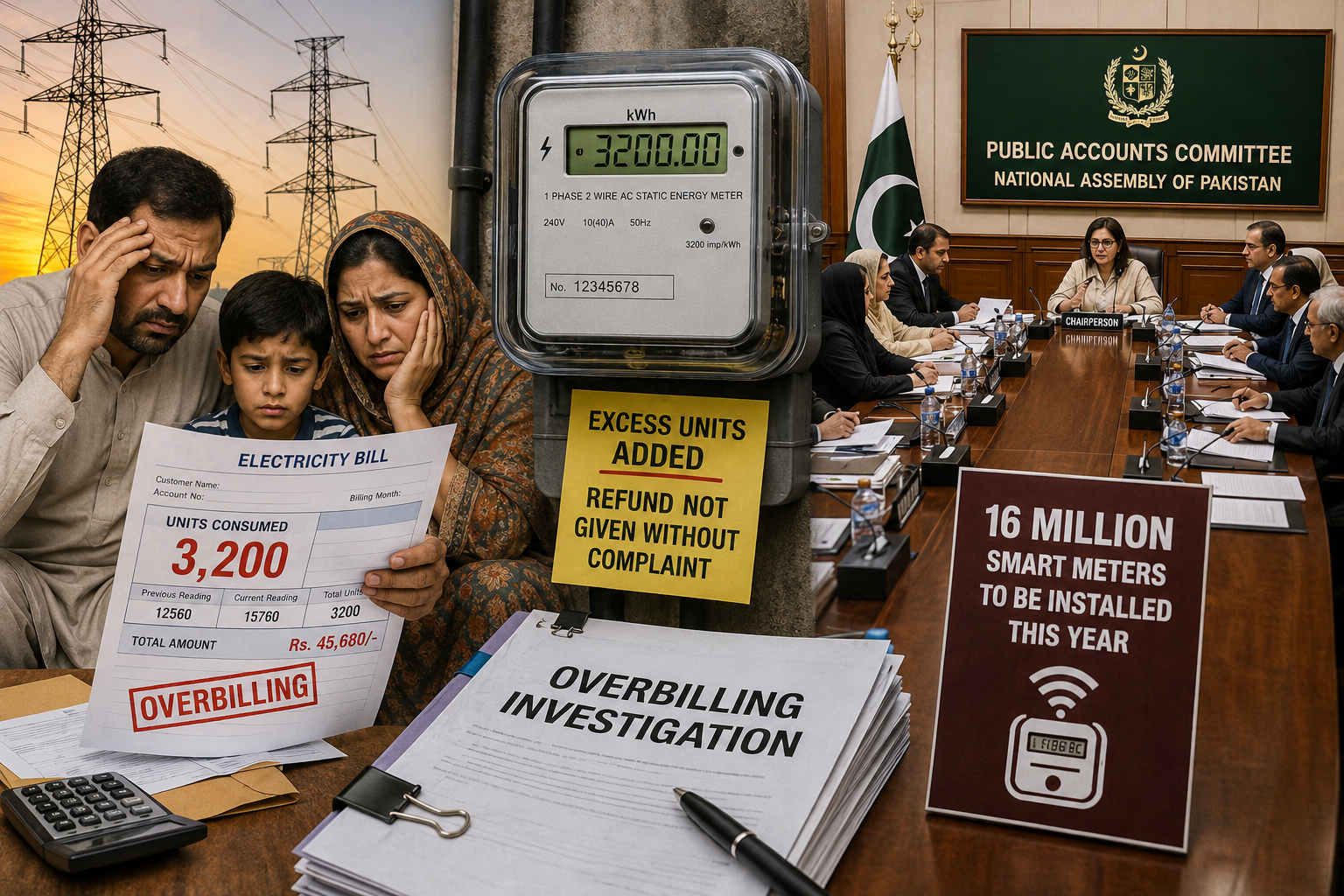
Electricity Overbilling has come under renewed scrutiny in Pakistan after the National Assembly’s Public Accounts Committee (PAC) revealed that power distribution companies placed thousands of excess electricity units on consumers’ bills. During the committee meeting, officials disclosed that many affected consumers do not receive refunds unless they formally submit claims, raising concerns over billing practices and consumer protection.
The revelations were made during a PAC session chaired by Shahida Akhtar, where audit officials presented findings related to electricity billing, refunds, and the performance of power distribution companies.
⚡ PAC Reveals Electricity Overbilling Cases
During the committee meeting, audit officials informed members that consumers who do not apply for overbilling refunds are generally not reimbursed. Officials stated that refunds are processed only after complaints are received, meaning many consumers may never recover money charged through excess billing.
The disclosure prompted committee members to question whether consumers are unfairly carrying financial burdens due to billing errors.
📊 Thousands of Consumers Received Refunds
According to the audit briefing, refunds were issued to approximately 278,000 consumers involving nearly 904.6 million electricity units.
Committee member Senator Afnan Ullah questioned how a single consumer could legitimately consume around 3,200 electricity units, asking whether industrial consumers were included among those receiving refunds.
In response, the CEO of Lahore Electric Supply Company (LESCO) confirmed that some industrial consumers and tube well connections were part of the refunded cases.
🏠 Committee Questions Impact on Domestic Consumers
Members of the committee expressed concern that ordinary households may have been charged for electricity they never used.
Senator Afnan Ullah stated that many people had sold personal belongings, including jewelry, to pay electricity bills, adding that consumers who never filed complaints may have permanently lost their money.
Committee members also questioned whether smaller amounts of overbilling could be affecting a much larger number of consumers without being detected.
🔍 Power Companies Cite Electricity Theft
During the meeting, LESCO officials said electricity theft remains a serious challenge.
According to the utility, some individuals allegedly use advanced devices to manipulate electricity meters and bypass accurate billing systems. Officials claimed certain consumers install electronic devices that interfere with meter readings.
However, committee members stressed that the audit report primarily focuses on the performance and responsibilities of electricity distribution companies rather than consumer misconduct.
🗣️ Lawmakers Raise Concerns Over Billing Practices
Committee member Hussain Tariq referred to media reports claiming that some consumers were charged as many as 41,000 units in a single day, questioning the accuracy of electricity billing systems.
Shazia Marri criticized the approach of blaming consumers, saying the audit report highlights institutional negligence and administrative failures within electricity companies rather than public wrongdoing.
Members emphasized that consumers should not bear the financial consequences of operational weaknesses or billing errors.
💡 Government Plans Smart Meter Installation
Secretary of Energy informed the committee that electricity companies had submitted audit records late, requesting that the audit observations remain open until the issues are fully addressed.
The secretary announced that the government plans to install 16 million smart meters during the current year to improve billing accuracy and reduce losses caused by faulty or outdated metering systems.
According to the briefing, discussions have already been held with Saudi Arabia and Türkiye regarding smart meter projects, while authorities are also considering implementing the initiative through a public-private partnership model.
The secretary further stated that whenever an existing electricity meter becomes defective, it will be replaced with a smart meter instead of a conventional one.
📑 PAC Directs Further Action
Following the discussion, the Public Accounts Committee directed that the matter be examined by the Departmental Accounts Committee (DAC) before being reported back to the PAC.
Committee members stressed the importance of ensuring transparency in electricity billing, timely refunds for overcharged consumers, and stronger oversight of power distribution companies to prevent similar issues in the future.
The committee also emphasized that improving metering technology and strengthening accountability mechanisms could help reduce billing disputes and restore consumer confidence in Pakistan’s electricity sector.