
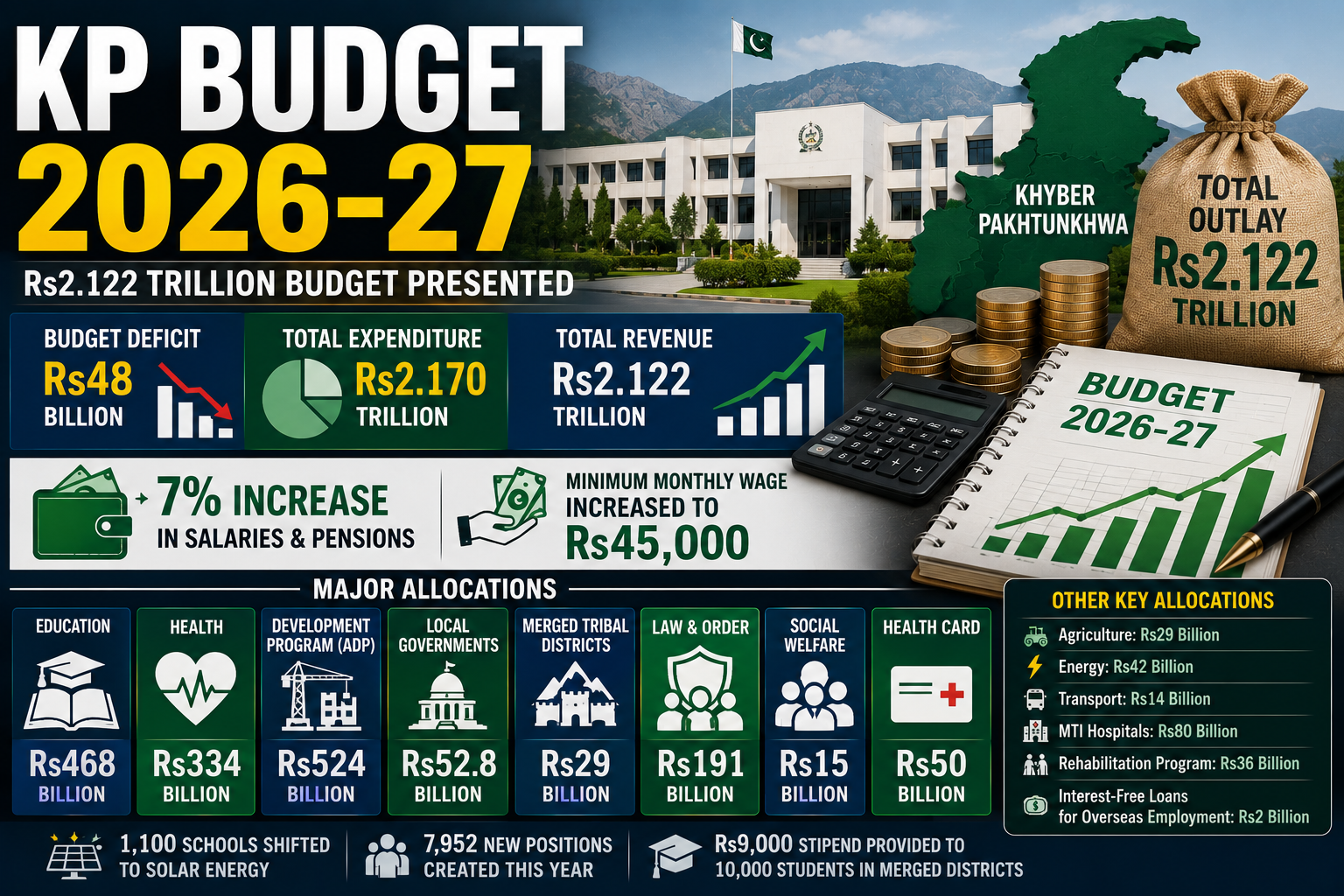
KP Budget 2026-27 has been unveiled with a total outlay of Rs2.122 trillion, including a proposed 7 percent increase in salaries and pensions for government employees and an increase in the minimum monthly wage to Rs45,000.
The budget was presented by Khyber Pakhtunkhwa Chief Minister Sohail Afridi, who outlined the province’s financial priorities for the upcoming fiscal year. The proposed budget includes allocations for education, healthcare, development projects, social welfare, infrastructure, and law enforcement.
According to the provincial government, the budget aims to balance development spending with public welfare initiatives while addressing economic and administrative challenges.
💰 Budget Size and Fiscal Outlook
The Khyber Pakhtunkhwa government has proposed a budget worth Rs2.122 trillion for fiscal year 2026-27.
Officials estimate a budget deficit of approximately Rs48 billion. Total expenditures have been projected at Rs2.170 trillion, while estimated revenues stand at Rs2.122 trillion.
The government stated that financial planning for the upcoming year focuses on maintaining development momentum while ensuring the continuation of essential public services.
Economic observers will closely monitor revenue performance and expenditure management as the fiscal year progresses.
📈 Development Projects Receive Major Allocation
A significant portion of the budget has been allocated for development activities.
The Annual Development Program (ADP) has been allocated Rs524 billion, making it one of the largest components of the budget.
Provincial authorities stated that development spending will support infrastructure improvements, education projects, healthcare facilities, energy initiatives, and local government programs.
The government also highlighted ongoing investments in public services and efforts aimed at improving living standards across the province.
Development spending remains a key driver of economic activity and job creation.
👨🏫 Salaries, Pensions and Minimum Wage Increase
Among the most notable proposals is a 7 percent increase in salaries and pensions for government employees.
The government has also proposed raising the minimum monthly wage from Rs40,000 to Rs45,000.
Officials say the increase is intended to provide relief to workers amid rising living costs and economic pressures.
Public sector employees and pensioners are expected to benefit if the proposal receives final approval.
The wage increase is also expected to impact workers employed in various sectors covered by provincial labor regulations.
🎓 Education and Health Receive Large Funding
Education and healthcare remain among the largest sectors in the proposed budget.
The provincial government has proposed allocating Rs468 billion for education and Rs334 billion for healthcare services.
Officials highlighted several achievements from the outgoing fiscal year, including the creation of 7,952 new positions and the transition of 1,100 schools to solar energy systems.
The budget also includes continued support for educational initiatives in merged districts and funding aimed at improving access to quality education.
In the healthcare sector, allocations include funding for hospitals, public health services, and the continuation of healthcare support programs.
🏥 Social Welfare and Public Services
The budget includes funding for various welfare initiatives and public service programs.
The government has proposed allocating Rs15 billion for the Ehsaas support program and Rs50 billion for the health card initiative.
Additionally, Rs80 billion has been proposed for Medical Teaching Institutions (MTIs), while Rs36 billion has been earmarked for rehabilitation programs.
Funding has also been allocated for local governments, merged tribal districts, and social support initiatives targeting vulnerable communities.
Officials say these programs are intended to improve social protection and public service delivery.
🚲 Agriculture, Transport and Economic Growth Plans
Several allocations focus on economic development and employment opportunities.
The budget proposes Rs29 billion for agriculture, Rs42 billion for energy projects, and Rs14 billion for the transport sector.
A total of Rs2.5 billion has been allocated for electric bike and rickshaw schemes aimed at promoting affordable and environmentally friendly transportation.
The government has also proposed Rs2 billion in interest-free loans for individuals seeking overseas employment opportunities.
Additional funding has been earmarked for farmers through the Ehsaas Kisan Program and other agricultural support initiatives.
Officials believe these measures can contribute to economic growth, employment generation, and improved public services across the province.