
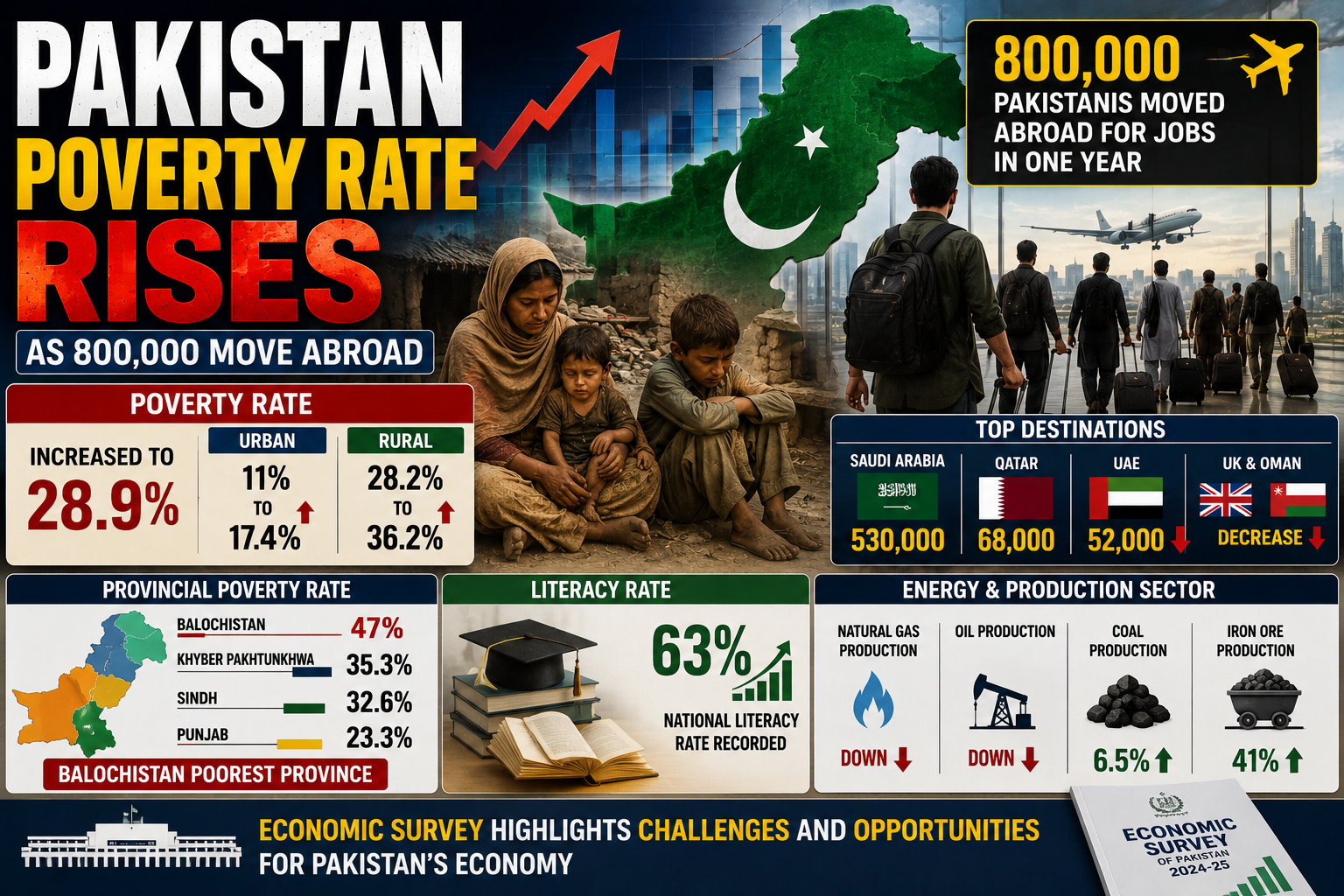
Pakistan Poverty Rate Rises while hundreds of thousands of citizens continue seeking employment opportunities overseas, according to figures presented in the latest Economic Survey of Pakistan.
The report, presented by Finance Minister Muhammad Aurangzeb in the National Assembly, highlights several economic and social trends, including an increase in poverty levels, migration for employment, literacy improvements, and mixed performance across key industrial sectors.
The findings have sparked debate among economists and policymakers, particularly as the government continues to emphasize economic stabilization and growth initiatives.
📉 Poverty Levels Increase Across Pakistan
One of the most notable findings in the economic survey is the rise in poverty levels nationwide.
According to the report, Pakistan’s poverty rate has reached 28.9 percent. The increase was recorded in both urban and rural areas, indicating that economic pressures have affected households across different regions of the country.
Urban poverty increased from 11 percent to 17.4 percent, while rural poverty rose from 28.2 percent to 36.2 percent.
The figures suggest that rising living costs, employment challenges, and economic uncertainty have continued to affect a significant segment of the population.
Economists note that poverty indicators are closely watched because they provide insight into household incomes, purchasing power, and overall living standards.
🌍 More Pakistanis Seek Jobs Overseas
The survey also revealed that a large number of Pakistanis continued to leave the country in search of employment opportunities.
During the previous fiscal year, approximately 800,000 citizens reportedly moved abroad for work.
Saudi Arabia remained the most popular destination for Pakistani workers, attracting around 530,000 individuals. The kingdom has long been a preferred destination due to its large labor market and demand for skilled and semi-skilled workers.
Meanwhile, approximately 68,000 Pakistanis traveled to Qatar for employment opportunities.
The number of people choosing the United Arab Emirates declined compared with previous years, with around 52,000 workers heading there during the reporting period.
Migration to the United Kingdom and Oman also reportedly decreased.
🏘️ Provincial Poverty Figures Paint Different Picture
The survey provided a provincial breakdown of poverty levels across Pakistan.
According to the data, Balochistan recorded the highest poverty rate in the country at 47 percent.
Khyber Pakhtunkhwa ranked second with a poverty rate of 35.3 percent, followed by Sindh at 32.6 percent.
Punjab recorded the lowest poverty rate among the four provinces at 23.3 percent.
The regional differences highlight the varying economic conditions across the country and the challenges faced by policymakers in addressing poverty at both national and provincial levels.
Development experts often point to infrastructure, education, employment opportunities, and investment levels as key factors influencing regional poverty rates.
📚 Literacy Rate Shows Continued Progress
Despite concerns surrounding poverty, the survey also reported progress in the education sector.
Pakistan’s literacy rate was recorded at 63 percent, reflecting ongoing efforts to improve access to education across the country.
Education remains one of the most important indicators of long-term economic development. Policymakers generally view improvements in literacy as essential for enhancing workforce skills, increasing productivity, and creating better employment opportunities.
While challenges remain, the latest figures suggest gradual advancement in educational outcomes.
Experts argue that sustained investment in education will play a crucial role in reducing poverty over the long term.
⚡ Mixed Results in Energy and Production Sectors
The economic survey also highlighted varying trends across the energy and industrial sectors.
Natural gas and oil production both recorded declines during the reporting period, reflecting ongoing challenges facing Pakistan’s energy industry.
However, some sectors showed positive performance.
Coal production increased by 6.5 percent, while iron ore production posted an exceptional increase of 41 percent. The rise in iron ore output was described as one of the strongest performances among industrial sectors during the year.
Industry observers view higher production levels as a positive sign for economic activity, particularly in sectors linked to manufacturing and infrastructure development.
📊 Economic Challenges Remain in Focus
The latest survey presents a mixed picture of Pakistan’s economy.
While improvements in literacy and growth in selected industrial sectors offer encouraging signs, rising poverty and continued migration for employment highlight ongoing economic challenges facing many households.
Analysts say the figures underscore the importance of policies focused on job creation, investment, education, and economic inclusion.
As policymakers review the findings, the survey is expected to play an important role in shaping future economic priorities and development strategies aimed at improving living standards and supporting long-term growth.