
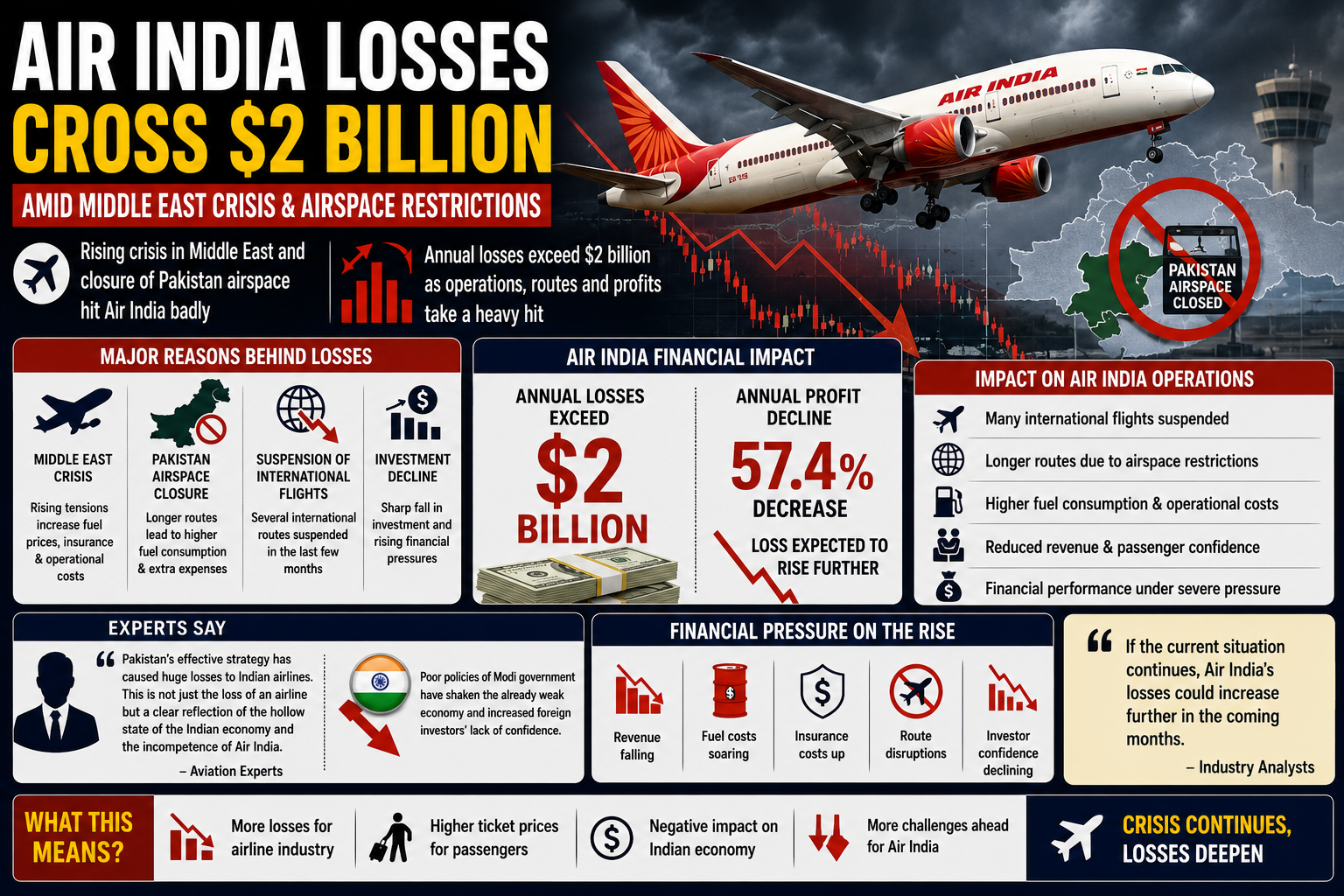
Air India losses have reportedly crossed the major $2 billion mark as ongoing Middle East tensions and restrictions linked to Pakistan’s airspace continue affecting the Indian aviation sector. According to reports, operational disruptions, reduced international routes, and rising aviation costs have increased financial pressure on the airline during recent months.
The latest developments have also renewed discussion regarding regional aviation challenges, international flight operations, and investor confidence in the Indian airline industry.
✈️ Middle East Crisis Impacts Aviation Sector
Reports stated that continued tensions in the Middle East have significantly affected regional air travel and airline operations.
According to international media coverage, disruptions connected to regional security concerns and altered flight routes increased operational costs for several airlines operating across Asia and the Gulf region.
Air India has reportedly faced additional challenges because of restrictions related to Pakistan’s airspace, forcing longer travel routes for some international flights.
💰 Air India Annual Losses Reportedly Exceed $2 Billion
According to reports cited from international media sources, Air India’s yearly losses have now crossed $2 billion.
The airline has reportedly struggled with higher fuel costs, route disruptions, operational adjustments, and reduced profitability during the ongoing regional crisis.
Analysts believe aviation companies operating on long-haul international routes remain particularly vulnerable to geopolitical instability and airspace restrictions.
📉 Profitability and Investment Decline Reported
Reports also indicated that Air India’s annual profit reportedly declined by nearly 57.4 percent.
According to analysts, concerns regarding operational efficiency and financial performance may continue affecting investor confidence in the airline sector.
The reports suggested that reduced investment activity and increasing operational costs added further pressure on the company’s financial outlook.
🌍 International Flights and Operations Affected
According to reports, Air India has suspended or reduced several international flight operations in recent months.
Industry observers say longer alternative flight paths due to regional restrictions can increase fuel consumption, maintenance expenses, and overall operational costs for airlines.
Global aviation markets continue monitoring developments in the Middle East because regional instability often directly affects international air travel networks.
🇵🇰 Pakistan Airspace Restrictions Remain Key Factor
Analysts stated that restrictions related to Pakistan’s airspace have become one of the major operational challenges affecting Indian carriers.
Longer routes and increased flying times reportedly placed additional pressure on airline schedules and fuel expenses.
Aviation experts noted that regional airspace access remains highly important for maintaining efficient international flight connectivity between South Asia, Europe, and the Middle East.
📊 Experts Highlight Wider Economic Concerns
Economic and aviation analysts believe the losses reflect broader financial pressures facing airlines during periods of geopolitical uncertainty.
Experts stated that rising fuel prices, security concerns, and reduced passenger confidence often create long-term challenges for airline profitability and market stability.
Some analysts also linked the situation to wider concerns regarding investor confidence and financial conditions within the aviation sector.
🛫 Aviation Industry Faces Ongoing Uncertainty
Global airline operators continue adjusting flight routes and operational strategies because of security developments across the Middle East.
Experts believe the aviation sector may continue facing uncertainty if geopolitical tensions remain unresolved in coming months.
Industry observers say stability in regional airspace and international relations will remain important for restoring confidence in global airline operations and investment activity.