
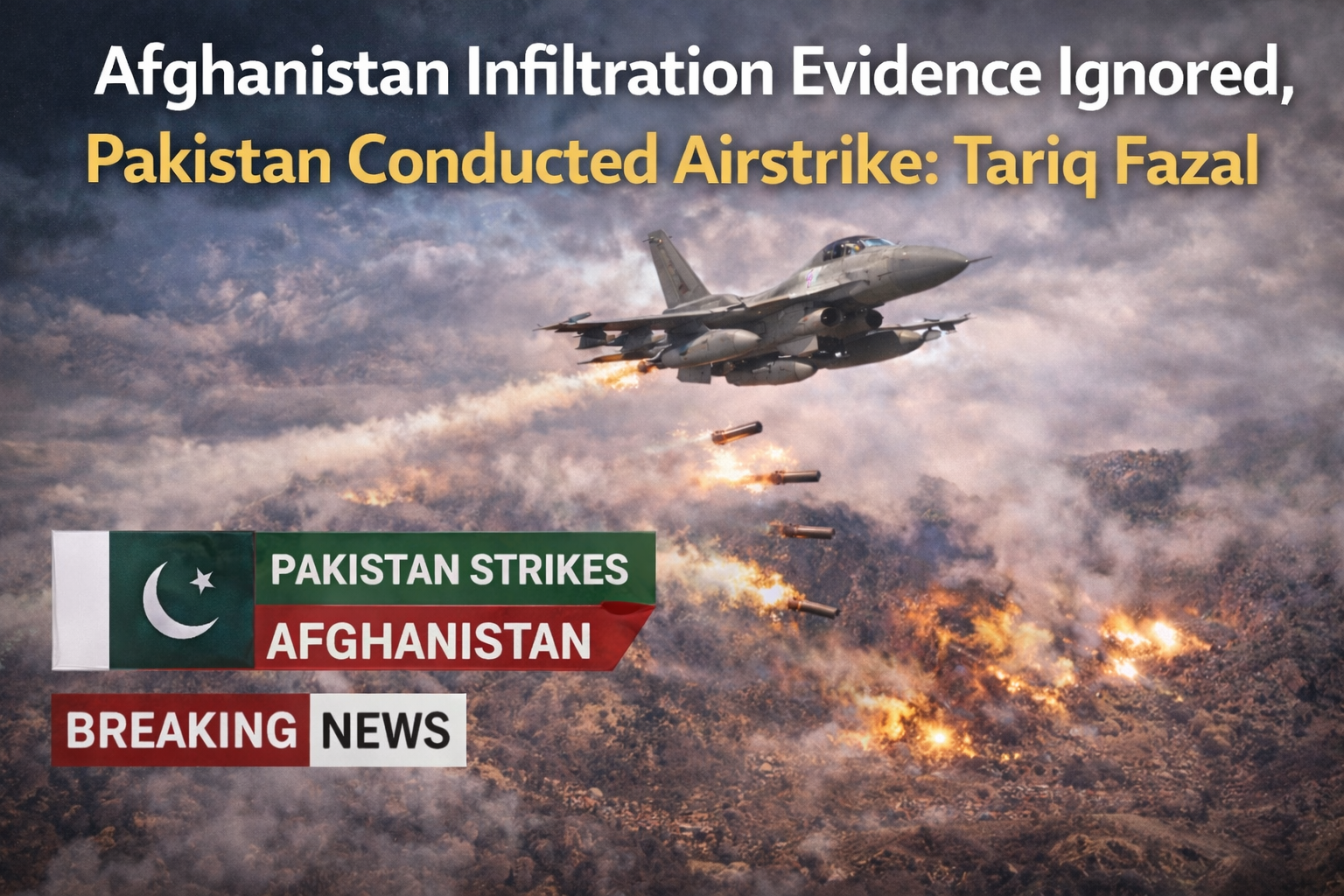
Afghanistan Infiltration Evidence Ignored, Pakistan Conducted Airstrike: Tariq Fazal as the federal government presented its official stance in the Senate regarding recent cross-border military operations. The statement follows heightened tensions along the Pakistan–Afghanistan border and renewed security concerns.
The remarks were delivered during a Senate session chaired by Yousaf Raza Gilani, where Federal Minister for Parliamentary Affairs Tariq Fazal Chaudhry outlined the government’s position on the air operations conducted inside Afghan territory.
Government Presents Official Position
Addressing lawmakers, Tariq Fazal Chaudhry stated that the recent airstrikes were intelligence-based operations targeting militant camps allegedly operating across the border.
He said the strikes were not sudden or reactionary but came after repeated diplomatic engagement and security briefings provided to Afghan authorities.
According to the minister, Pakistan had shared evidence of cross-border infiltration and identified locations allegedly used by militant groups.
Claims of Repeated Warnings to Kabul
The minister said Pakistan had presented multiple instances of alleged infiltration to the Afghan government during bilateral discussions.
He added that authorities had pointed out specific camps believed to be facilitating attacks inside Pakistan.
Chaudhry further claimed that during negotiations, Afghan officials acknowledged the presence of certain elements but proposed relocating camps across the border under financial arrangements — a proposal Islamabad did not accept.
He argued that without clear guarantees against further attacks, Pakistan could not rely solely on assurances.
Link to Recent Attacks
The minister connected recent incidents in areas including Tralai, Bannu, and Bajaur to alleged cross-border networks.
He stated that Pakistan possesses verified evidence linking militant activities to sanctuaries beyond its western border.
Chaudhry emphasized that the government could not remain passive in the face of continued attacks, asserting that national security measures would be taken when necessary.
Air Operations Described as Targeted
According to the statement, the air operations targeted militant camps in three Afghan provinces.
The government described the action as a counterterrorism measure aimed at preventing further infiltration rather than escalating tensions.
No independent verification of the targeted sites was immediately available.
Cross-Border Security Concerns
Security challenges along the Pakistan–Afghanistan border have persisted despite previous coordination efforts between the two countries.
Officials say cross-border movement and militant sanctuaries remain key points of contention.
Chaudhry reiterated that Pakistan had repeatedly urged Afghan authorities to prevent infiltration and dismantle militant infrastructure.
He stated that despite requests and evidence-sharing, no effective response had been observed from Kabul.
Broader National Security Implications
The minister noted that militant threats are not confined to border districts but have wider implications across Pakistan.
He maintained that protecting citizens remains the government’s foremost priority and that necessary steps would continue to be taken to safeguard national security.
Political observers say the situation underscores ongoing diplomatic strain between Islamabad and Kabul.
Call for Regional Stability
While defending the military action, Chaudhry said Pakistan seeks stability in the region and does not desire prolonged escalation.
He emphasized that diplomatic engagement remains important but must be accompanied by effective measures to prevent cross-border militancy.
As tensions remain elevated, further developments are expected in diplomatic and security channels in the coming weeks.