
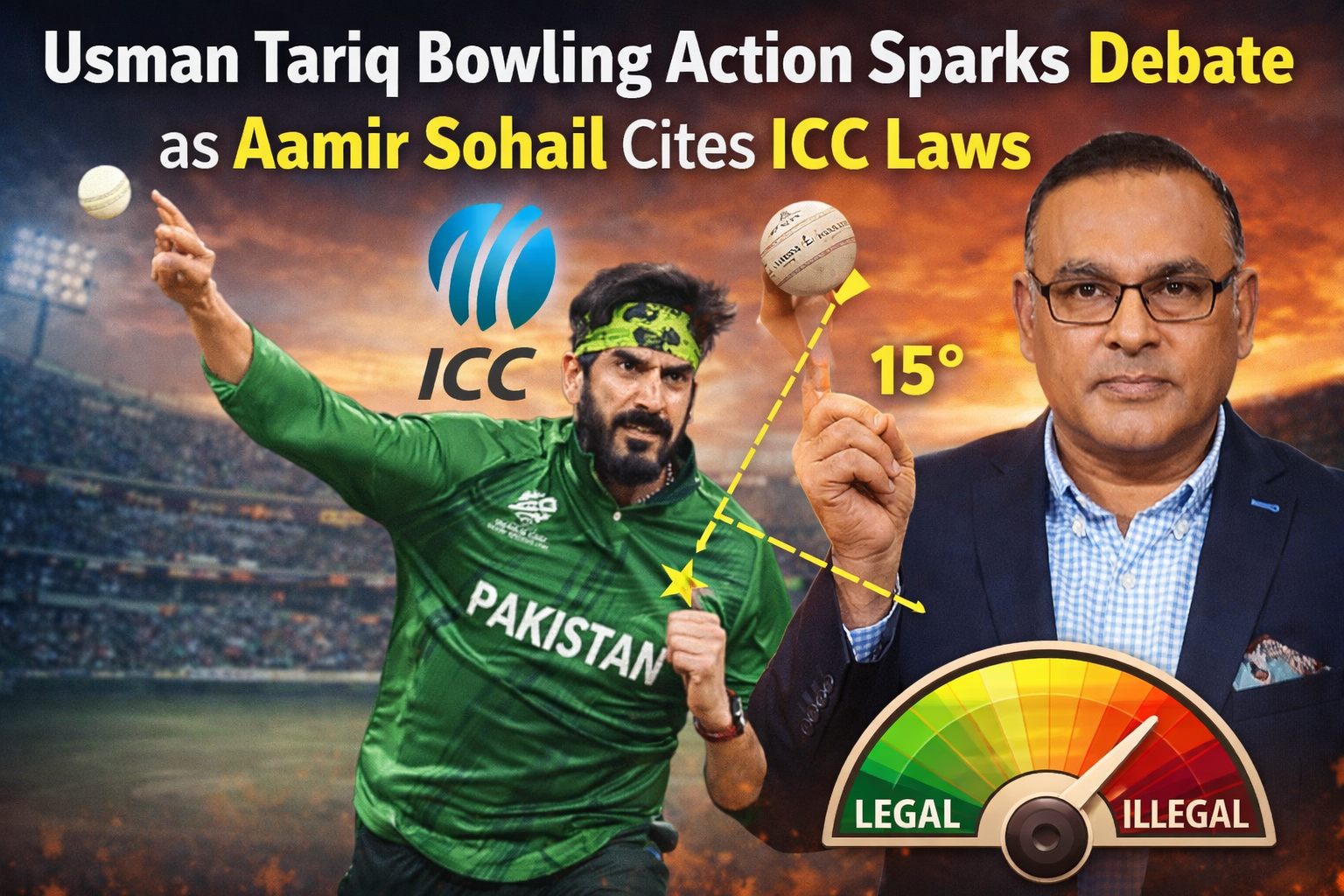
Usman Tariq Bowling Action Sparks Debate as Aamir Sohail Cites ICC Laws after discussions resurfaced around the Pakistani spinner’s unique delivery style during the ongoing T20 World Cup build-up. While opposition teams have reportedly raised concerns, former Pakistan captain Aamir Sohail has publicly defended the bowler, citing international regulations and biomechanical allowances.
Unique Action Draws Global Attention
Pakistani spinner Usman Tariq has quickly gained attention in international cricket due to his unconventional bowling action. His delivery involves a brief pause before releasing the ball — a variation that can disrupt a batter’s timing and shot preparation.
Cricket analysts say this split-second delay makes it harder for batters to pick line and length early, especially in high-pressure tournaments like the T20 World Cup where unfamiliar bowlers can hold a tactical advantage.
Previous ICC Clearances
Despite fresh debate, Usman Tariq’s bowling action has already undergone scrutiny in the past. The International Cricket Council (ICC) previously reviewed his action twice and declared it legal under established bowling regulations.
These clearances came after biomechanical testing, where elbow extension and arm movement are analyzed through motion tracking systems to determine legality.
However, with the World Cup spotlight intensifying, the action has once again become a talking point among rival teams and commentators.
Aamir Sohail Demonstrates ICC Rules
Addressing the controversy, former Pakistan captain Aamir Sohail defended the spinner during a televised sports discussion. Holding a cricket ball, he demonstrated bowling mechanics to explain how ICC rules apply to spin bowlers.
He noted that under ICC regulations, a bowler’s arm is permitted a certain degree of flex during delivery — commonly referred to as the 15-degree tolerance limit.
According to Sohail, this allowance exists because natural arm movement and biomechanical variation make a completely rigid arm unrealistic in professional bowling.
Explaining the 15-Degree Law
Sohail elaborated that if a bowler’s arm bends excessively to generate unfair speed or advantage, it could be categorized as an illegal action.
However, he clarified that slight flex — particularly during spin deliveries like leg-breaks or googlies — falls within permissible limits.
He explained that in Usman Tariq’s case, the arm may show minimal bend during release, but it straightens afterward — a motion considered legal under ICC biomechanical frameworks.
Spin Bowling Mechanics in Focus
The former captain added that many international spin bowlers display similar arm flex during deliveries. Such movement is often necessary to impart revolutions on the ball, which generate turn and deception.
Based on his observation, Sohail stated that Usman Tariq’s action aligns with ICC guidelines and does not warrant disciplinary action.
He further remarked that occasional mixed deliveries — where arm position slightly varies — are common even among elite bowlers worldwide.
Claims of Opposition Pressure
Sohail suggested that criticism surrounding the spinner’s action may stem from tactical concerns rather than regulatory violations.
He argued that opposition teams might be unsettled by the difficulty of facing an unfamiliar bowling style in a major tournament environment.
According to him, the effectiveness of Tariq’s variations — particularly his pause before release — could be contributing to the scrutiny.
Debate Likely to Continue
While ICC has previously cleared the action, discussions around bowling legality often resurface when bowlers gain sudden prominence on global stages.
For now, no fresh review has been officially announced, and the spinner remains eligible to compete under existing clearances.
Cricket experts believe that unless formal complaints lead to new biomechanical testing, the debate will remain largely opinion-driven.