
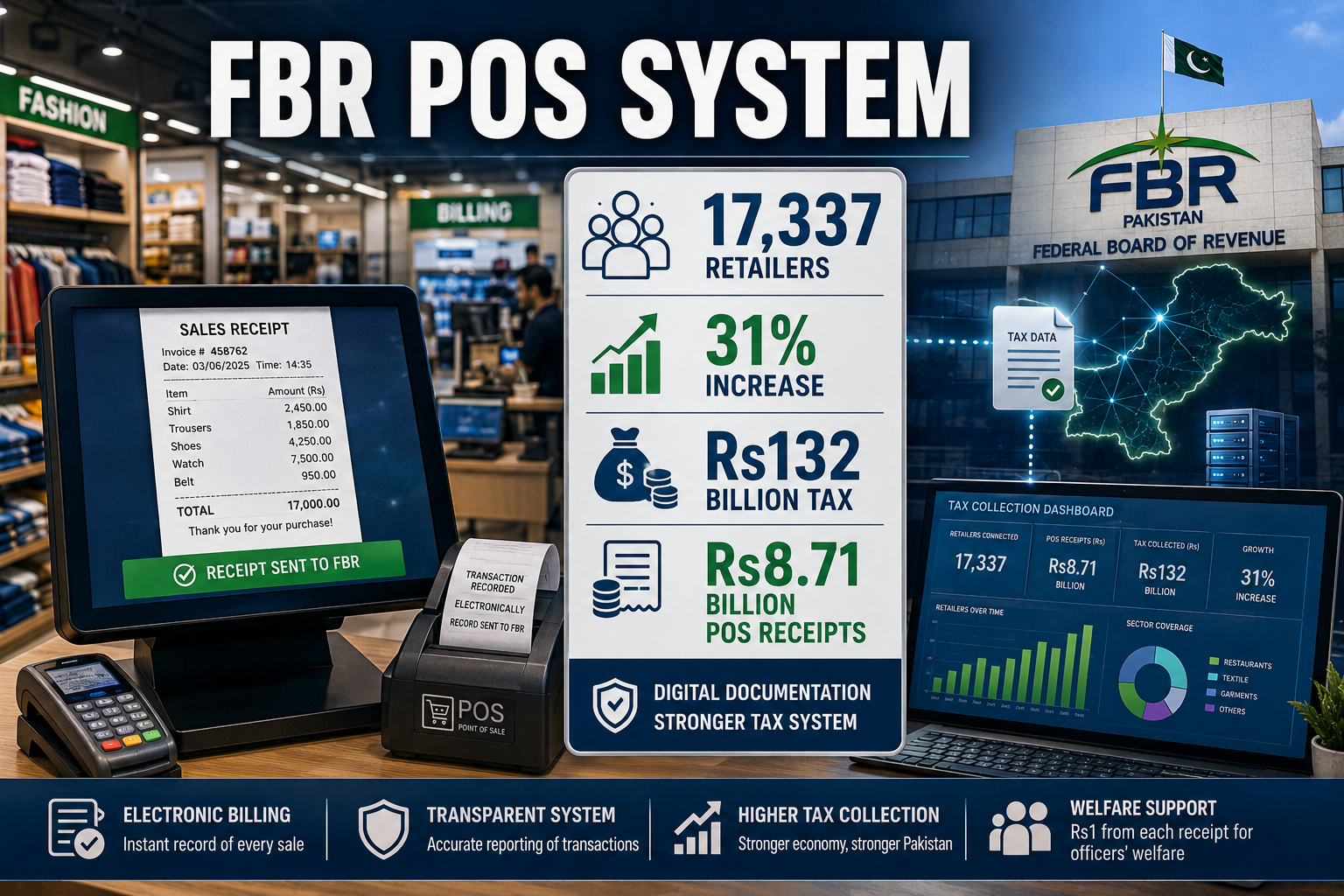
FBR POS System expanded significantly during the last financial year as the government’s campaign to bring large retailers into the tax system gained momentum. According to Federal Board of Revenue (FBR) data, the number of large retailers connected to the Point of Sale (POS) system reached 17,337 during the financial year 2025-26.
The number increased by 4,124 in one year, representing growth of about 31 percent. The expansion also coincided with higher collections from retailers connected to the electronic system.
🏪 FBR POS System Expands Retailer Network
The FBR’s data shows that the number of large retailers connected to the POS system increased substantially during fiscal year 2025-26.
There were 4,124 more retailers connected to the system compared with the previous financial year. This represents an increase of approximately 31 percent and takes the total number of connected large retailers to 17,337.
The scheme for connecting large retailers with the POS system was introduced in December 2019. Under the system, sales made by participating businesses are recorded electronically, allowing the tax authority to receive transaction information.
The expansion is part of the government’s wider effort to bring major retailers into the formal tax system and improve documentation of retail transactions.
💰 FBR Collects Rs8.71 Billion From POS Receipts
The increase in the POS network was accompanied by higher collections for the tax authority.
According to official figures, the FBR received Rs8.71 billion from POS receipts during the last financial year. This was around 17 percent higher than the amount collected during the previous financial year.
Under the POS arrangement, the FBR receives one rupee from every purchase receipt issued through the system. According to tax officials, this amount is used for the welfare of FBR officers.
The receipt-based collection is separate from the tax collected from retailers and represents an additional amount generated through transactions processed through the electronic system.
🧾 Electronic Billing Records Sales
The POS system electronically generates a bill when a customer makes a purchase at a shop or business establishment. A copy of the transaction is simultaneously received by the FBR.
This arrangement creates an electronic record of sales at the time the transaction takes place. As a result, it becomes more difficult for a business to later report a lower volume of sales because transaction information has already been received by the tax authority.
The electronic record is intended to improve documentation of retail activity and provide the FBR with direct information about transactions taking place at connected businesses.
According to tax authorities, the increase in retailers linked with the FBR POS System has also contributed to a significant rise in tax collected from these businesses.
📈 Retailers Pay Rs132 Billion in Tax
Large retailers connected to the system paid Rs132 billion in taxes during the last financial year, according to official figures.
Tax officials said the increase in the number of retailers connected to the POS network was accompanied by a significant increase in tax collection from these businesses.
The government has been focusing on expanding electronic documentation in the retail sector. Restaurants, textile businesses and garment shops are among the areas receiving particular attention from the FBR.
Officials say bringing more businesses into electronic billing can improve the recording of sales and help determine tax obligations on the basis of documented transactions.
🏛️ Withholding Tax Rules Expand POS Coverage
According to tax officials, changes in the new withholding tax limits under Sections 236G and 236H of the Income Tax Ordinance have also contributed to the expansion of the POS network.
These changes have helped increase the scope of businesses connected to the system. The FBR is particularly focusing on businesses operating in sectors such as restaurants, textiles and garments.
However, a large number of service providers remain outside the tax network.
The authorities’ efforts are therefore not limited to traditional retail businesses. The tax department is also seeking greater documentation of transactions and income among businesses providing professional and other services.
⚠️ Small Trader Scheme Raises Questions
At the same time, a new government scheme for small traders has raised questions about the digital documentation of the retail sector.
Under the new scheme, small traders have been given room for annual sales of up to Rs200 million under the relevant arrangement. The scheme provides for a tax rate of one percent on their annual sales.
The new framework has prompted questions about how smaller businesses will be documented compared with retailers connected to electronic billing systems.
The issue is particularly relevant because the POS system provides the FBR with transaction records electronically, while the new arrangement provides a separate tax mechanism for small traders.
👨⚕️ Service Providers Remain Outside Tax Net
Tax authorities say a significant number of service providers are still outside the formal tax network.
According to FBR officials, doctors and other professionals providing services are not generally willing to disclose their actual income and transactions. Officials also say clinics and hospitals have resisted being connected to electronic billing systems.
The FBR maintains that electronic billing is a uniform standard and is not intended to target any particular profession.
Officials say the objective is to improve documentation and ensure that businesses operating in different sectors are properly included in the tax system.
📊 FBR Focuses on Digital Tax Documentation
The growth of the FBR POS System reflects the government’s continued effort to document retail transactions electronically.
Officials say connecting more retailers to the system has already contributed to higher tax collection from those businesses. The network now covers 17,337 large retailers, following an increase of 4,124 during the 2025-26 financial year.
At the same time, the authorities face the challenge of extending digital documentation beyond large retailers. Service providers, including professionals and businesses operating clinics and hospitals, remain an area where tax officials say further integration is needed.
The FBR says electronic billing is intended to establish a common standard for recording transactions rather than target specific professions or business categories.
The government’s retail tax campaign therefore combines expansion of electronic billing with measures aimed at increasing documentation and tax collection. The latest figures show that the FBR POS System has expanded considerably, while retailers connected to the network generated Rs132 billion in tax during the last financial year.