
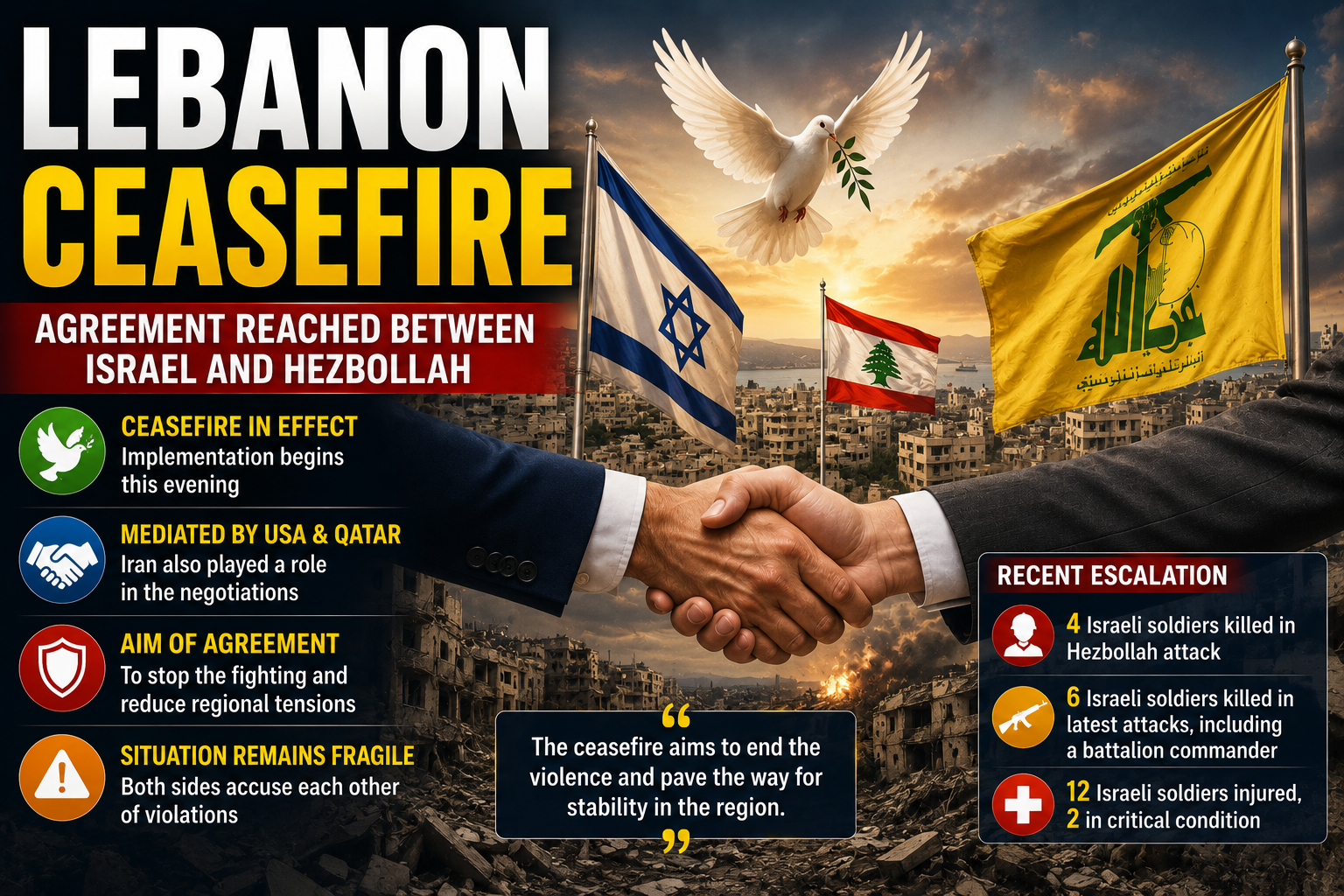
Lebanon Ceasefire has officially come into effect after Israel and Hezbollah reportedly agreed to halt hostilities following hours of intense fighting and rising casualties.
The development marks a significant diplomatic breakthrough amid ongoing tensions in the Middle East. According to multiple international media reports, the ceasefire began during the evening hours after negotiations involving regional and international mediators.
The agreement is being closely watched by governments and international observers who hope it could help reduce violence and prevent a wider regional escalation.
🕊️ Ceasefire Comes Into Effect
According to reports, Hezbollah confirmed that implementation of the ceasefire agreement with Israel began following official notification from mediators.
Sources familiar with the negotiations stated that both sides were informed of the agreement before its scheduled activation time, allowing preparations for implementation.
The ceasefire follows a period of intense military exchanges that resulted in casualties and increased concerns about regional stability.
Observers say the coming days will be critical in determining whether the agreement can hold and create conditions for broader diplomatic efforts.
🤝 Mediation Efforts Played Key Role
International reports indicate that the ceasefire was achieved through extensive diplomatic engagement involving multiple parties.
The United States and Qatar were reportedly among the key mediators involved in facilitating discussions between the parties. Reports also suggested that Iran played a role in supporting efforts aimed at advancing negotiations.
Diplomatic observers note that mediation remains one of the most important tools for reducing tensions during periods of conflict.
The involvement of regional and international stakeholders reflects the wider significance of developments in Lebanon and their potential impact on Middle Eastern stability.
🌍 International Community Welcomes Development
The ceasefire announcement has attracted significant international attention.
Several global media organizations reported that the agreement is intended to reduce violence, improve security conditions, and create space for diplomatic engagement.
Analysts say reducing hostilities could help prevent further civilian suffering and lower the risk of a broader regional confrontation.
International organizations and governments have repeatedly called for restraint and emphasized the importance of dialogue as a means of resolving disputes.
The latest agreement is therefore being viewed as an important step toward de-escalation.
⚠️ Concerns Remain Over Future Stability
Despite the agreement, reports indicate that concerns remain regarding its long-term durability.
Some sources have suggested that both sides have previously exchanged accusations regarding alleged violations during earlier periods of reduced hostilities.
Political analysts warn that ceasefires often face challenges during their initial implementation phase, particularly when tensions remain high.
As a result, observers are closely monitoring developments on the ground to assess whether both parties continue adhering to the terms of the agreement.
The success of the ceasefire may depend largely on sustained diplomatic engagement and effective communication mechanisms.
🚀 Escalation Preceded the Agreement
The ceasefire follows a period of heightened military activity between Israel and Hezbollah.
Reports indicated that recent clashes resulted in casualties on both sides, contributing to growing international concern over the possibility of a wider conflict.
The latest escalation increased pressure on diplomatic channels to find a solution capable of preventing further violence.
Security experts note that developments in southern Lebanon are often viewed as highly sensitive because of their broader implications for regional stability.
This context helps explain the international focus on the ceasefire agreement.
📈 Region Watches Next Steps Closely
Attention is now shifting toward implementation and monitoring of the ceasefire.
Governments, international organizations, and regional stakeholders will likely continue assessing whether the agreement contributes to a reduction in tensions.
Many observers believe the ceasefire could create an opportunity for further diplomatic discussions aimed at addressing broader security concerns.
However, analysts caution that maintaining stability will require continued commitment from all parties involved.
For now, the agreement represents an important attempt to halt hostilities and reduce uncertainty in a region that remains central to global political and security discussions.