
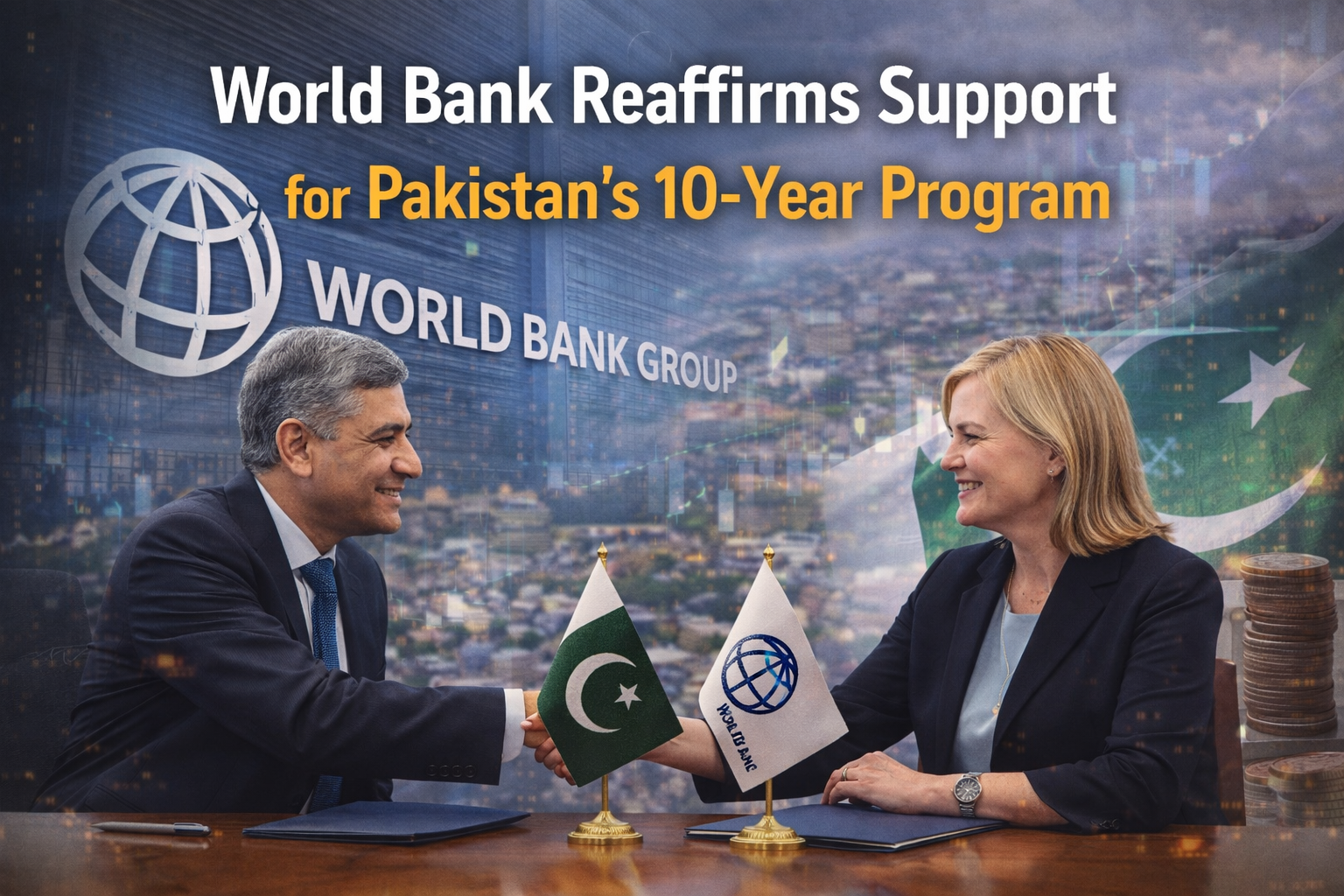
World Bank reaffirms support for Pakistan’s 10-year program as global financial cooperation discussions continue around long-term development priorities, economic reforms, and sectoral investments aimed at strengthening Pakistan’s growth trajectory.
High-Level Meeting at AlUla Conference
The reaffirmation came during a meeting between Pakistan’s Federal Finance Minister Muhammad Aurangzeb and Anna Bjerde, Managing Director of the World Bank.
The meeting took place on the sidelines of the annual AlUla Conference for Emerging Market Economies held in Saudi Arabia, where policymakers and financial leaders gathered to discuss economic challenges and opportunities facing developing nations.
Focus on Development Partnership Framework
During the discussions, both sides reviewed progress under the Country Partnership Framework — the World Bank’s strategic cooperation plan with Pakistan.
Talks centered on aligning financial assistance with Pakistan’s national development priorities, ensuring targeted investment across sectors critical to long-term economic sustainability.
Officials emphasized that structured partnerships remain essential for driving institutional reforms, infrastructure development, and social sector improvements.
Key Sectors Identified for Cooperation
The dialogue covered multiple priority sectors where collaboration is expected to expand, including:
-
Energy sector reforms and sustainability
-
Education system strengthening
-
Healthcare infrastructure development
-
Climate change mitigation and adaptation
-
Financial and fiscal reforms
These sectors form the backbone of Pakistan’s medium-to-long-term economic planning, particularly in addressing structural challenges and service delivery gaps.
$20 Billion Long-Term Development Commitment
Anna Bjerde reiterated the World Bank’s full support for Pakistan’s $20 billion, 10-year development financing program.
She highlighted that the initiative is designed to accelerate socio-economic progress while supporting macroeconomic stability. The program aims to fund projects that enhance human capital, infrastructure resilience, and environmental sustainability.
Bjerde stressed that timely and effective implementation will be critical to maximizing the program’s development impact.
Pakistan Pledges Institutional Cooperation
Finance Minister Muhammad Aurangzeb reaffirmed Pakistan’s commitment to maintaining close coordination with the World Bank.
He assured that all relevant federal ministries would extend full institutional support to ensure smooth execution of development initiatives.
Aurangzeb also underscored the importance of policy continuity and governance reforms in strengthening investor confidence and multilateral partnerships.
Provincial Role Deemed Essential
The finance minister noted that provincial governments would play a central role in program execution, particularly in sectors such as education, healthcare, and local infrastructure.
He emphasized that improved inter-governmental coordination would be necessary to ensure projects are delivered on time and aligned with regional development needs.
Development experts say provincial participation is critical because service delivery and project implementation often fall under sub-national jurisdictions.
Broader Economic Context
The reaffirmation of World Bank support comes as Pakistan navigates economic stabilization following fiscal tightening and structural reforms.
International financial backing is viewed as essential for sustaining reform momentum, strengthening public finances, and funding climate resilience and social protection programs.
Analysts note that long-term concessional financing programs help reduce fiscal pressure while enabling governments to invest in growth-enhancing sectors.
Outlook for Development Cooperation
With the 10-year financing framework in place, Pakistan and the World Bank are expected to deepen collaboration through policy support, technical assistance, and investment programs.
Officials say successful execution could improve economic productivity, expand public services, and enhance climate resilience — key pillars for sustainable development in the coming decade.