
Sindh Revenue Board Records Tax Growth in Feb 2026
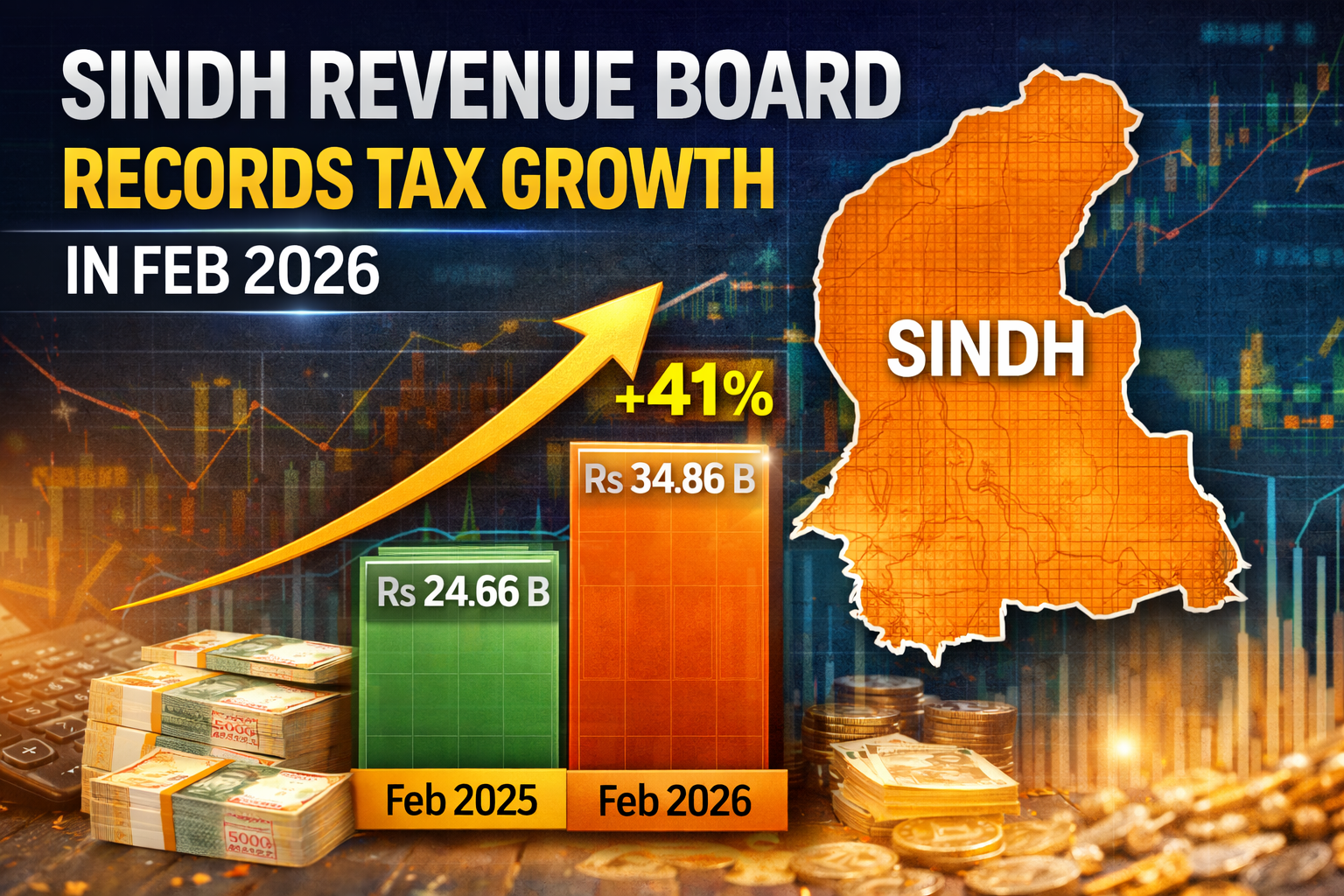
Sindh Revenue Board Records Tax Growth in Feb 2026 as provincial tax authorities reported a significant increase in revenue collection compared with the same period last year. The performance review meeting, chaired by Sindh Chief Minister Syed Murad Ali Shah, highlighted improvements in tax enforcement, digital monitoring systems, and sectoral contributions that helped boost provincial revenues.
Senior officials including Chief Secretary Asif Hyder Shah, Finance Secretary Fayaz Jatoi, and SRB Chairman Wasif Memon attended the meeting where detailed figures regarding tax collections were presented.
Revenue Collection Shows Strong Annual Growth
According to the briefing presented during the meeting, the Sindh Revenue Board (SRB) collected Rs34.86 billion in February 2026, representing a 41 percent increase compared with Rs24.664 billion collected in February 2025.
Officials also reported that after extensive recovery efforts, outstanding tax liabilities worth Rs9.5 billion were successfully recovered during the period.
The growth in revenue collection was attributed to improved compliance monitoring, expanded tax enforcement operations, and stronger digital tax systems.
Total Revenue for Fiscal Year Shows Significant Increase
The briefing further revealed that total revenue collection from July to February reached approximately Rs225.653 billion, compared with Rs182.605 billion during the same period last year.
This represents an overall 24 percent increase in revenue during the current fiscal year so far.
Officials said the consistent rise in tax collection reflects expanding economic activity in the services sector and stronger tax administration practices.
Long-Term Growth Since Establishment of SRB
The meeting also reviewed long-term growth in provincial tax revenues since the establishment of the Sindh Revenue Board.
In the 2011–12 fiscal year, provincial tax revenue stood at around Rs25 billion. By 2024–25, the figure had grown to approximately Rs306.6 billion, marking a significant increase in provincial fiscal capacity.
Officials noted that revenue collections first crossed the Rs100 billion mark in fiscal year 2017–18, and have continued to rise steadily since then.
The Sindh Sales Tax on Services accounted for Rs284.4 billion of the total revenue, reflecting the expanding contribution of the services sector to the provincial economy.
Key Sectors Contributing to Revenue
Several sectors played a major role in generating tax revenue for the Sindh government.
According to the briefing:
-
Port, airport, and terminal operators contributed around Rs40.2 billion.
-
Telecommunications sector generated approximately Rs24.2 billion.
-
Banking sector contributed Rs20.34 billion.
-
Franchise services produced Rs17.53 billion in revenue.
-
Insurance sector added Rs14.56 billion.
Together, the top ten sectors contributed about Rs155.6 billion in revenue collections.
Meanwhile, more than 27 service sectors each generated over Rs1 billion in tax contributions.
Strong Growth in Emerging Sectors
The briefing also highlighted strong growth in several emerging sectors.
Revenue from IT and software consultancy services increased by 49 percent, while goods transportation services recorded a 50 percent increase.
Similarly, the engineering consultancy sector saw a 44 percent rise in tax revenue.
For the first time, the funds and asset management sector entered the list of major taxpayers, contributing Rs5.76 billion, reflecting an increase of 162 percent.
Digital Systems Improve Tax Monitoring
Officials informed the meeting that improved tax collection was supported by digital financial management systems including FABS (Financial Accounting and Budgeting System) and SAP-based monitoring platforms.
Revenue collected through withholding agents reached Rs48.42 billion, compared with Rs37.43 billion during the previous year.
Additionally, Sindh Workers Welfare Fund collections reached Rs22.25 billion, exceeding targets with 55 percent growth.
SRB has also established new intelligence, investigation, and prosecution wings, along with a Special Enforcement Unit to combat tax fraud and fake invoicing.
Chief Minister Praises Revenue Performance
Chief Minister Murad Ali Shah expressed satisfaction over the improved tax performance, calling the achievement of Rs300 billion in annual revenue an important milestone for the province.
He stated that improved governance, transparency, and institutional reforms played a key role in strengthening provincial finances.
The chief minister also emphasized the need to expand the tax net by bringing undocumented service providers into the system while ensuring that tax reforms do not place excessive burden on existing taxpayers.