
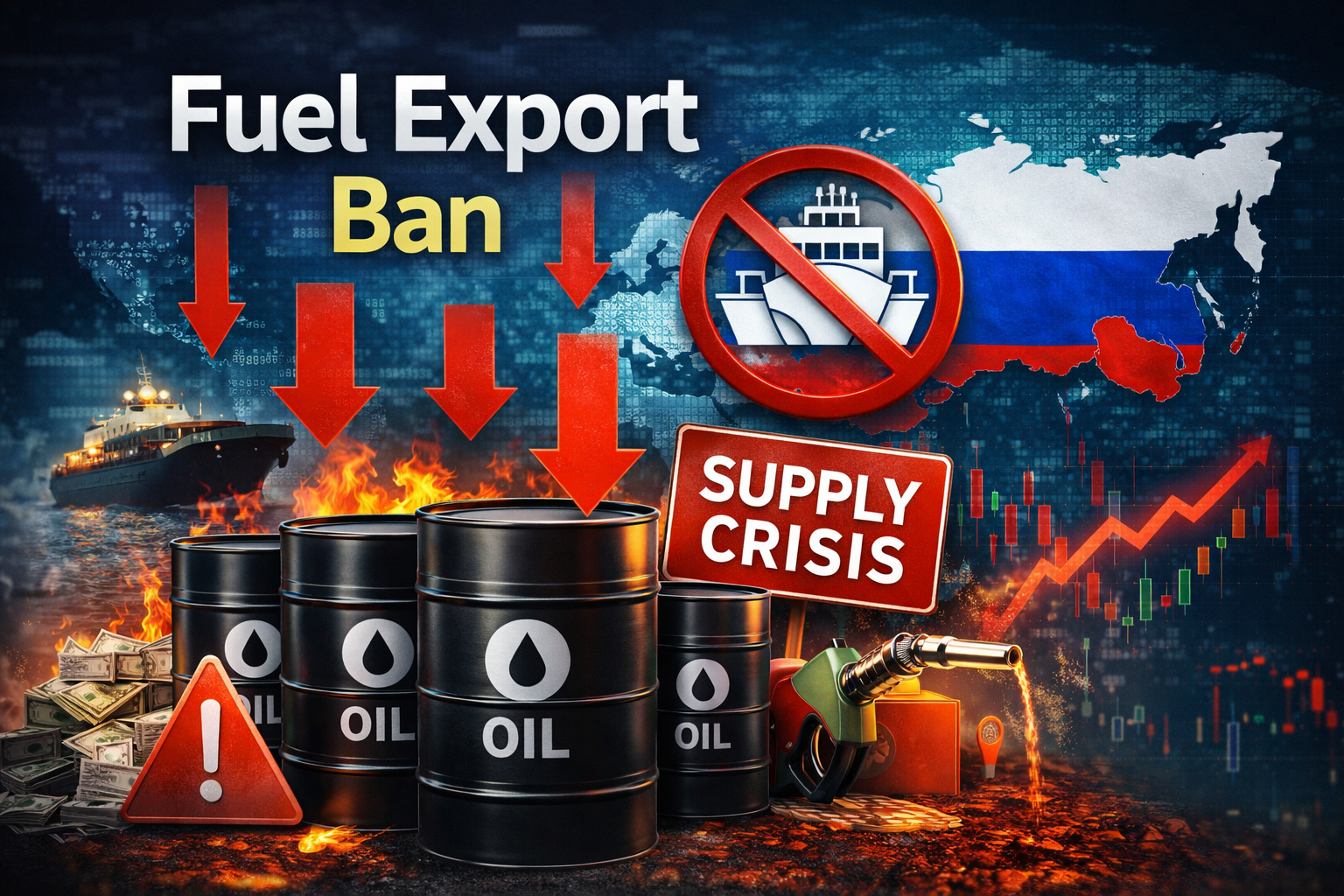
Russia fuel export ban triggers global supply concerns, as the country moves to halt petrol exports for several months amid rising volatility in global energy markets.
⛽ Russia Announces Export Ban
Russia has announced a temporary ban on petrol exports, which will remain in effect from April 1 to July 31. The decision has been taken to stabilize domestic fuel supply and control prices within the country.
According to reports, the directive was issued under the supervision of Deputy Prime Minister Alexander Novak, who instructed the Ministry of Energy to finalize the export restriction plan.
📊 Reason Behind the Decision
Russian authorities stated that the primary objective of this move is to ensure adequate domestic availability of petroleum products. Officials emphasized that maintaining internal supply and price stability is a priority amid current global uncertainties.
The ongoing tensions in the Middle East, particularly involving Israel and Iran, have contributed to increased volatility in global oil and fuel markets. This has led to fluctuations in prices, prompting precautionary measures by major producers like Russia.
🌍 Impact on Global Markets
Russia is a significant exporter of refined petroleum products, including petrol. The country exports approximately 120,000 to 170,000 barrels of petrol per day. The temporary suspension of these exports is expected to impact global supply chains.
Countries that rely heavily on Russian fuel exports are likely to feel the effects more strongly. These include China, Türkiye, Brazil, several African nations, and Singapore, all of which import substantial quantities of Russian petroleum products.
📉 Countries Likely to Be Affected
The export ban could lead to supply shortages or price adjustments in countries dependent on Russian petrol. Markets in Asia, Africa, and parts of South America may experience fluctuations as supply dynamics change.
However, India is expected to face minimal impact from this decision. This is because India primarily imports crude oil rather than refined petrol, allowing it to maintain relative stability in its fuel supply.
🛢️ Domestic Supply in Russia
Russian officials have assured that domestic fuel reserves are sufficient. Authorities confirmed that petrol and diesel stocks are available in large quantities and that refineries are operating at full or even above capacity.
Oil companies have also verified that current production levels are adequate to meet domestic demand during the export restriction period.
⚖️ Previous Export Restrictions
This is not the first time Russia has imposed restrictions on petrol exports. Similar measures have been implemented in the past to address domestic supply concerns and stabilize prices.
Such decisions are often influenced by internal market conditions as well as external factors affecting global energy markets.
📈 Market Reaction and Outlook
The announcement is expected to influence global fuel prices and supply patterns in the coming months. As one of the key players in the energy market, Russia’s policy decisions can have wide-ranging effects on international trade and pricing.
Market analysts are likely to monitor developments closely, especially in regions dependent on Russian exports.
🔍 Broader Energy Implications
The export ban highlights ongoing challenges in global energy markets, where geopolitical tensions and supply disruptions continue to play a significant role.
Countries may explore alternative suppliers or adjust their import strategies to manage potential shortages. The situation underscores the importance of stable supply chains in the global energy sector.