
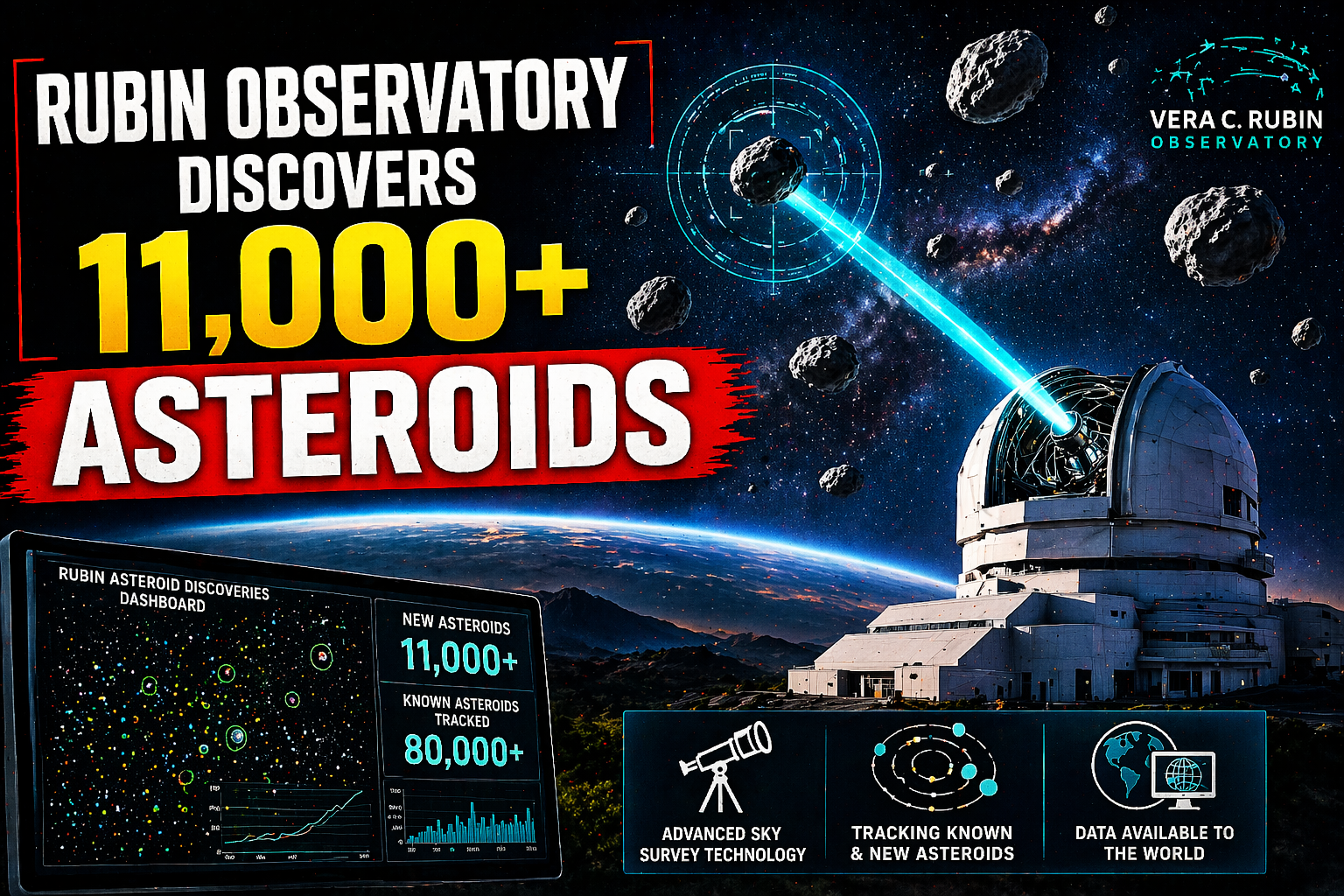
Rubin Observatory discovers 11000 asteroids in a major update, marking one of the largest space discoveries in recent times as scientists continue analyzing newly collected data.
📌 Major Discovery Announced
Scientists at the Vera C. Rubin Observatory have announced the discovery of more than 11,000 new asteroids. This milestone represents one of the largest single batches of asteroid detections recorded so far.
The discovery comes as part of ongoing observation work carried out by the facility, which became operational recently and has already started producing significant results.
🔭 Additional Tracking of Known Asteroids
Along with the newly discovered objects, the observatory has also re-recorded over 80,000 previously known asteroids.
Some of these asteroids had earlier been observed but were later considered “lost” due to unclear orbital paths. The new observations have helped scientists refine their trajectories and confirm their positions.
This process improves the accuracy of asteroid tracking and contributes to long-term space monitoring.
📊 Data Still Under Analysis
Experts have indicated that the full dataset collected by the observatory has not yet been completely analyzed.
Despite this, the early findings already demonstrate the scale and capability of the observatory’s systems. Scientists expect further discoveries as more data is processed in the coming months.
The ongoing analysis suggests that the number of identified objects could increase significantly.
⚙️ Advanced Observation Technology
The observatory uses advanced sky survey technology designed to scan large portions of space quickly and repeatedly.
This allows it to detect moving objects such as asteroids with higher precision and speed compared to earlier systems.
The technology plays a key role in identifying both new and previously untracked celestial bodies.
🌌 Early Results Within Short Timeframe
One notable aspect of this achievement is the short time in which these discoveries have been made. The observatory has not yet completed a full year of formal operations.
Despite this limited timeframe, it has already produced a substantial volume of scientific data, highlighting its operational efficiency.
The early success indicates strong potential for future discoveries.
🛰️ Public Access to Discovery Data
Details about the discovered asteroids are being made available through official platforms, including the Rubin Orbit Viewer and asteroid discovery dashboards.
These tools allow researchers and the public to explore data related to asteroid positions, movement, and classification.
The availability of this information supports transparency and collaboration within the scientific community.
🌍 Expanding Understanding of Space
The findings contribute to a broader understanding of objects within the solar system. Tracking asteroids is important for studying space environments and identifying potential risks.
The increasing number of discoveries reflects improvements in observation capabilities and data processing techniques.
Scientists continue to analyze the data to gain further insights into the structure and behavior of celestial objects.