
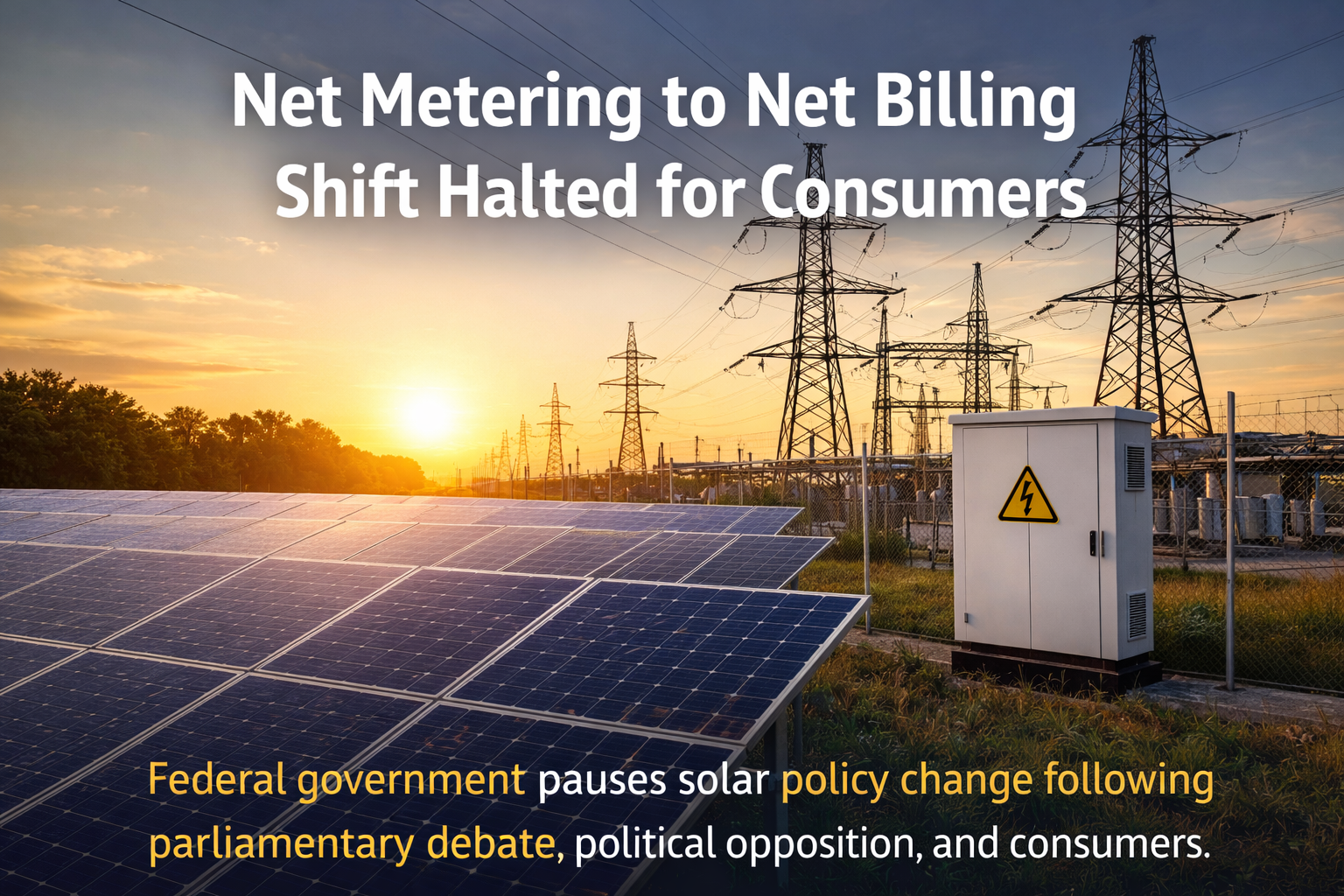
Net metering to net billing shift halted for consumers as the federal government pauses implementation of the proposed policy change following parliamentary debate, political opposition, and public concern over its impact on solar users.
National Assembly Takes Up Solar Policy Issue
The issue surfaced during a session of the National Assembly of Pakistan, presided over by Deputy Speaker Syed Ghulam Mustafa Shah.
A calling attention notice regarding the government’s decision to convert solar net metering into net billing was formally presented by members of the Pakistan Peoples Party.
Shortly after the session began, lawmaker Iqbal Afridi pointed out the lack of quorum, prompting the deputy speaker to suspend proceedings temporarily until quorum was completed.
Assembly Proceedings Resume After Quorum
Once quorum requirements were met, the session resumed. During the question hour, lawmakers raised concerns related to electricity supply issues, including load-shedding on K-Electric feeders.
The matter triggered protests by Muttahida Qaumi Movement members, after which the parliamentary secretary assured the house that detailed responses would be provided in the next session.
Government Explains Status of Net Billing Proposal
Federal Minister Awais Leghari addressed the assembly to clarify the government’s position on the solar policy.
He said the proposal to shift from net metering to net billing had been under intense discussion in recent days across parliament, traditional media, and social media platforms.
According to the minister, although the Economic Coordination Committee had approved a summary related to the policy, it was never ratified by the federal cabinet.
On the instructions of Prime Minister Shehbaz Sharif, the government decided to halt implementation and review the decision.
Background of the Solar Net Metering Policy
Awais Leghari explained that the net metering framework was originally introduced in 2017, during his previous tenure as a federal minister.
Since then, National Electric Power Regulatory Authority has made four to five regulatory adjustments to the policy.
He acknowledged that some of those changes were criticized as being unfavorable to solar adoption, triggering resistance from consumers and lawmakers alike.
Political and Public Opposition
The minister admitted that opposition to the proposed shift came not only from opposition parties but also from within the ruling coalition.
Members of parliament argued that the move could undermine the solar policy and negatively affect ordinary electricity consumers who invested heavily in rooftop solar systems under the existing net metering framework.
As a result, the government opted to pause implementation rather than proceed amid widespread resistance.
Current Scale of Solar Usage in Pakistan
Providing data to the assembly, Awais Leghari said Pakistan’s total installed solar capacity currently stands between 20,000 and 22,000 megawatts.
Out of this:
-
Around 7,000 MW is connected through the net metering system
-
Approximately 2,200 MW comes from industrial, commercial, and domestic net-metered users
-
About 4,800 MW represents installed solar panels outside the net metering framework
He clarified that 12,000 to 14,000 MW of solar users are not affected by the proposed policy change.
Number of Affected Consumers
The minister stated that around 600,000 to 700,000 electricity consumers across Pakistan are currently enrolled in the net metering system.
These consumers would have been directly impacted by any immediate transition to net billing, which calculates exported solar power differently than net metering.
Policy Review to Continue
Officials indicated that further consultations will be held before any final decision is made.
The government emphasized that stakeholder input, parliamentary consensus, and consumer protection would remain central to the policy review process.