
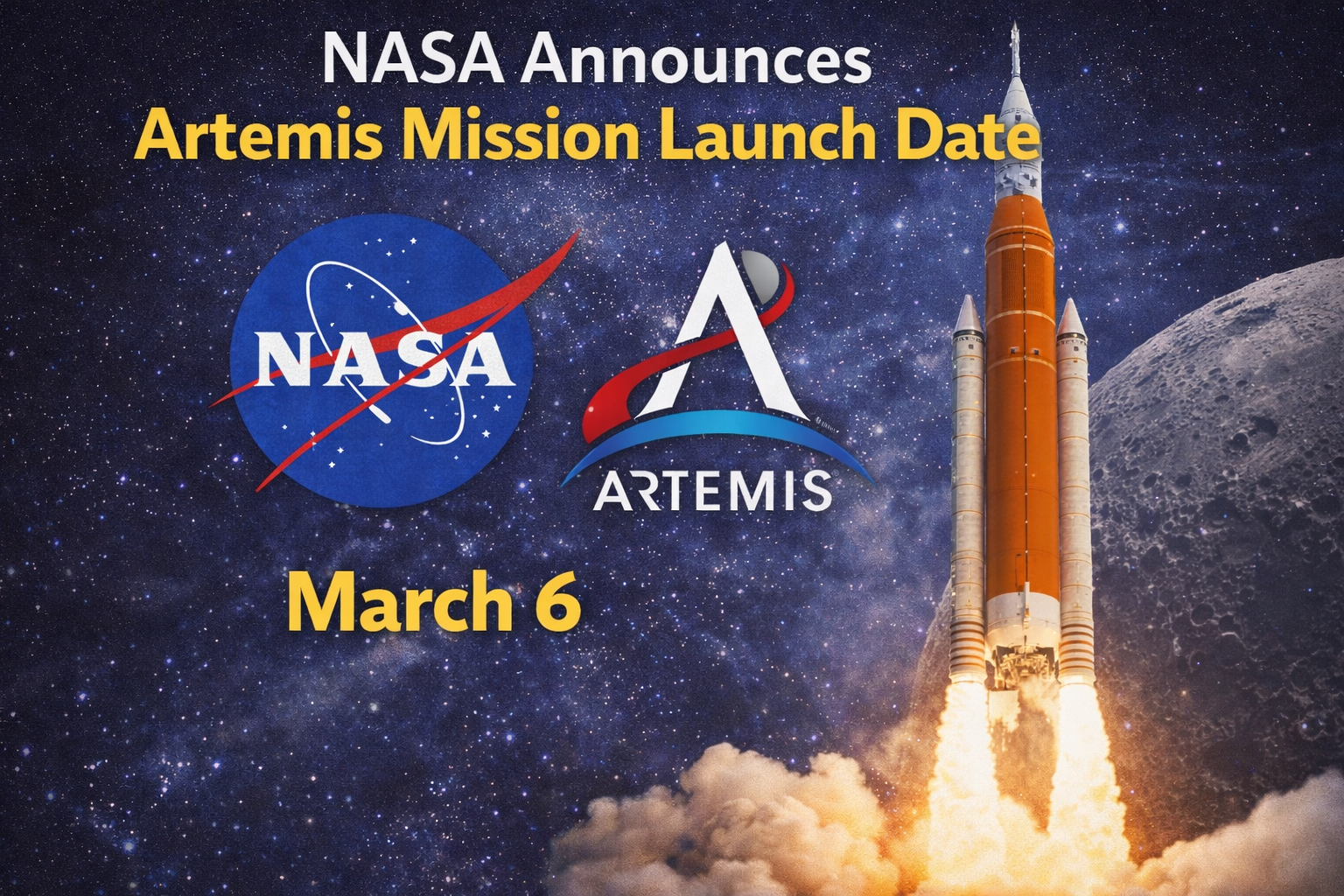
NASA Announces Artemis Mission Launch Date as the US space agency confirms it will send its next lunar mission toward the Moon on March 6, marking a significant step in humanity’s return to deep space exploration.
According to official updates, the upcoming launch is part of NASA’s Artemis program, designed to send astronauts back into lunar orbit for the first time in more than five decades. The mission represents a renewed effort to establish a long-term human presence beyond Earth.
Mission to Orbit the Moon
The scheduled launch will carry four astronauts on a 10-day journey around the Moon. The crew will travel aboard NASA’s Orion spacecraft, which is engineered for deep-space missions and extended-duration flights.
The astronauts will orbit the far side of the Moon — a region not directly visible from Earth — before returning safely. This trajectory will test spacecraft systems, crew performance, and mission operations in preparation for future lunar landings.
The Artemis mission is widely regarded as a technological milestone in modern space exploration.
First Crewed Lunar Orbit in Over 50 Years
The last time humans traveled to the Moon was during the Apollo era in the early 1970s. With the Artemis program, NASA aims to restore human lunar capability after more than half a century.
Officials describe the mission as a foundational step toward sustained lunar exploration rather than a one-time expedition.
Unlike earlier missions that focused on short-term visits, the Artemis framework envisions continuous engagement with lunar orbit and surface operations.
Preparing for Future Lunar Landings
While this specific mission will not land astronauts on the Moon’s surface, it serves as a critical rehearsal for future landing missions under the Artemis program.
NASA officials have emphasized that this flight will validate life-support systems, navigation protocols, communication networks, and spacecraft resilience in deep-space conditions.
Successful execution would pave the way for upcoming missions that aim to place astronauts back on the lunar surface.
Building Toward a Permanent Lunar Presence
The broader goal of the Artemis program is to establish a sustained human presence on the Moon. Future missions are expected to support infrastructure development, including potential habitats and research facilities.
Such developments could eventually lead to the creation of a semi-permanent lunar base.
Experts suggest that establishing operations on the Moon would provide a strategic advantage for future interplanetary missions.
A Stepping Stone to Mars
NASA views the Moon as a testing ground for eventual human missions to Mars. Lunar operations allow space agencies to refine technologies needed for long-duration space travel, including life support, radiation shielding, and resource utilization.
By developing experience closer to Earth, mission planners can reduce risk before undertaking multi-year journeys to Mars.
Officials believe that lunar infrastructure could one day serve as a launch platform for deep-space missions, including expeditions to the Red Planet.
International Collaboration and Future Plans
The Artemis program also involves international partnerships, with multiple space agencies and private aerospace companies contributing to mission components.
This collaborative model reflects a shift toward global participation in space exploration efforts.
NASA officials have indicated that additional Artemis missions will follow in a phased approach, each building upon the technical achievements of the previous launch.