
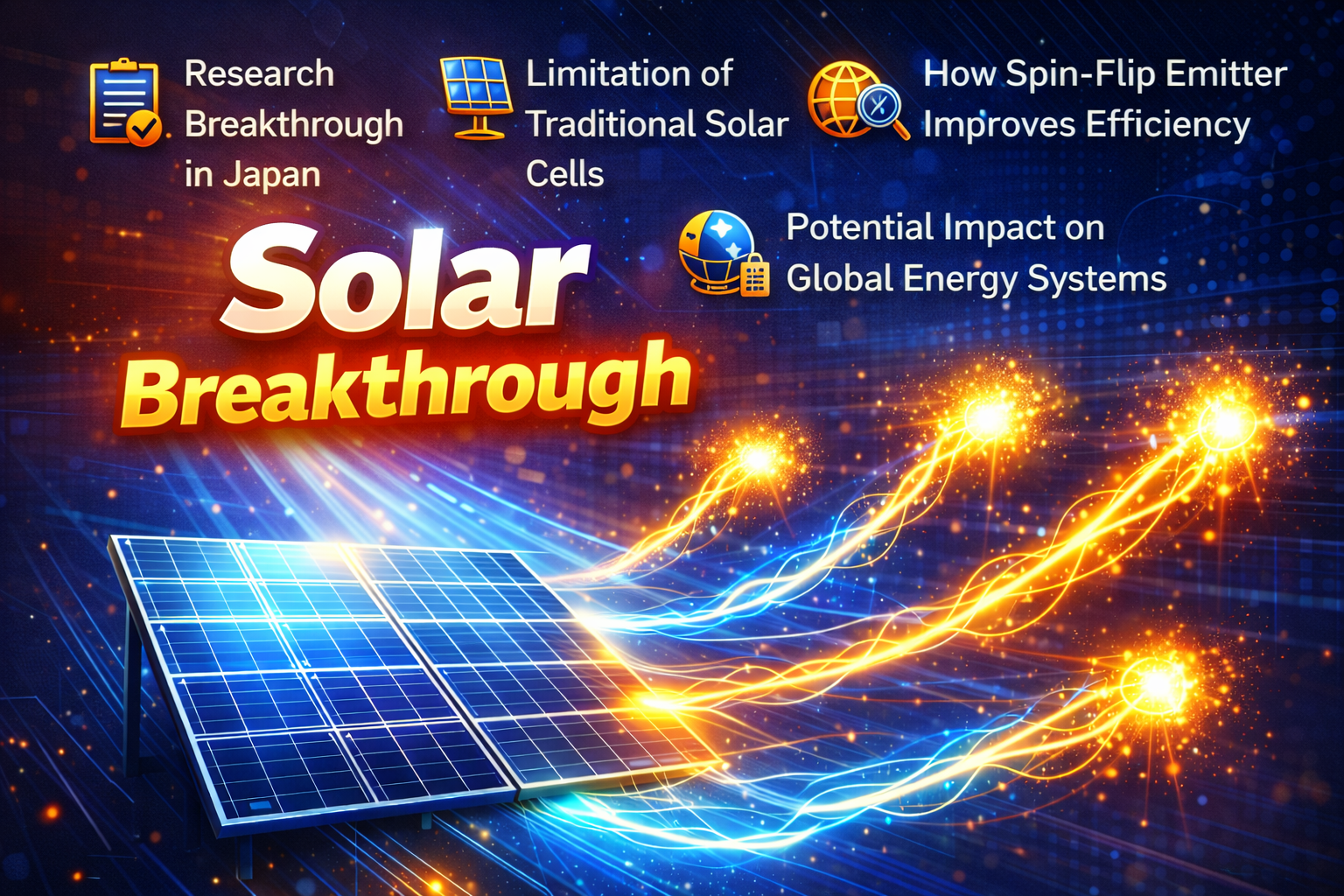
Japan solar technology breakthrough has introduced a major advancement in renewable energy, as scientists have developed a new material that significantly increases the efficiency of solar cells beyond previous technological limits.
📌 Research Breakthrough in Japan
Researchers at Kyushu University have successfully developed a new material that enhances the performance of solar cells. The innovation focuses on capturing energy from sunlight that was previously lost during the conversion process.
The research team introduced a special mechanism known as a “spin-flip” emitter, which plays a key role in improving how solar energy is utilized.
⚙️ Limitation of Traditional Solar Cells
Traditional solar cells convert sunlight into electricity through photons, which generate energy carriers known as excitons. These excitons are responsible for producing electric current.
However, existing solar technologies have a major limitation. They can only utilize about one-third of the available sunlight energy. High-energy photons often lose their excess energy in the form of heat instead of being converted into electricity.
This inefficiency has remained a long-standing challenge in solar energy development.
🔬 How Spin-Flip Emitter Improves Efficiency
The newly introduced spin-flip emitter changes the energy conversion process. It enables solar cells to capture excess energy from high-energy photons instead of losing it as heat.
This process allows additional energy carriers to be generated from the same light source. As a result, more electricity can be produced without increasing the size or number of solar panels.
The technology improves the internal energy transfer mechanism, making solar cells more efficient in converting sunlight into usable power.
📊 Significant Increase in Energy Output
According to the findings, the new material has increased solar energy output by up to 130 percent compared to conventional systems.
Previously, solar panels were limited in how much sunlight they could convert. With this development, a greater portion of solar radiation can now be utilized.
This increase represents a substantial improvement in solar efficiency and could redefine performance standards in the industry.
🌍 Potential Impact on Global Energy Systems
The breakthrough could have wide-ranging implications for global energy systems. Higher efficiency means more electricity can be generated from the same solar installations.
This can support the expansion of renewable energy adoption, particularly in regions with high sunlight exposure. It may also reduce the cost per unit of electricity over time by improving output efficiency.
Enhanced solar performance can contribute to energy sustainability efforts worldwide.
⚡ Industrial and Commercial Applications
The new material has potential applications across multiple sectors. It can be integrated into residential solar panels, commercial energy systems, and large-scale solar farms.
If adopted widely, this technology could improve the performance of solar infrastructure without requiring major design changes.
Industries relying on renewable energy may benefit from increased output and improved system efficiency.
🔋 Future Research and Commercialization
Further research is expected to focus on scaling the technology for mass production. Scientists will work on ensuring that the material can be produced efficiently and integrated into existing manufacturing processes.
Commercial adoption will depend on factors such as cost, durability, and compatibility with current solar technologies.
If successfully implemented, this innovation could become a standard component in next-generation solar panels.
📈 Long-Term Energy Efficiency Outlook
The development marks a step forward in overcoming the efficiency ceiling of traditional solar cells. By addressing energy loss through heat, the technology enhances the overall effectiveness of solar energy systems.
This advancement could contribute to long-term improvements in renewable energy output and support global energy transition goals.