
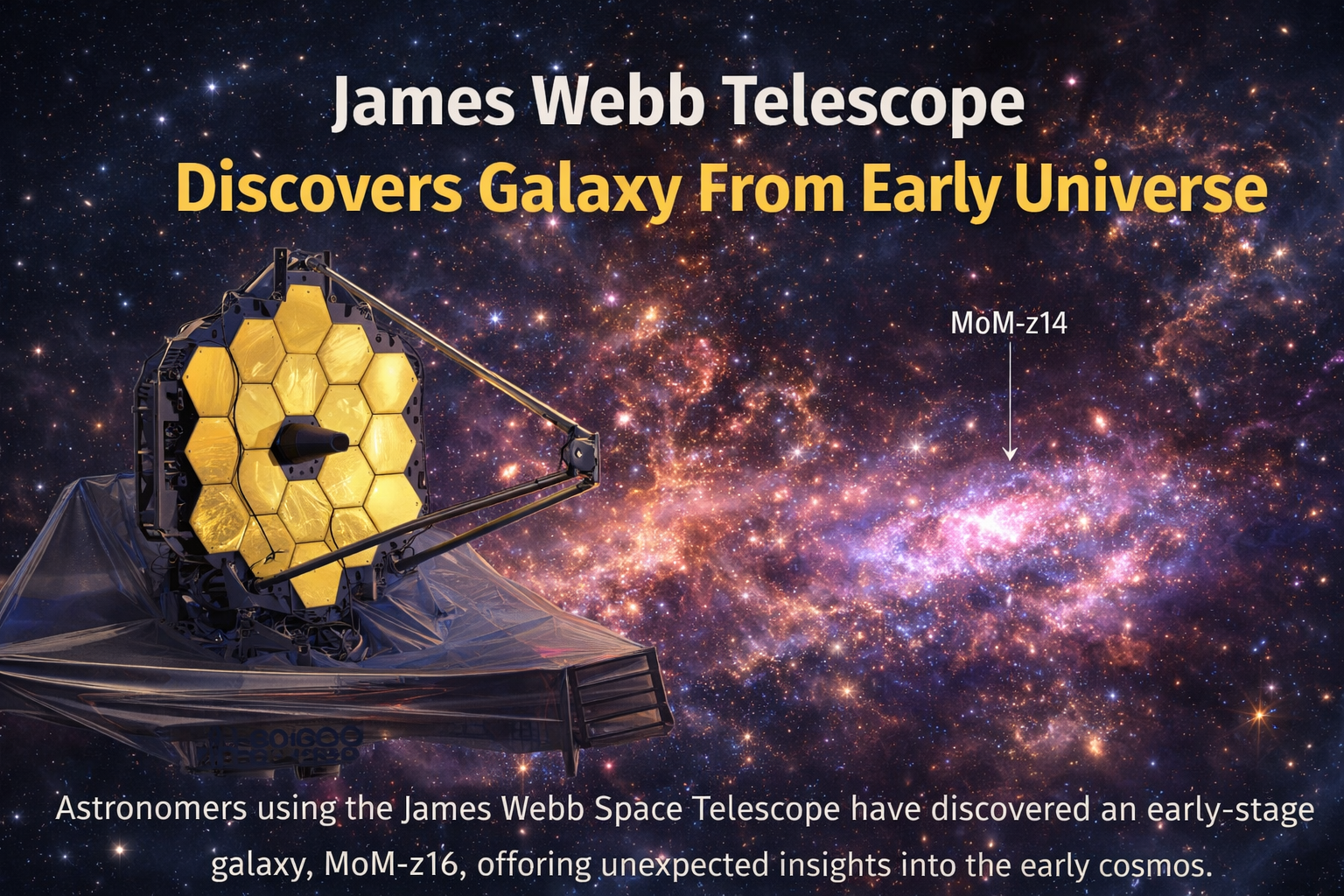
James Webb telescope discovers galaxy from early universe as astronomers using the space observatory have identified a previously unknown bright galaxy that is providing unexpected insights into the earliest stages of cosmic history.
According to researchers, the discovery sheds new light on how galaxies formed shortly after the Big Bang and challenges existing scientific assumptions about the composition and evolution of the early universe. The findings were made using data captured by the James Webb Space Telescope (JWST), which continues to expand humanity’s understanding of deep space.
Newly Discovered Galaxy MoM-z14
The newly identified galaxy has been named MoM-z14, and scientists estimate that it existed just 280 million years after the Big Bang. While this may appear to be a long period, it is considered extremely early when compared to the universe’s estimated age of 13.8 billion years.
Astronomers say MoM-z14 represents one of the closest observational pieces of evidence to the birth of the universe ever recorded, offering rare insight into conditions that existed during cosmic infancy.
Observations Using James Webb Instruments
Researchers analyzed the galaxy using Webb’s Near-Infrared Spectrograph (NIRSpec), which allowed them to measure how the galaxy’s light changed wavelength as it traveled across vast cosmic distances to reach the telescope.
This technique enabled scientists to determine the galaxy’s age, composition, and brightness with unprecedented precision. According to experts, Webb’s advanced instruments have made it possible to observe phenomena that were previously beyond human reach.
Unexpected Chemical Signatures
One of the most surprising findings involves the presence of nitrogen within the galaxy. Scientists observed unusually high levels of nitrogen in MoM-z14, exceeding what existing models had predicted for galaxies formed so soon after the Big Bang.
The unexpected chemical composition raises fundamental questions about how early stars formed and evolved. Researchers noted that several galaxies, including MoM-z14, show chemical characteristics that challenge long-held theories about early cosmic development.
Insights Into Cosmic Reionization
Another key area of study is reionization, a critical phase in the early universe when intense radiation from young stars cleared dense hydrogen fog, allowing light to travel freely through space.
The brightness of MoM-z14 suggests that early galaxies may have played a more significant role in reionization than previously believed. Scientists say these findings could reshape understanding of how the universe transitioned from darkness to transparency.
Scientists React to the Discovery
Lead researcher Rohan Naidu from the Massachusetts Institute of Technology described the discovery as both challenging and exciting. He stated that Webb has enabled scientists to observe cosmic phenomena that do not fully match existing predictions, highlighting gaps in current models.
Team member Yijia Li, a graduate of Pennsylvania State University, also expressed excitement over the findings. She said the data reveal that the early universe still holds vast amounts of information waiting to be uncovered, emphasizing Webb’s importance in future discoveries.
Expanding the Frontiers of Astronomy
Astronomers believe MoM-z14 will play a crucial role in refining theories about galaxy formation, chemical evolution, and early cosmic activity. As Webb continues to scan deeper into space, scientists expect more discoveries that could redefine humanity’s understanding of the universe’s origins.
For now, MoM-z14 stands as a remarkable example of how next-generation technology is transforming modern astronomy and opening new windows into the universe’s earliest moments.