
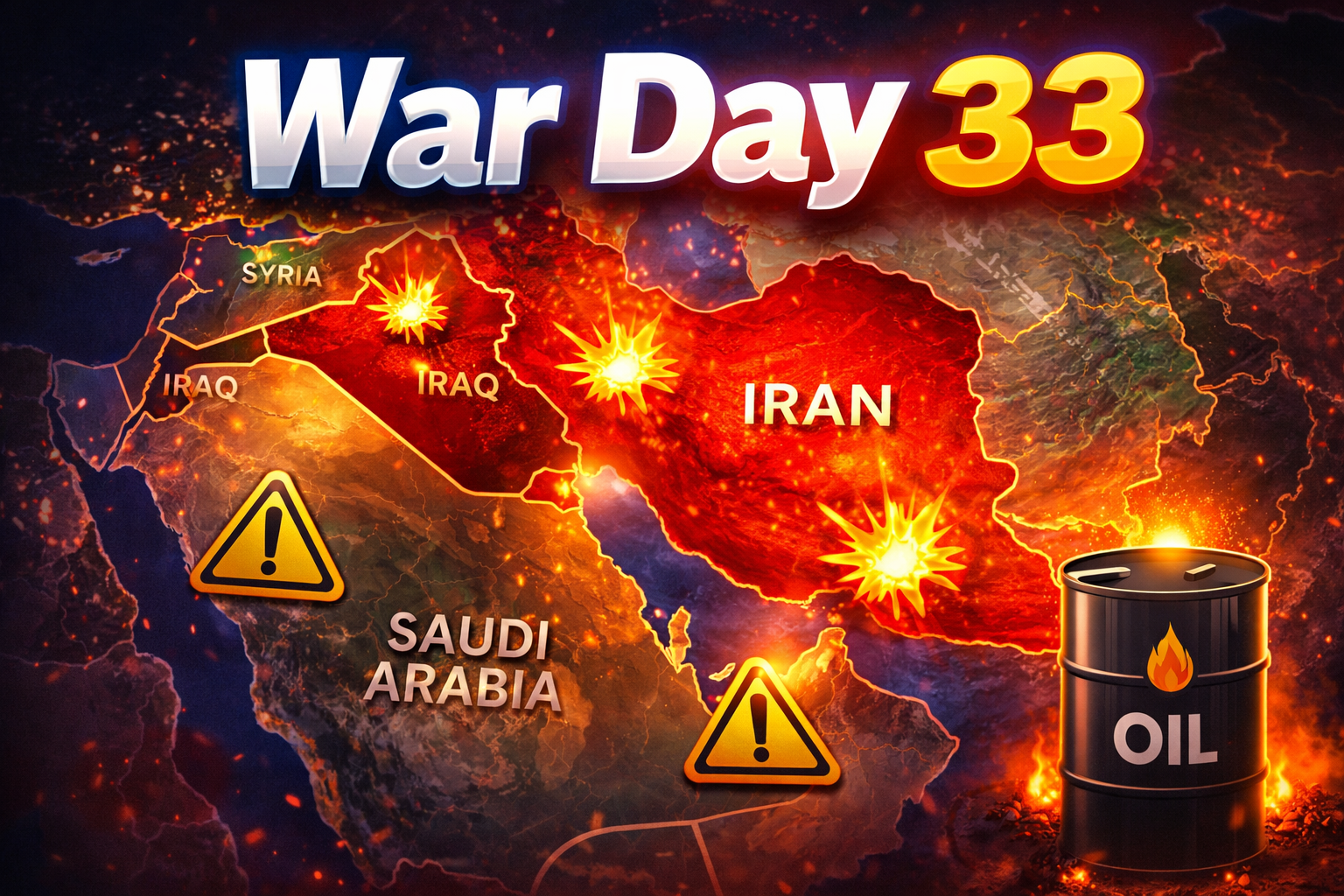
Iran war day 33 escalation continues as military operations intensify across multiple regions, while diplomatic tensions and humanitarian concerns remain unresolved. The ongoing conflict involving Iran, the United States, and Israel has entered its 33rd day with no clear signs of immediate de-escalation.
📌 Ongoing Military Operations in Iran
Airstrikes targeting various locations across Iran are ongoing, according to multiple reports. Industrial and civilian infrastructure has been affected as attacks continue in several major cities.
Explosions have been reported in cities including Bandar Abbas, Isfahan, Shiraz, Ahvaz, Kharg, and Kermanshah. These incidents indicate a broad geographical spread of military activity, impacting both strategic and urban areas.
In Tehran, a pharmaceutical research facility has reportedly been targeted during recent strikes. Additionally, a desalination plant located on Qeshm Island in the Strait of Hormuz has been shut down following reported damage.
📊 Statements from US and Iranian Leadership
Recent statements from leadership on both sides reflect continued tensions. US President Donald Trump stated that the conflict could end within two to three weeks and suggested that a formal agreement may not be required to conclude the war.
On the other hand, Iran’s Foreign Minister Abbas Araghchi stated that there is zero trust regarding negotiations with the United States. Despite this stance, reports indicate that indirect message exchanges have taken place between the two countries.
These developments highlight a complex diplomatic environment where communication exists, but mutual trust remains absent.
🌍 Diplomatic Efforts and International Response
Efforts to reduce tensions are ongoing at the international level. China and Pakistan have jointly presented a five-point plan aimed at achieving a ceasefire and ensuring the reopening of the Strait of Hormuz.
At the same time, several NATO member countries have taken restrictive measures in response to ongoing military operations. Countries including Spain, France, and Italy have limited access to their airspace and military bases for operations linked to the conflict.
These actions reflect growing international concern and attempts to manage the broader impact of the conflict.
⚠️ Rising Tensions in Gulf Region
The Gulf region continues to experience heightened security concerns. Kuwait’s airport has reportedly been targeted multiple times by drone attacks, indicating ongoing threats to critical infrastructure.
In Bahrain, warning sirens have been activated, and residents have been advised to move to safer locations as a precautionary measure.
Saudi Arabia has also reported intercepting several drone attacks, while near Qatar, an oil tanker has reportedly sustained damage. These developments indicate that the conflict’s impact is extending beyond immediate war zones.
💣 Israel and Lebanon Front Developments
Military operations are also ongoing in Lebanon, where Israeli forces are conducting airstrikes and ground activities. Reports indicate widespread bombardment in southern regions.
Israeli Defense Minister Israel Katz has stated that homes in southern Lebanon will be demolished, and displaced residents will not be allowed to return. This reflects continued escalation on this front of the conflict.
🪖 US and Israel Strategic Position
Statements from defense officials indicate a continued military approach. The US Defense Secretary has stated that the United States is engaging through military means, suggesting that upcoming days may be decisive.
Israeli Prime Minister Benjamin Netanyahu has also indicated that operations will continue, reinforcing the likelihood of prolonged conflict.
These positions suggest that both countries are maintaining their current strategies without immediate plans for de-escalation.
📉 Economic Impact and Global Markets
The ongoing conflict is also affecting global economic conditions. Oil prices have seen an increase due to disruptions and uncertainty in the region.
Energy supply concerns are rising, particularly due to developments around the Strait of Hormuz, a key global shipping route. These factors are contributing to broader economic pressure worldwide.
Analysts indicate that continued instability in the region could further impact global markets, especially in the energy sector.