
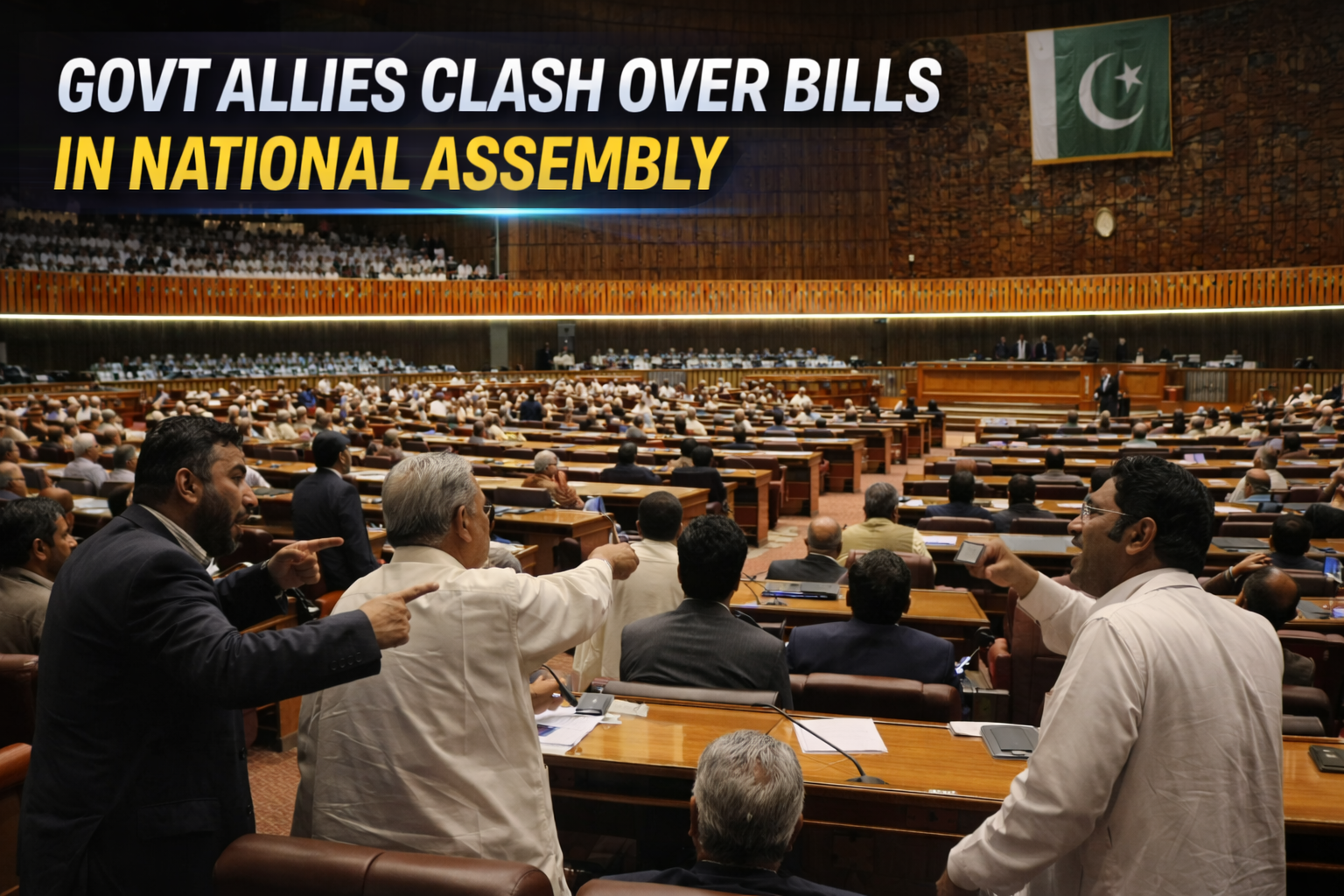
Govt Allies Clash Over Bills in National Assembly as lawmakers approved several important pieces of legislation during a session chaired by Deputy Speaker Syed Ghulam Mustafa Shah, while political tensions also emerged among members of the ruling coalition.
The session witnessed the passage of multiple bills covering legal reforms, public health measures, and administrative matters, alongside heated debate between coalition partners and opposition members.
National Assembly Passes Several Bills
During the proceedings, the National Assembly approved the Code of Criminal Procedure Amendment Bill 2025 along with the Prevention of Unauthorized Use of Pakistan’s Name and Symbols Amendment Bill 2025.
Lawmakers also passed the Mandatory Thalassemia Screening Bill 2025, a significant public health initiative aimed at reducing the spread of the genetic blood disorder.
The bill states that couples will be required to undergo thalassemia screening before marriage, while marriage registrars who register a marriage without proof of testing could face license cancellation and a fine of Rs100,000.
The legislation was introduced by Pakistan Peoples Party (PPP) Member of the National Assembly Dr. Sharmila Faruqui, while an amendment proposed by Naima Kishwar of Jamiat Ulema-e-Islam (JUI) was rejected by the house.
Civil Servants Amendment Bill Approved
The National Assembly also passed the Civil Servants Amendment Bill 2024, presented by PPP lawmaker Shazia Marri.
However, the bill triggered criticism from several lawmakers. Khawaja Izhar-ul-Hassan of the Muttahida Qaumi Movement (MQM) argued that the legislation conflicted with the spirit of the constitution.
He said the expansion of quota systems, including additional quotas for women and minority groups, could further complicate administrative structures.
Coalition Tensions Surface During Debate
The parliamentary debate also exposed political tensions among members of the governing alliance.
PPP leader Shazia Marri accused JUI of maintaining silence over government-backed bills while opposing legislation introduced by individual lawmakers.
In response, JUI lawmaker Alia Kamran rejected the allegation and criticized PPP for what she described as political compromises with the government.
The exchange highlighted underlying differences among coalition partners despite their formal alliance in parliament.
Dispute Over MQM Legislative Proposal
A separate dispute emerged when the PPP opposed a bill introduced by MQM lawmaker Khawaja Izhar-ul-Hassan.
PPP leader Naveed Qamar raised objections, arguing that the proposed legislation required further examination before approval.
Izhar-ul-Hassan maintained that the bill had already been cleared by the relevant committee and should proceed to a vote in the assembly.
Deputy Speaker Ghulam Mustafa Shah eventually decided to postpone the bill’s approval following suggestions from Minister for Parliamentary Affairs Tariq Fazal Chaudhry and Opposition Leader Mahmood Khan Achakzai.
The decision prompted protests from MQM lawmakers, who later staged a walkout from the assembly session.
Opposition Raises Broader Political Concerns
During the session, opposition lawmaker Junaid Akbar Khan criticized the government for failing to consult parliament on key foreign policy matters.
He argued that lawmakers had not been properly briefed regarding Pakistan’s involvement in international initiatives such as the Board of Peace.
Meanwhile, PPP member Fatahullah Khan warned that he would stage a hunger strike if development issues in Dera Ismail Khan were not addressed in the upcoming federal budget.
He claimed that flood-affected areas in the region had not received adequate support despite earlier government commitments.