
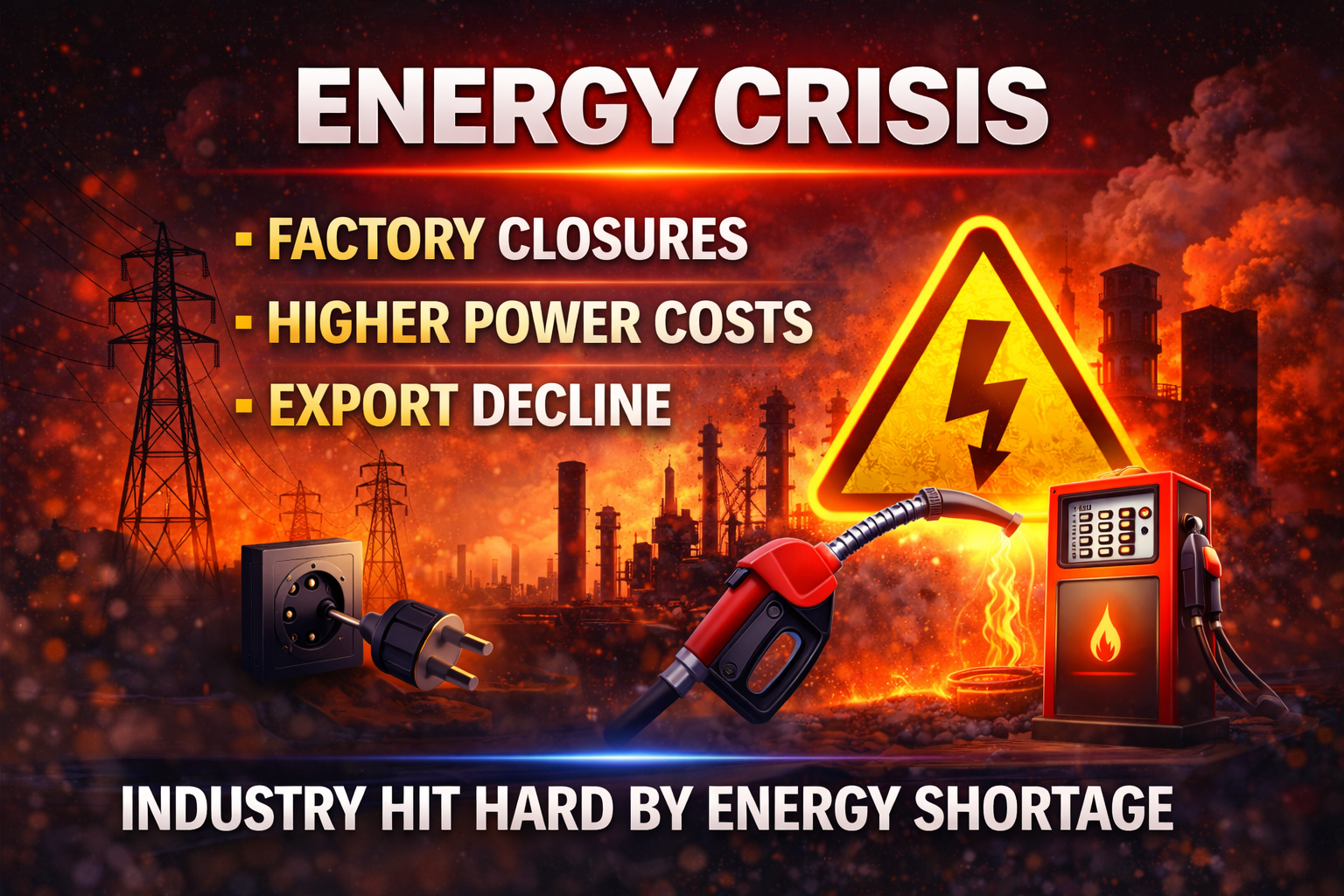
Energy crisis Pakistan is intensifying as rising electricity and gas costs, declining exports, and widespread industrial closures continue to put pressure on the business community.
⚡ Rising Energy Costs Impact Industry
Pakistan’s business sector is facing growing challenges due to the increasing cost of electricity and gas.
Industry representatives highlighted that energy tariffs have increased significantly over the past two decades, making production more expensive and reducing competitiveness in regional markets.
🏭 Industrial Activity Declines
Business leaders stated that many industries are either operating at minimal capacity or have shut down completely.
Despite having an installed electricity capacity of around 41,000 megawatts, industrial consumption remains limited to approximately 3,000 to 3,200 megawatts, reflecting reduced production activity.
📉 Export Targets Under Pressure
Export performance is also being affected by the current economic conditions.
Officials noted that while the government had set an export target of $37 billion, the expected figures may remain close to $30 billion, indicating a potential shortfall of around $7 billion.
🔌 Energy Supply and Demand Mismatch
Experts pointed out a significant imbalance between available energy and its utilization.
Although there is capacity for cheaper electricity generation, industries are unable to fully benefit due to infrastructure and transmission limitations.
🌍 Transmission Issues and Lost Capacity
A major concern raised during the briefing was the lack of transmission infrastructure.
Officials highlighted that nearly 9,000 megawatts of low-cost electricity generated in southern regions is not being effectively transmitted to other parts of the country.
Projects such as key transmission lines have faced delays, impacting efficient energy distribution.
⛽ LNG and Gas Supply Challenges
Industry representatives also expressed concern over LNG shortages and gas supply issues.
They emphasized that inconsistent supply and high pricing are making it difficult for industries to maintain stable operations.
🏪 Retail Sector Also Affected
The retail sector, which contributes approximately 18 percent to the national GDP, is also facing difficulties.
Business leaders suggested extending market operating hours to 10 PM, stating that restricted timings are negatively affecting sales and tax collection.
📊 Economic Pressure on Business Community
The overall economic environment has created uncertainty for investors and businesses.
Industry leaders noted that investment tends to flow where profitability is achievable, and current conditions are discouraging both local and foreign investment.
🏗️ Development Slowdown in Key Areas
Concerns were also raised about slowing development in regions such as Gwadar.
Officials reported that industrial activity has declined, and economic opportunities have reduced, affecting local populations.
💡 Calls for Policy Reforms
Business representatives urged the government to introduce reforms aimed at reducing energy costs and improving supply.
They emphasized the need for clear policies in the upcoming budget to support industrial growth and economic stability.
📅 Future Economic Planning Under Discussion
It was also announced that a shadow budget and a five-year economic plan will be presented soon.
These proposals are expected to address current economic challenges and outline strategies for recovery.
🔄 Ongoing Dialogue with Government
Officials confirmed that discussions with the government are ongoing regarding relief measures for industries.
The focus remains on improving energy availability, reducing costs, and supporting economic growth.