
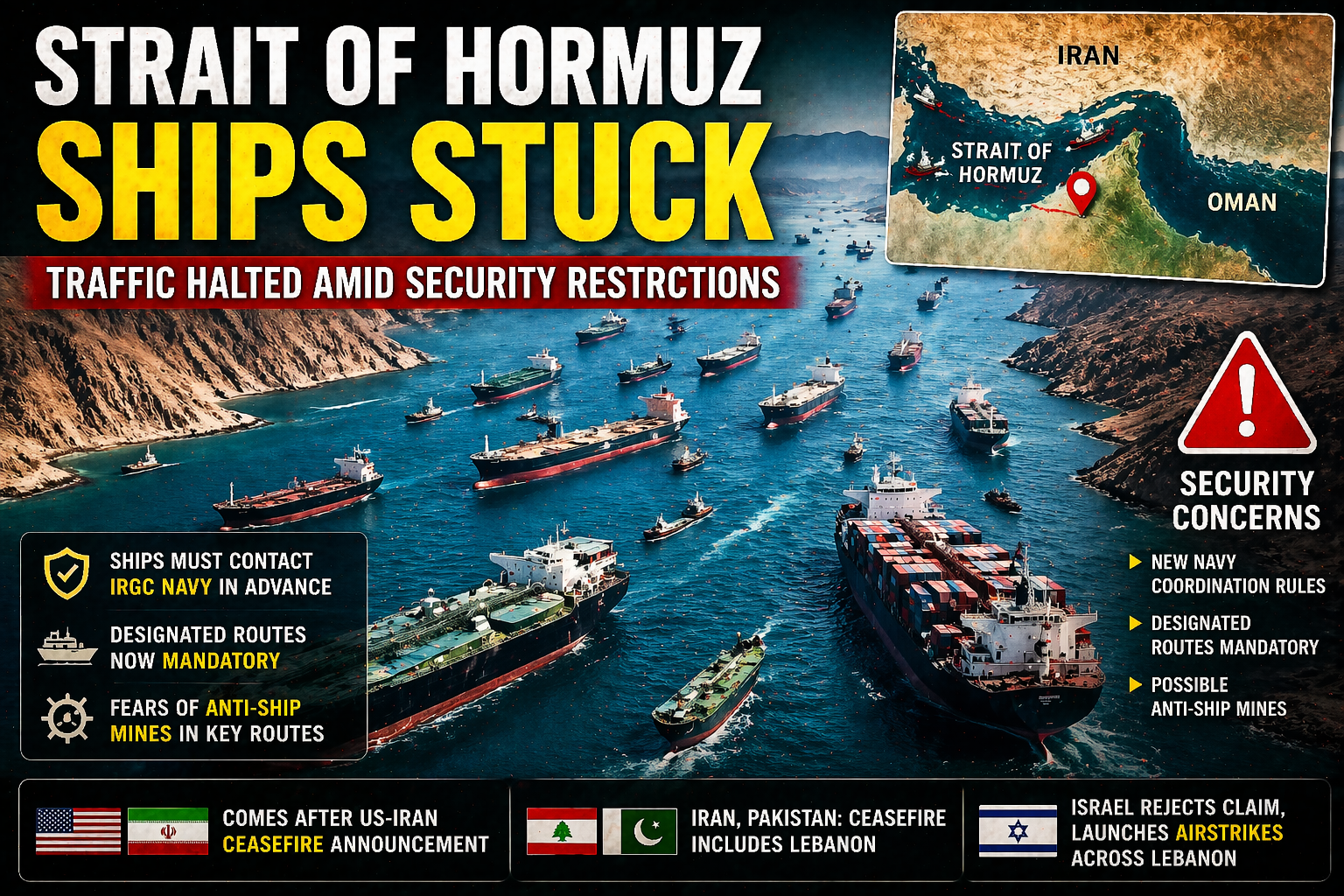
Strait of Hormuz ships stuck has raised concerns about global maritime traffic as reports indicate a large number of vessels remain halted in the critical waterway.
📌 Reports of Ships Stuck in Strait of Hormuz
A significant number of ships have reportedly been stuck in the Strait of Hormuz since Thursday morning.
This development has triggered concerns about disruptions in global shipping routes, as the strait is one of the most important maritime passages for international trade.
⚠️ Security Concerns Behind Restrictions
According to Tasnim News Agency, security concerns and newly imposed restrictions are the primary reasons behind the situation.
Reports suggest that maritime authorities have introduced additional measures to regulate vessel movement in the area.
These steps are believed to be linked to ongoing tensions in the region.
🚢 New Rules for Passing Ships
International media reports indicate that vessels passing through the strait are now required to coordinate in advance with Iran’s naval authorities.
Specifically, ships must maintain prior communication with the naval forces of the Islamic Revolutionary Guard Corps (IRGC) and follow designated routes.
These requirements have slowed down vessel movement and contributed to congestion in the waterway.
💣 Concerns Over Maritime Safety
Officials have pointed to possible threats such as anti-ship mines in key transit routes.
These concerns have led to stricter controls aimed at ensuring maritime safety.
The measures reflect heightened caution in response to evolving security risks in the Gulf region.
🌍 Impact on Global Trade
The Strait of Hormuz is a critical route for global oil shipments and commercial trade.
Any disruption in this corridor can affect supply chains and energy markets worldwide.
The current situation has increased uncertainty among shipping operators and global markets.
📰 Context of Recent Ceasefire
The development comes shortly after the announcement of a ceasefire agreement between the United States and Iran.
The agreement was expected to ease tensions in the region.
However, the current situation indicates that operational and security challenges persist.
🔥 Regional Tensions Continue
At the same time, tensions remain high in other parts of the region.
Reports indicate continued military activity in Lebanon, adding to broader instability.
These developments highlight the complexity of the regional situation despite diplomatic efforts.
🛑 Ongoing Monitoring of Situation
Authorities and international stakeholders are closely monitoring the situation in the Strait of Hormuz.
Further updates are expected as maritime conditions evolve and security measures are reassessed.
The situation remains fluid, with potential implications for global trade and energy supply.