
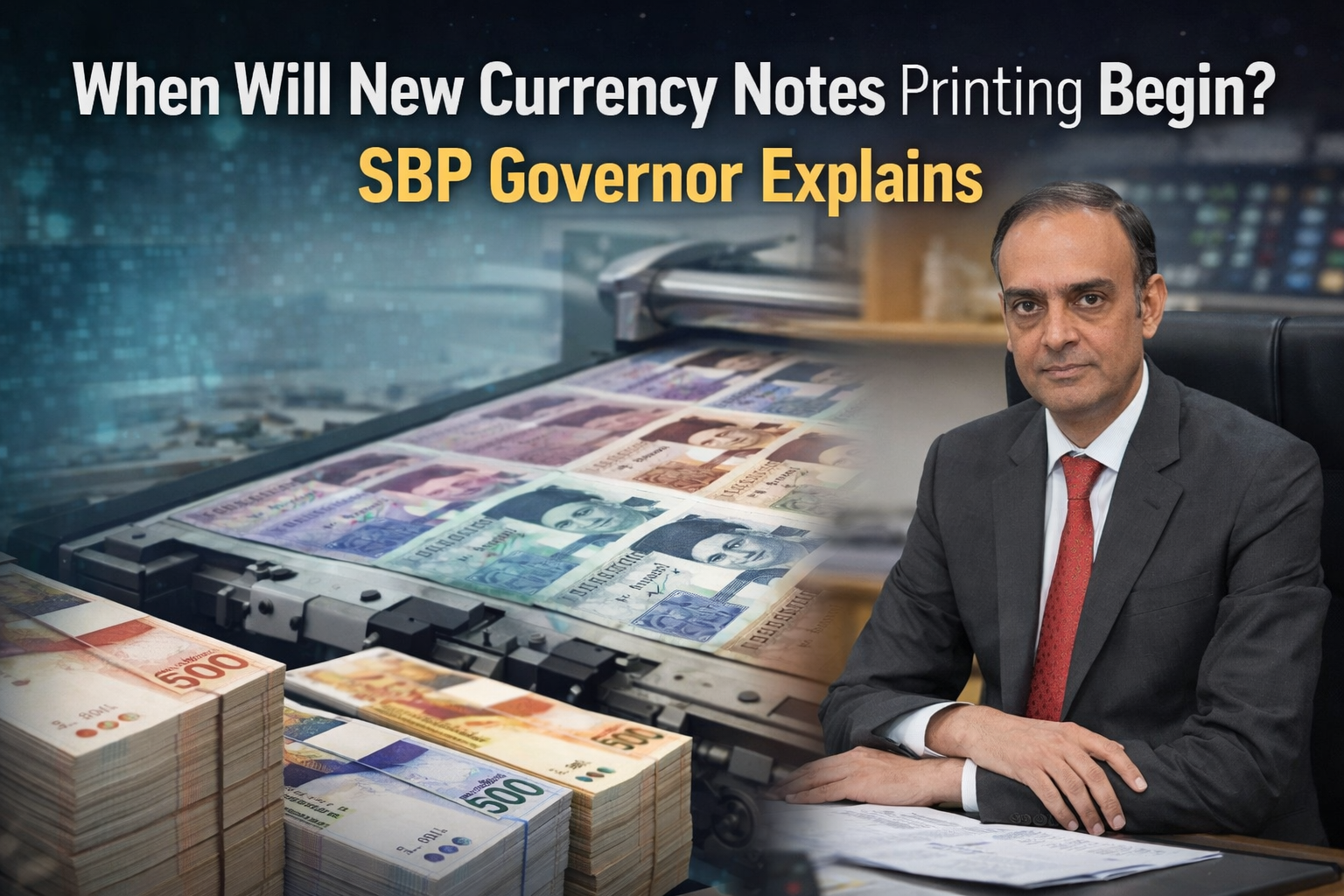
When will new currency notes printing begin? SBP Governor explains as Pakistan’s central bank chief outlines the timeline for currency issuance while sharing broader updates on monetary policy, debt management, and economic stability.
Cabinet Approval Required for New Notes
Governor of the State Bank of Pakistan, Jameel Ahmad, stated that the printing of new currency notes will commence only after formal approval from the federal cabinet.
He clarified that preparatory work has been discussed at policy levels, but the final decision rests with the government’s executive authorization process. Once cabinet clearance is granted, operational steps for printing and circulation will move forward.
The central bank has periodically reviewed currency structure and security features to align with international standards, though the governor did not specify an exact launch date for the new notes.
Monetary Policy Linked to IMF Commitments
Jameel Ahmad also highlighted that Pakistan remains bound by a tight monetary policy framework under its agreement with the International Monetary Fund.
He said the policy stance is part of broader commitments aimed at stabilizing macroeconomic indicators, controlling inflation, and strengthening external accounts.
Despite pressures on exports, the governor maintained that the country’s overall economic situation has shown signs of improvement under disciplined fiscal and monetary management.
Debt Repayment and Rollover Outlook
Providing updates on external liabilities, the SBP governor noted that Pakistan has already repaid $6 billion in debt obligations.
He added that an additional $4 to $4.5 billion in repayments are scheduled within the current fiscal year. Meanwhile, certain loans are expected to be rolled over until September 2027, offering temporary breathing space for foreign exchange reserves.
Officials view debt rollover arrangements as critical for maintaining liquidity buffers while longer-term structural reforms take hold.
Economic Stability and Policy Continuity
Jameel Ahmad emphasized that sustained policy continuity will remain essential for achieving durable economic growth.
He indicated that macroeconomic policies will likely remain consistent for at least the next two years to ensure stabilization gains are not reversed. According to the central bank, Pakistan’s economy is gradually transitioning from a stabilization phase toward a growth trajectory.
The governor stressed that reform momentum must continue across fiscal management, taxation, and external sector performance.

External Sector and Inflation Projections
Addressing trade dynamics, the SBP chief acknowledged that exports have declined while imports have risen. However, he maintained that broader economic indicators still point toward gradual improvement.
He projected that by June 30:
-
Current account deficit will remain between 0% and 1% of GDP
-
Inflation will likely stay within the 5% to 7% range
These projections reflect easing price pressures compared to previous high-inflation periods, supported by monetary tightening and currency market adjustments.
SME Financing and Banking Sector Indicators
The governor also shared updates on private sector credit, particularly for small and medium enterprises (SMEs).
He revealed that financing support for the SME sector has been doubled, reaching approximately Rs11 trillion. The move is aimed at boosting industrial output, employment generation, and export capacity.
In the banking sector, non-performing loans have declined to around 7%–8%, indicating improving asset quality and repayment capacity.
Exchange Market Reforms
Jameel Ahmad said the central bank has taken firm action to address irregularities in the exchange market.
He disclosed that out of 166 money changers, around 140 have been shut down for regulatory violations. Authorities say these enforcement measures are designed to stabilize currency trading, curb speculation, and improve transparency in foreign exchange operations.