
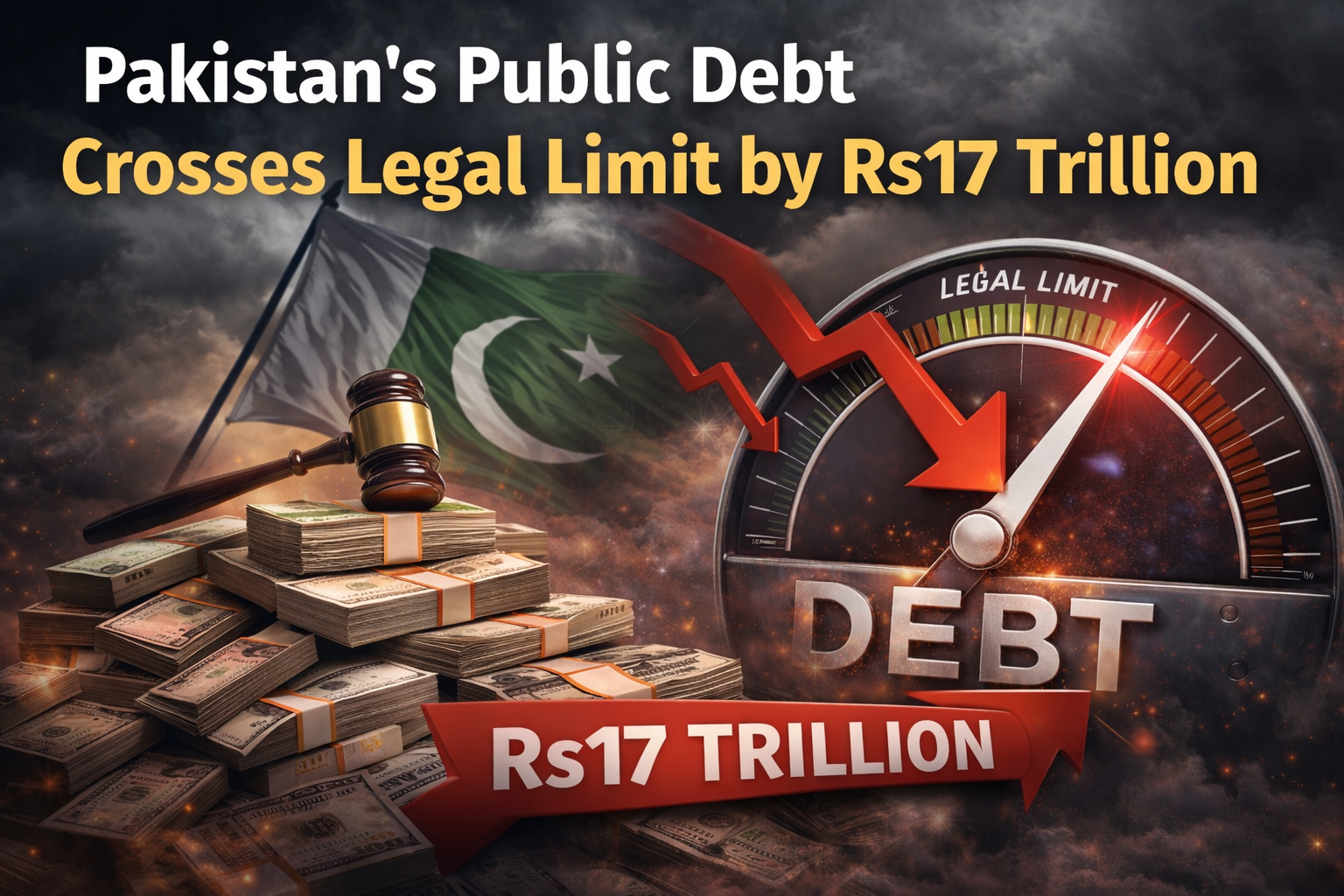
Pakistan’s public debt crosses legal limit by Rs17 trillion during the last fiscal year, exceeding the ceiling set by parliament, even as the government claims that extending the maturity of domestic debt has reduced refinancing risks.
According to the Debt Policy Statement 2026, Pakistan’s total public debt has risen to 70.7 percent of gross domestic product (GDP), significantly higher than the 56 percent limit prescribed under the Fiscal Responsibility and Debt Limitation Act (FRDLA).
The report revealed that during fiscal year 2024–25, public debt exceeded the legal threshold by Rs16.8 trillion, equivalent to 14.7 percent of GDP, highlighting growing pressure on the country’s fiscal position.
Debt Servicing Consumes Nearly Half of Budget
The statement warned that high and unsustainable debt levels are placing a severe burden on public finances. Nearly half of the annual federal budget is now being spent on debt servicing, leaving limited fiscal space for development spending and social welfare.
As a result, the government has increasingly relied on higher taxation, further adding to the financial strain on citizens and businesses. The rising cost of debt servicing has also constrained the government’s ability to stimulate economic growth.
Tax Collection Falls Short of Targets
The report also pointed to weak revenue performance by the Federal Board of Revenue (FBR). Between July and January, the FBR collected Rs7.174 trillion, falling Rs347 billion short of the revised target.
On a year-on-year basis, tax revenues grew by only 10.5 percent, which officials described as insufficient given the scale of fiscal challenges facing the country.
The shortfall in tax collection has further complicated efforts to manage debt and control the budget deficit, forcing the government to rely more heavily on borrowing.
Rising Debt-to-GDP Ratio Raises Concerns
The Ministry of Finance informed parliament that the debt-to-GDP ratio increased further during fiscal year 2025, underscoring the urgency of corrective measures.
However, the government reiterated its commitment to bringing public debt to a sustainable level over the medium term by pursuing fiscal consolidation and maintaining a primary surplus.
Officials said these measures are aimed at gradually reducing reliance on borrowing while strengthening long-term economic stability.
Fiscal Deficit Exceeds Parliamentary Limit
According to the Fiscal Policy Statement 2026, the federal fiscal deficit also breached the limit approved by parliament, exceeding it by 2.7 percent of GDP.
The persistent gap between revenues and expenditures reflects structural weaknesses in Pakistan’s fiscal framework, including low tax compliance, high subsidies, and mounting debt obligations.
Shift in Debt Management Strategy
The Ministry of Finance highlighted changes in the government’s debt management approach to reduce short-term risks. Under the new strategy, greater emphasis has been placed on medium- and long-term instruments, including longer-tenure bonds, zero-coupon bonds, and Sukuk.
As part of this shift, the share of short-term treasury bills declined from 24 percent in June 2024 to 16.6 percent by June 2025, reducing exposure to frequent refinancing pressures.
Officials said extending debt maturities is intended to improve stability in government financing and lower vulnerability to interest rate fluctuations.
Growing Pressure on Economic Stability
Economists warn that while changes in debt structure may ease short-term risks, the overall level of public debt remains a serious concern. Without sustained improvements in revenue generation, expenditure control, and economic growth, debt pressures are likely to persist.
The report concludes that although Pakistan has avoided immediate fiscal distress, rising public debt continues to pose a major challenge to long-term economic stability.